
by Nancy Armitage
The Victorian “Calling-Cards” had multiple purposes. They were an identification for a person in society (mainly high society), a reference, a business card, & an invitation, also. Calling Cards were also called “Visiting Cards” because they were exchanged during social visits to homes or hotels at “At-Home” tea gatherings. The tradition of calling cards go back to the 1700’s (France); then spread to England & then America. I’m focusing on calling cards from 1870’s to 1920’s & the Huntington Family.
Identification
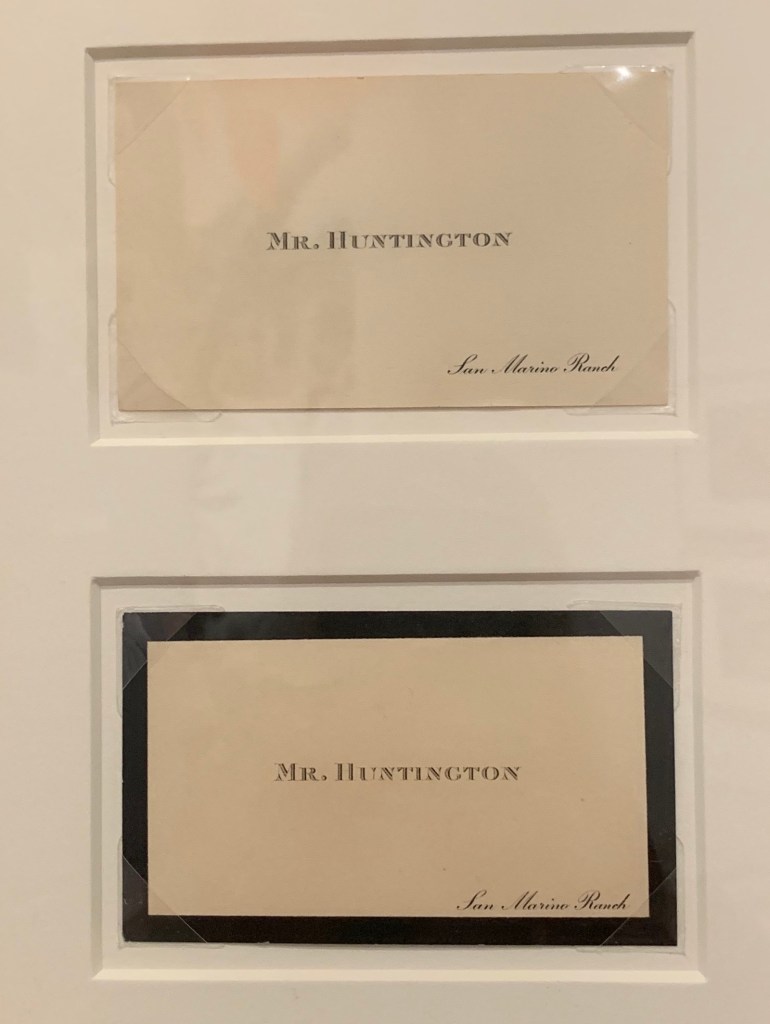
Some Victorian calling cards were super simple, just the person’s name like “Matthew J. Nicholas”. Mr. Henry E. Huntington had calling cards printed up for his California ranch. The card simply states: “Mr. Huntington” & on the bottom right it states “San Marino Ranch” (below). I was quite surprised at the simplicity of Mr. Henry E. Huntington calling card. I love the font he used for his name.
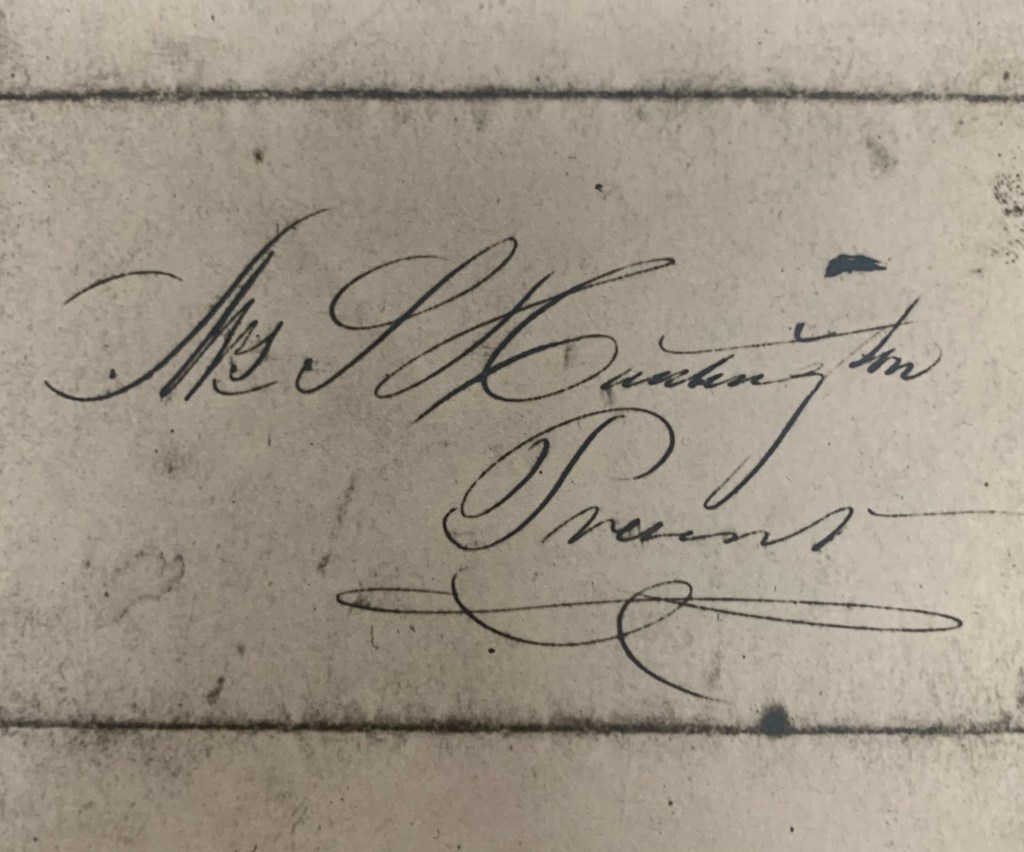
But most Victorian calling cards usually were printed in mass (50 or 100 or more). Sometimes, people would take a stack of card stock cards & write their name in fancy script writing (above). Sometimes, people would use lavender or turquoise ink; sometimes the ink was scented of lavender blossoms, so Victorian & so romantic!
Letter of Reference/Letter of Introduction
By reference, the calling card could have been used with a “letter of reference” or “letter of introduction”. If one was traveling to Europe or another large city in USA & wanted to get job. They would ask a mentor, a teacher, or a close friend with means to write a letter on their behalf. This “letter of introduction” was enclosed in a envelope & also included the calling card of the mentor. At the Huntington Library in HEH correspondence, I saw many of these “letters of introduction” to Mr. Henry E. Huntington.

Victorian Calling Cards: a Invitation to a “At-Home” tea gathering
Between 1880’s to the 1920’s, a Victorian Calling Card was a invitation to “tea & a chat”. These Gilded Ages teas were called “At-Homes”. On the calling card, the host used a printer to print their name, address, & a day & time of the week for their “at-home”. In different neighborhoods, they had different days of the week for their at-home gathering. On the bottom left hand side of the calling card was “Tuesday” or “1st Tuesday” (meaning the 1st Tuesday of every month, this host gave a “At-Home” tea.) She would meet people through her socializing, invite someone to tea & give them her card with her name & address on the card. Sometimes, the calling card would actually state the time of the At-Home tea: “1st Tuesday 4-6pm”
Hotel “At-Homes” teas:
There was several times that Mrs. Collis Huntington (Arabella) or Mrs. H. E. Huntington (Arabella) with her husbands lived in a luxury hotels. They might have stayed at the hotels for 1 month or several months. The Huntingtons would be renovating a home, mansion, or chateau; I can think of at least 3 times this happened. They lived in Palace Hotel in San Francisco (CPH & ADH), 5th Ave. Hotel in NYC (CPH & ADH), & Hotel Bristol in Paris, France (HEH & ADH). So as a general rule in 1890’s, the Hotel(s) “At-Home” were always on Mondays. The hotels had reception rooms & the host would receive their guests. Serving tea & little nibbles like canapes, tea sandwiches, & petit desserts. These hotel “at-home” tea gathering were usually between 4-6 pm or 5-7 pm.
For instance, before Collis & Arabella Huntington owned their mansion on Nob Hill, in San Francisco they stayed at a the Palace Hotel. Before that on a annual basis, for the whole month of May & sometimes longer, they would stay at the Palace Hotel. May was the month Collis Huntington (President of Southern Pacific Co.) would host their annual formal dinner banquet. About 110 guests- his top executives were invited. The Huntingtons (CPH & ADH & sometimes Archer) would stay in a suite of rooms (with their entourage of butlers, social secretary’s, gentlemen’s valet, & ladies maid) at the Palace Hotel in San Francisco, California.
In 1890’s, if one was living in a hotel, your “At-Home” day was on Mondays. So Arabella Huntington most likely would have a calling card printed up. For example, to let people know where she was staying; the calling card would have her name like, “Mrs. Collis P. Huntington” printed in the middle & on the bottom right would be “Palace Hotel, San Francisco” & on the left would be printed: “1st Monday 4-6pm”.
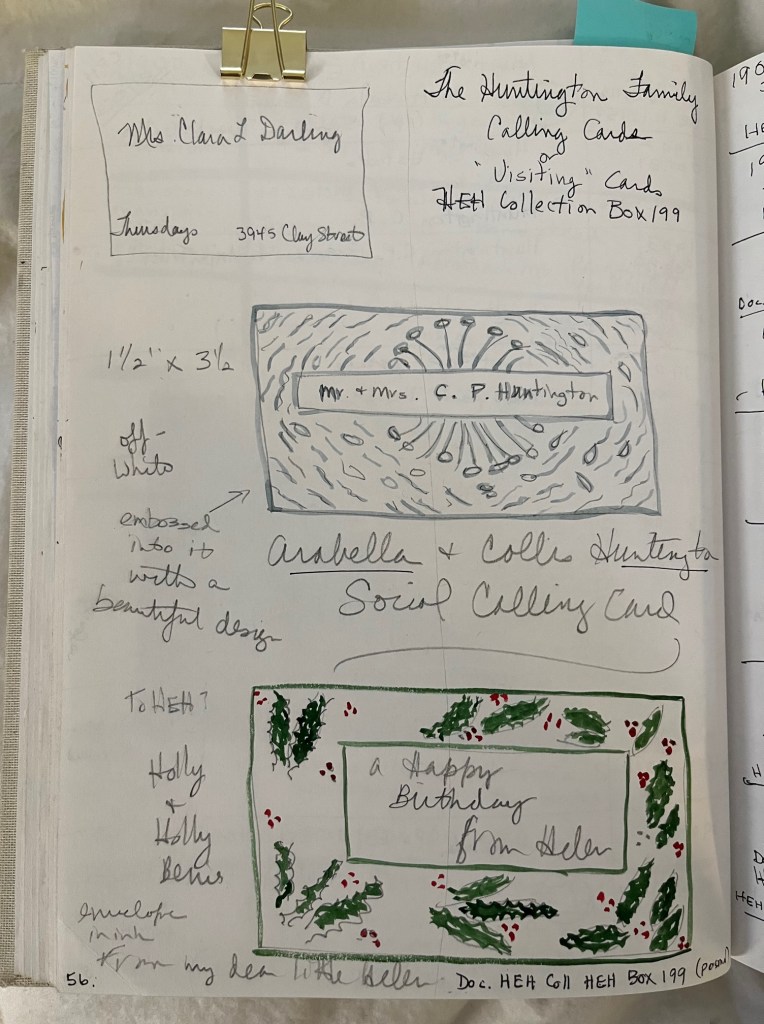
A shared calling card between a husband and a wife. It is illustrated above of the Collis Huntington’s (above) that just stated “Mr. & Mrs. Collis Huntington”. It had a embossed peacock pattern around the name. So Mr. & Mrs. Collis P. Huntington (Collis & Arabella “Belle”) shared this calling card, both could use it when meeting new people. When Mrs. Arabella “Belle” Huntington would meet someone at an “entertainment” (tea, lecture, or the theatre), she or her social secretary would write Mrs. Huntington’s information on the back of the calling card. They would write, their address where they were “In-Residence” & the time of Arabella’s would be hosting her “At-Home” tea. At the Huntington’s Nob Hill mansion on California Street in San Francisco: her “At-home” tea was often on the First Tuesday of each month in the 1890’s. Several of these “at-homes” were documented in 1894 by Belle & Collis’ niece Carrie Huntington (later Holladay), sometimes with 50-60 people were gathered. Document: HEH Coll. MS 52/2 (1-2) Carrie Huntington’s Journals
Train Pass (Railroad calling card)
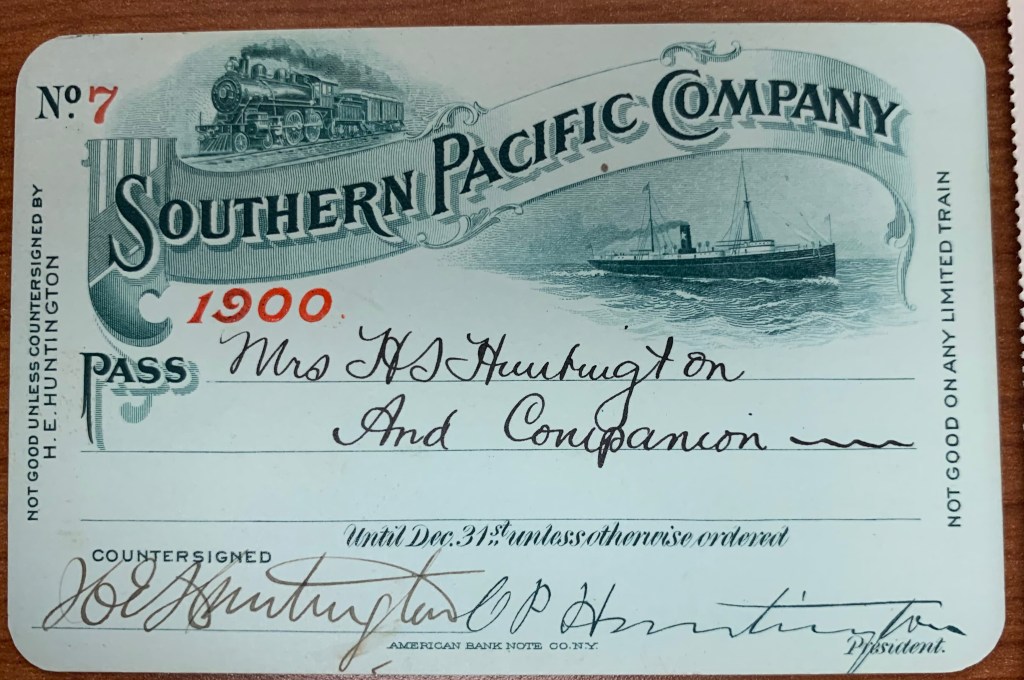
This 1900 Train Pass (above) was a treasure to behold. It gave Henry Edwards Huntington’s mother – Mrs. H. “Harriet” S. Huntington free transportation on any ship or any train that Southern Pacific owned!! That was a lot of ships & massive amount of trains to travel on across the USA. This one is unusual because it has both HEH & CPH (President of Southern Pacific Co.) signatures. In fact on the left side of the card it states “not good unless countersigned by H. E. Huntington”.
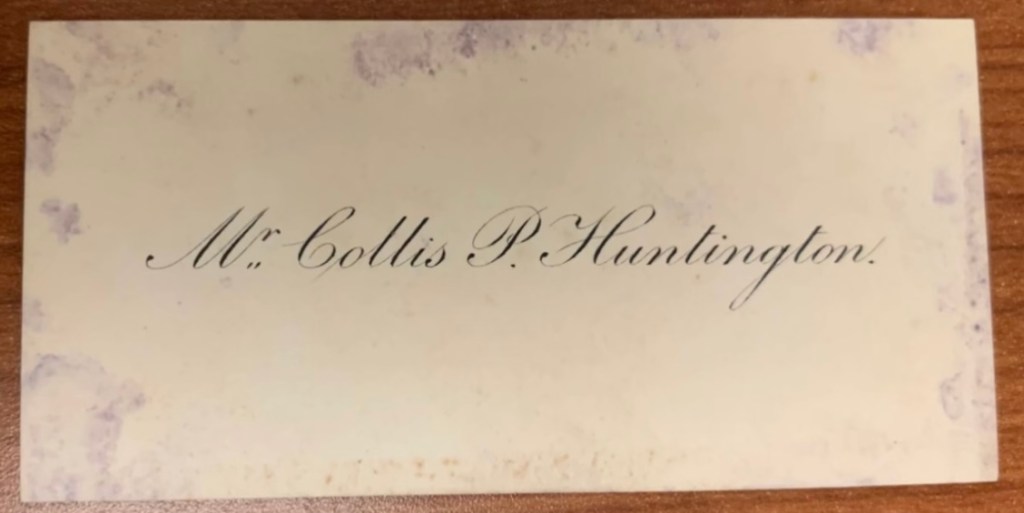
Collis P. Huntington’s Calling Card:
I’ve seen several of Collis Huntington’s Calling Cards, one just simple his name on it (above). When a man such as him, traveled so much & owned several homes, & owned so many railroad and ship companies, this was a simply & easy identification. After meeting someone, he or his social secretary could just write his current contact information on the back of the card.
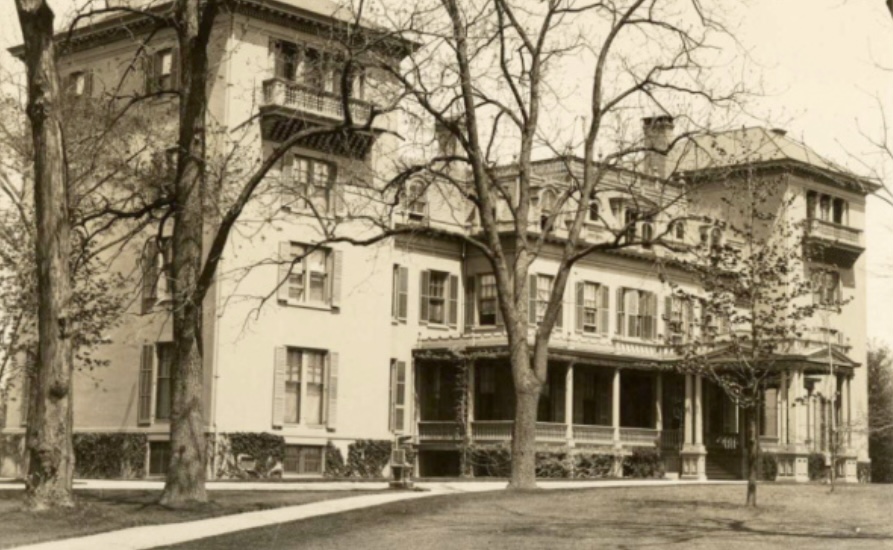
Mrs. Collis P. Huntington – “Arabella”:
“(1884-1913). I found a calling-card for “Mrs. Collis P. Huntington” from the grand estate (above) with “The Homestead & Throgg’s Neck” printed in the right bottom corner. it was on thick card stock and the size was 2 1/2″(1884-1913). I found a calling-card for “Mrs. Collis P. Huntington” from the grand estate (above) with “The Homestead & Throgg’s Neck” printed in the right bottom corner. it was on thick card stock & the actual size of the calling card was 2 1/2″ x 3″. Calling cards where wider in those days. Today (2023) our USA business cards are 3 1/4″wide x 1 3/4″ length. Ladies in society had fancy little sterling silver holders with a silver chain, to hold their calling cards. Sometimes, these ornate silver calling card holders had their initials or a castle or landscape engraved on them.
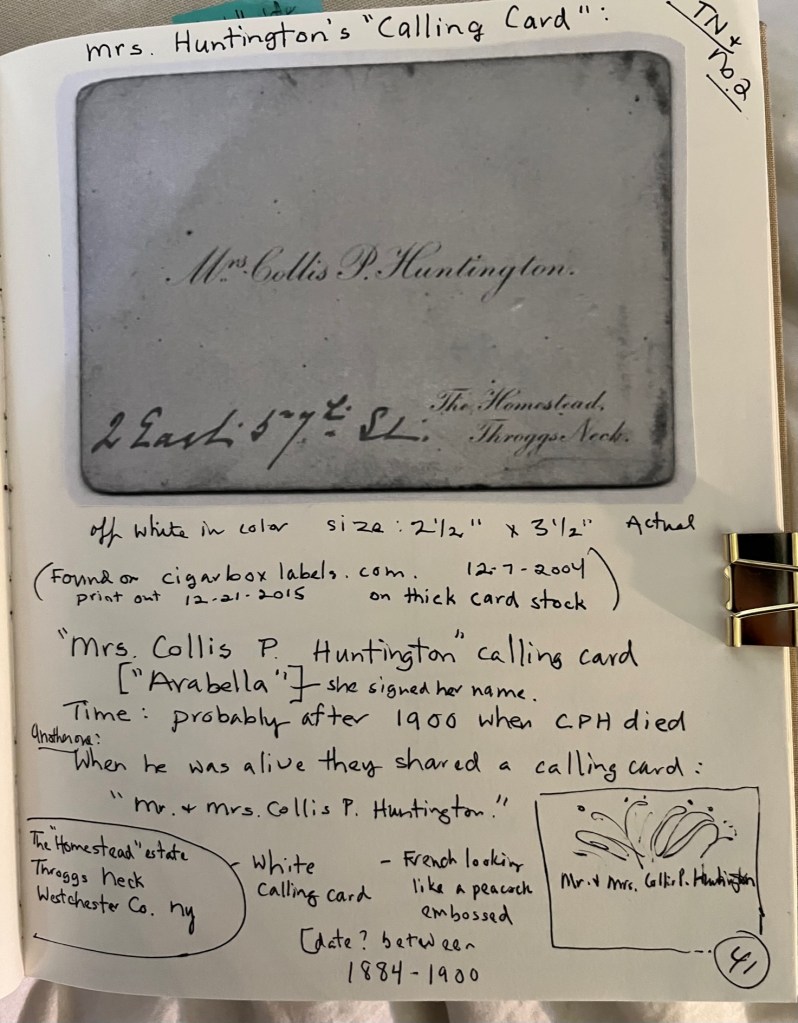
Mrs. Arabella Huntington was “Mrs. Collis P. Huntington” from the time she married Collis in 1884 to the time she married Henry E. Huntington in 1913. I have never found a calling card of Mr. & Mrs. Henry E. Huntington or Mrs. H. E. Huntington (Arabella).
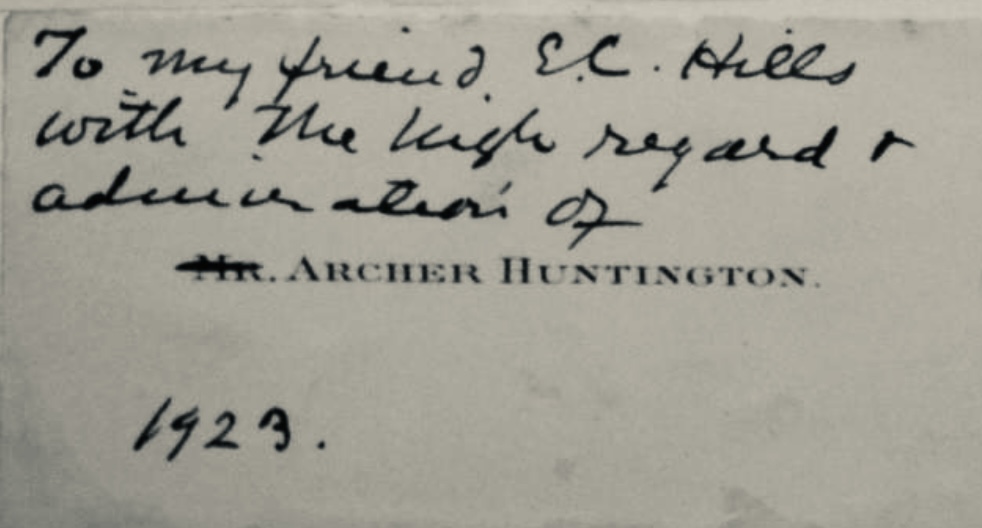
Mr. Archer Milton Huntington (Arabella Huntington’s son)
I found Mr. Archer Huntington’s calling card. It was written (all in capital letters) in a book, given to one of Archer’s friends. The book was titled: “Initials & miniatures of the IXth Xth, & XIth centuries from the Mozarabic manuscripts of Santo Domingo de Silos in the British Museum”. These book was written by Archer M. Huntington. A book about beautiful illustrated initials/letters for that time period.
The Calling card simply states “Mr. Archer Huntington.” This book on Medieval Initials that Archer Huntington wrote was for sell on ebay for $3,000.00 (2023). It seems that Archer had given the book to his friend, E. C. Hills, Archer wrote a hand-written message on his calling card stating, “To my friend, E. C. Hills with the high regard & admirations of Mr. Archer Huntington”. But the Mr. was crossed out as to minus the formality of the fancy calling card. The calling card also had 1923 on the bottom left corner.

Miss Caroline Huntington (later Mrs. E. Burke Holladay):
This was Miss Caroline D. Huntington’s fancy gold-rimmed “At-home” card invitation She was H.E. Huntington’s sister. She was born in 1860, so she would have been 17 yrs. old at the time of this invitation. She was later: Mrs. Caroline Holladay (E. Burke Holladay) & she was also Collis Huntington’s niece or Henry E. Huntington’s closest sister. Maybe this was her 1st official “At-home” gathering that Caroline or “Carrie” was the host. Maybe, this event was like a debutante ball, maybe it is ones entrance in the social world of the Victorian times. It was most likely at her mother & father’s house on Chestnut street in Oneonta, New York.
 Inside the Huntington's Story