
by Nancy Armitage

or “Dining with the Romneys” I could have called this article…..It has always interested me what the Huntington’s Formal Dining-Room really looked like. Especially, when the Huntingtons lived in the Huntington Mansion on the San Marino Ranch, CA.
Even when I was a child, my mother & I would visit the Huntington Library, in San Marino, CA; I always wondered “where the kitchen was”?? Later as a adult I thought, “they entertained alot, where’s the Butler’s Pantry??” No one seemed to know. I did find out about the Huntington Dining-Room in a Mansion Inventory book located in the Mr. H. E. Huntington’s archives.
While the H. E. Huntingtons (Belle & Edwards) lived at the San Marino Ranch, they “Dined with all the Romneys”. Meaning: All of their George Romney portrait paintings (English) graced the Dining-Room walls. Investigating some black & white photographs of the Huntington’s Dining-Room; we know that Romney’s: “Mrs. Burton” (Catherine Halhead Burton, 1789) hung above the Huntington’s fireplace. We also can see the 2 formal Dining-Room Chippendale chairs, that sat on each side of the fireplace. The other Romney oil paintings were: “Mr. Jeremiah Mills”, “Mrs. Jeremiah Mills”, “Lady Beauchamp-Procter”, Mrs. Penelope Lee Acton”, “Susan E. Beckford- Duchess of Hamilton & her sister”, “Mrs. General Orde”, Lady Hamilton, & “Mrs. Ralph Willet”. These life-sized paintings reached from the ceiling to the buffet tables. After Mr. H. E. Huntington died (1927), all these choice master portraits were moved from the Huntington’s Dining-Room to the large newly added Huntington Art Gallery (1931). Document: HEH Coll. MS 38/6 uncat [Huntington Mansion Inventory Brown Book]; Huntington.org website photo of Romney’s Mrs. Burton- Call number: HEH Coll photCl 107 Vol.13 (19) 1930 photo
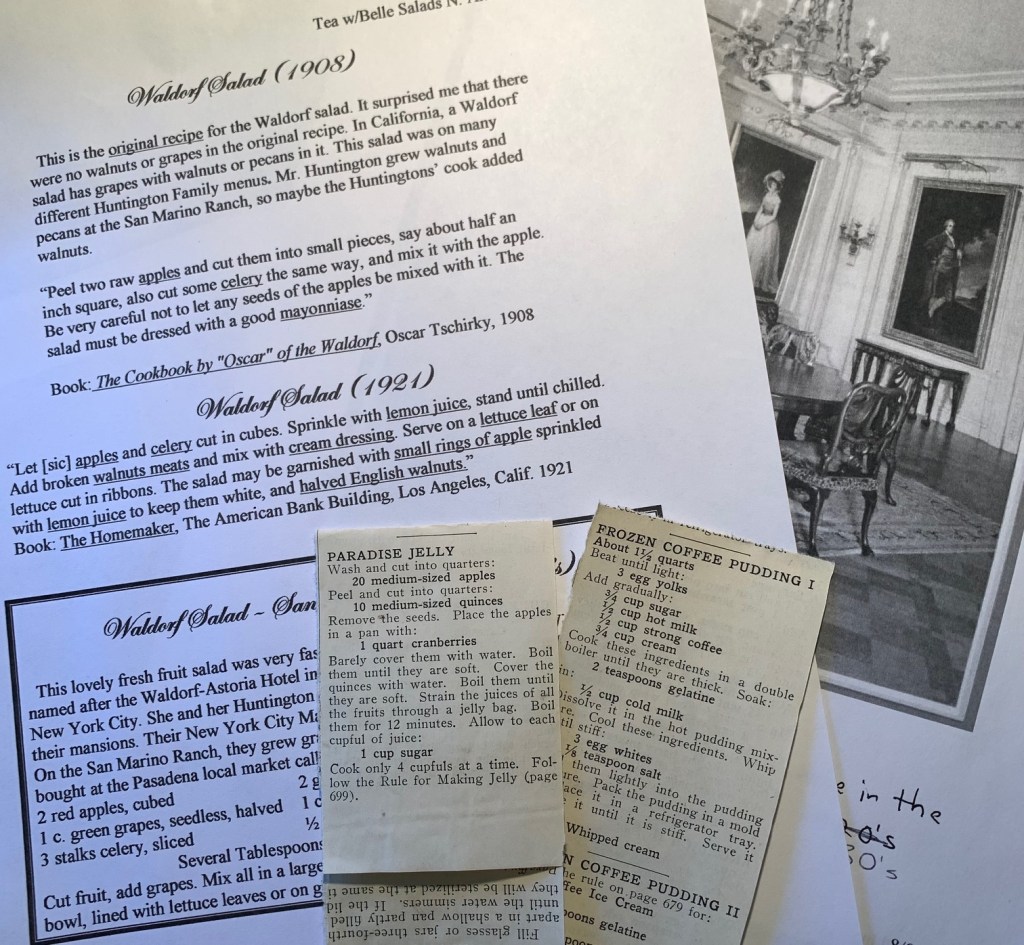
Symbols of Celebration
In the formal Huntington Dining-Room, an ornate carved fireplace is located on the east wall. There are several symbols of “celebration” decorating the fireplace: grapes, grape leaves, the bust of Bacchus (the god of wine & celebration), wheat to symbolize bread (Ranch grown barley & wheat), half moon, an artist’s palette (the Huntington’s as art collectors), wine vessels (entertainments) , & fruit (abundance of fruit & veggies grown on the San Marino Ranch). On each side of the grand fireplace, stood 2 bronze andirons with figures, children, & flames. These pieces were bought in Paris, in June of 1913, when Mr. & Mrs. H. E. Huntington (Arabella) got married and were on their honeymoon. “From Seligman No. 3659, 2 firedogs little children coming out of the scrollwork, guaranteed of time: French Louis XVI model by Clodion.”

The Mr. & Mrs. H. E. Huntington (Arabella) Dining-Room was used for numerous entertainments. There was Tea Receptions, Luncheons for 12 guests, Teas, Lectures, Concerts, Buffets, & Formal Dinners from 6 to 24 people. At their Huntington Mansion on the San Marino Ranch, most of their luncheons were intimate with 6 to 12 guests.
Luncheons in the 1920’s, in wealthy society were usually a formal sit-down 3-4 course meal. Luncheon would start with a Seafood Cocktail or Fruit Cocktail, a cream or light Consommé Soup, and/or a Light French Salad, an Chicken or Beef entrée with Rice or Potato & Vegetables, ending in a light Dessert & Ice Cream.
This afternoon meal would have been served “Service a la Russe” (Russian style) meaning one course at a time according to a menu. Was there a formal menu on the table at all meals? It is very possible, Mrs. Arabella Huntington ordered dozens of elegant menu cards for her dining purposes. Some of her menu cards were hand-written by Tiffany & Co. (with watercolors included and gorgeous calligraphy) & other fine stationary stores (Vromans in Pasadena). These menu cards & name cards were used for her formal dining in the Huntington mansions. A menu card can add excitement to dinner entertainment sometimes with a theme of a meal of what’s to come. Mrs. Arabella Huntington’s personal secretary (Miss Caroline M. Campbell) had pretty handwriting & could have also easily have written the menu courses out & the name place cards for the guests, also.

The color theme for the Huntington’s Dining-Room at the San Marino Ranch was green and gold. The room had subdued colors surrounding the room of white walls & three large French windows/doors draped with green satin curtains. The white “King’s White” walls was a brilliant idea to make the Huntington’s English portrait painting collection stand out & look exquisite in their gilded frames. Outside the Dining-Room windows, the Huntingtons could see the rose gardens & their sculpture, “Temple of Love” & the Formal Rose Gardens; and maybe a peacock or two walking by.
Staging Area for the Huntington’s Footmen
In the Huntington’s Dining-Room, there was a impressive Louis XIV style 6-panel needlepoint savonry screen; with carved wood gilded frame. This needlepoint screen now is located in the Large Library of the Huntington Library. Besides the Dining-Room table, their Dining-Room held another circular 6 ft. table with 6 carved legs. This could have been used for staging a formal dinner for the footmen & butlers for breakfast, or for grandchildren to sit & eat. This smaller table had a green velvet table cover, 9’2″. There was 3 marble-top “buffet” side tables; one side table, brown-mottled marble top (under picture), 2 side tables 30″ x 69″ (under picture), green-marble tops with carved sides & legs, with beautiful hand carvings of women [I think I have seen that large table upstairs on the north side of the stair case.] A 6ft. high 2-panel screen of green felt with oak serving stand. The under picture is a reference from Mr. H. E. Huntington’s last will. Which states that every table under a “picture” (painting) went to the Huntington Library instead of Mr. H. E. Huntington’s estate (his daughters). So these beautiful ornate French tables (under these Master Paintings) are still at the Huntington Library & Art Gallery for visitors to enjoy.
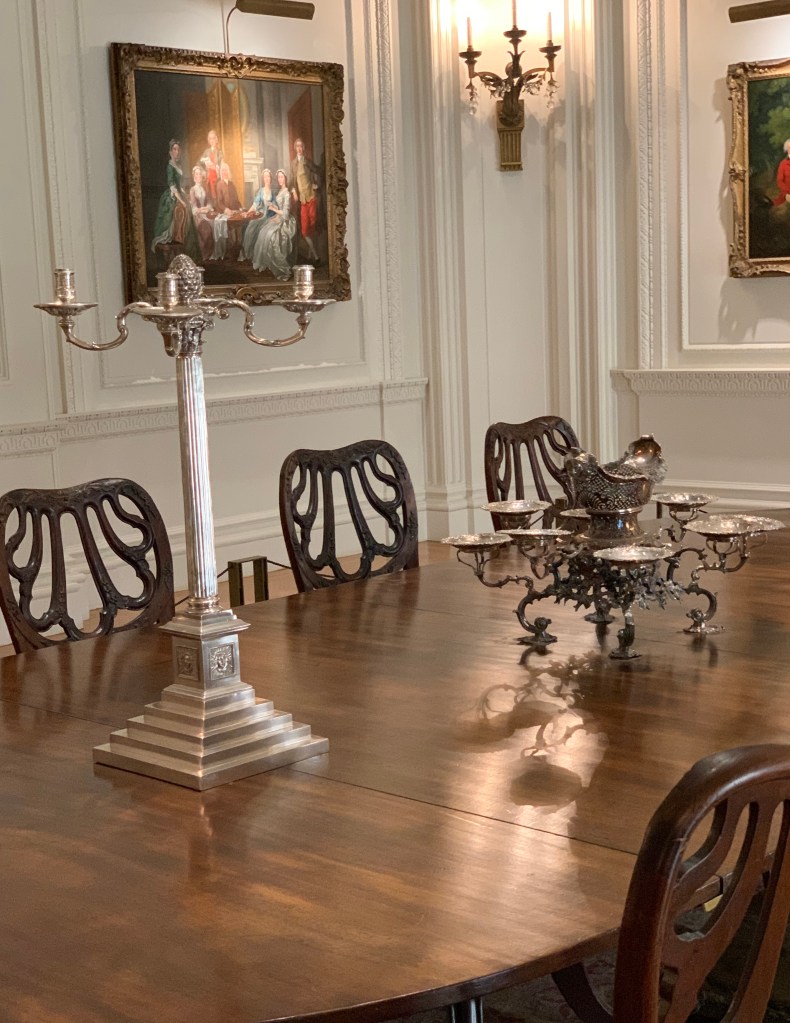
Seating for 6-24 guests at the Huntington Dining-Room
The Huntington’s had a beautiful Persian Oriental rug of Ispaham silk. It laid under the Marquetry oval Dining Table with Chippendale bear claw feet; often a drop leaf to enlarge the table. But this table actually had 5 leaves to extend the table for 24 or more guests. There were 16 Dining-Room chairs in the Dining- Room; total of 32 Chippendale Chairs in the main hallway & various other locations in the mansion. Which Mr. H. E. Huntington needed in 1926, at his most formal “Royal Dinner” when he entertained 24 royal guests. He was entertaining the young King & Queen of Sweden. For details of this amazing Huntington event, see my blog called “Royal Dinner”.
The formal rule of etiquette in the Victorian Era was to have a even number of persons at one’s dinner table. Often, Miss Campbell or Mr. Hapgood (Mr. & Mrs. Huntington’s social secretarys) were asked to “fill in”, when a person get ill or couldn’t come to dinner. In the Huntington’s Dining-Room, there was also a carved Chippendale settee with elegant French ribbon pattern. A Settee is a double Chippendale chair( like “Loveseat”, which 2 people could sit on.) Also, two large gold-carved trochees (tall, free standing massive candelabras) decorating the large Dining-Room.
“The Royal Dinner“
On Friday July 23, 1926, Mr. H. E. Huntington hosted his most elaborate dinner ever at the Huntington Mansion, the “Royal Dinner”. He invited 24 dinner guests for a multi-course dinner in honor of the Crown Prince Gustavus Alophus & Princess Louise of Sweden. After dinner, they enjoyed a concert at the Hollywood Bowl for a musical concert. It would be fun to know what musicians they listened to that evening.
The Prince and Princess stayed with Mr. Huntington for 4 days. For this white tie & tails event, he invited dear friends, some trustees, & their wives & his family to join them. Mr. Huntington’s favorite sister, Mrs. Caroline Holladay “Carrie” was his hostess; Mrs. Arabella Huntington had died in 1924. He entertained the Prince & Princess the whole weekend at the Huntington Mansion; with events at the Hotel Huntington in Pasadena with teas, lectures, luncheon events. A formal dinner at the Biltmore Hotel with LA Chamber of Commerce. Friday night his “Royal Dinner” at the Huntington Mansion on the beautiful San Marino Ranch. Also, visits to Warner Brothers & several other studio tours. Then the royal took a train north to Yosemite, California.
Typical Huntington formal dinner
In researching Huntington Formal Dinners were very formal indeed with many courses from 8 to 10 courses. In the 1880’s, the Huntingtons entertained with grand Gilded Age dinners that were actually 14-16 dinner courses. These formal dinners took several hours & many waiters serving them wine & champagne at each course.
A typical formal Huntington Dinner usually started with Oyster on the Half Shell to start, then a soup course (Clear Bouillon or Cream Soup like Artichoke Soup or Asparagus Soup), Fish course (small Crab Cake with Lemon Sauce or Santa Catalina sand-daps), Chicken course like Chicken Croquette with a Marsala or Truffle Sauce, Entrée Course (Turkey, Chicken or Leg of Lamb) with Vegetables (Asparagus, California Artichoke, French Green Beans or Petit Pois), then a Sorbet or Roman Punch and a pause for the guests,
then for the 2nd half of the grand dinner: a Game Course (Duck a la Orange or Pheasant), Salad Course (served French style after the Entrée like refreshing Waldorf Salad or California Avocado & Orange Salad, a Cheese course (Mrs. Arabella Huntington loved French cheese: “Fromage course” using Roquefort, Brie, or Camembert, served with water crackers. Desserts could be Royal Pudding or Fancy Cakes & shaped Ice cream, Dried Ranch Fruit like Apricots & Cherries or fresh Mango & Peaches with Nuts to finish, with Bon Bons or Jordan Almonds ( French Chocolate Truffles with Coffee or After-dinner drinks served in the Large Drawing-Room).
Formal Attire: Mandatory
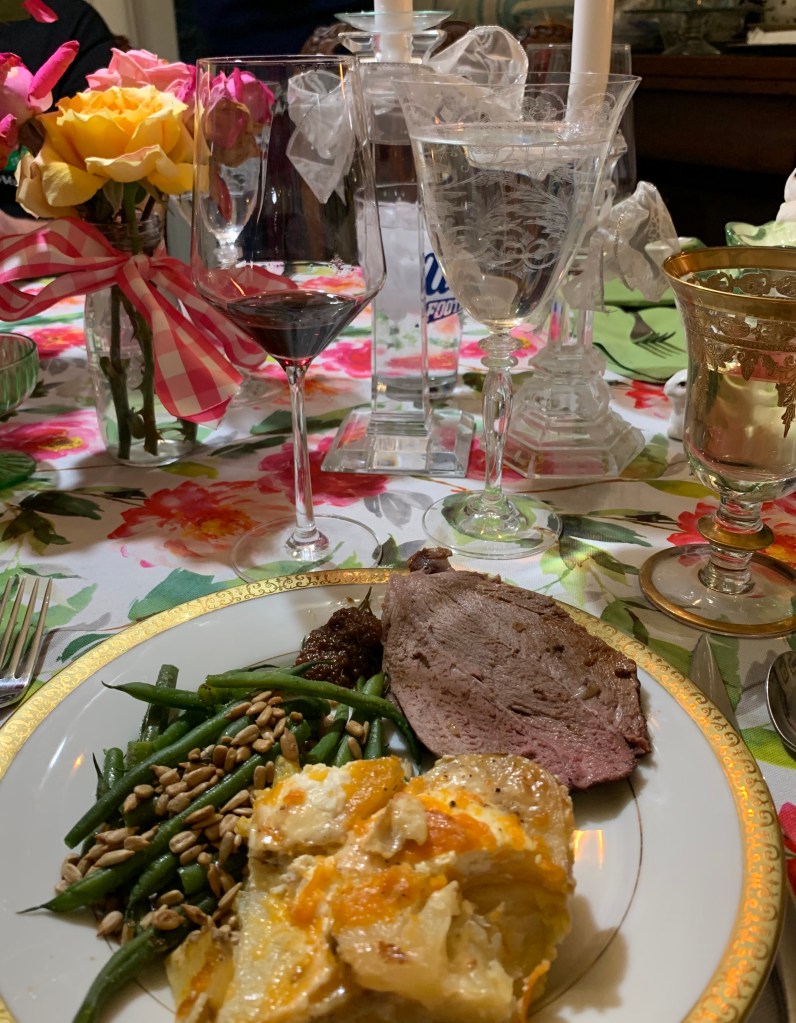
The Huntington’s luncheons & dinners were always formal. “Formal” meant formal attire for men (white tie & tails) & women in long sequin or lace gowns and long white gloves. For lunch: men dressed in grey “morning coats” & white ties & tails or black tie for men at dinner. The Huntingtons had four serving men (2 butlers & 2 footmen) as waiters (dressed in formal livery) for their elegant 4-5 course Luncheons or 6-8 course dinners.
Even when Mr. & Mrs. Huntington were alone, dinner was still formal. Formal meant four footmen in attendance; these 4 fancy- dressed male butlers/footmen in vests (Livery coats) & tux and tails with gloves. Two footmen serving plates to each individual guest & two others footmen standing in attendance behind the Huntington’s. To help the Huntington’s or their guests when needed to take away plates & help with wine, etc. Alfonzo Gomez, the Huntington’s Head Butler in the 1920’s, stated he always stood behind Mr. H. E. Huntington, if he needed him. Alfonzo was also Mr. Huntington’s gentlemen’s valet. Mr. James Temple also served as his valet if needed.

The Huntington’s Butler & Footmen “Call Buttons”
In the Huntington’s Dining-Room, both Mr. & Mrs. Huntington had servant “call buttons”. These Call-Buttons were located under the Dining-Room table, on the floor at their feet to alert the footmen or butlers, if needed. On the left side of the fireplace, they also had a small button on the wall. Most likely connected to a bell system, that rang in the Huntington’s Kitchen. This button was for the Head Butler use – to alert the staff without loudly calling out their names to the kitchen; or interrupting the Huntington’s dinner & their guests.

Mrs. Arabella Huntington & her Belguim griffon dog “Buster”
Alfonzo Gomez, (Mr. H. E. Huntington’s personal valet-butler) tells a sweet story about Mrs. Arabella Huntington’s & her beloved dog named “Buster”.
“& the dog [Buster], he had to have his dinner. He was very fierce, you remember? He laid on her dress [her lap], & that dog was so attached to Mrs. Huntington. He knew her every move. That dog met a terrible tragedy [he got killed by one of the Huntington’s guard dogs, at the San Marino Ranch]. She was so fond of this dog that he laid on her dress [while she was] eating lunch, but the instinct of the dog, he knew exactly when she was through. So before she made any move or got out of her chair, he knew she ought to be through, so he got up & stayed in the center of the room, waiting for her. “
“In the evening, when she was playing cards – she played till 10:30 -the dog laid on her dress & he knew what time she got through playing cards & [sic] 15 minutes. Before she finished playing cards, that dog went upstairs & he laid on her bed, waiting for her. So naturally, she loved him & that dog didn’t like anyone else.” Document: HEH Coll MS 19/1-18 uncat (Alfonso Gomez Tape B. p.11) Historical Note: Both the Huntington’s green Amazon parrot [who spoke exactly like Mrs. Arabella Huntington’s voice with 200 nautical word vocabulary] & the Belguim Griffon dog both had the same name “Buster” as the Mrs. Huntington’s Green Amazon Parrot named “Buster”. These pet animals adored & protected Mrs. Huntington & didn’t particularly like Mr. Huntington or Alfonso, the Butler. “Buster”, the dog, was buried in the Huntington’s rose garden.
I believe that when the Huntingtons were alone or with another couple like Mr. Huntington’s sister, Carrie & Burke Holliday dinners was greatly reduced. A elegant dinner but with small portions (maybe 5-6 courses) depending on the season or French-style with 3-4 course. The oysters might be a oyster soup or New Orleans gumbo, a fish or a chicken course, a entrée or a game course, with cheese served with salad course, fresh Ranch fruit & nuts served with small fancy cakes like “petit fours” & homemade ice cream.

Mrs. Arabella Huntington’s fine bone china & porcelain plates
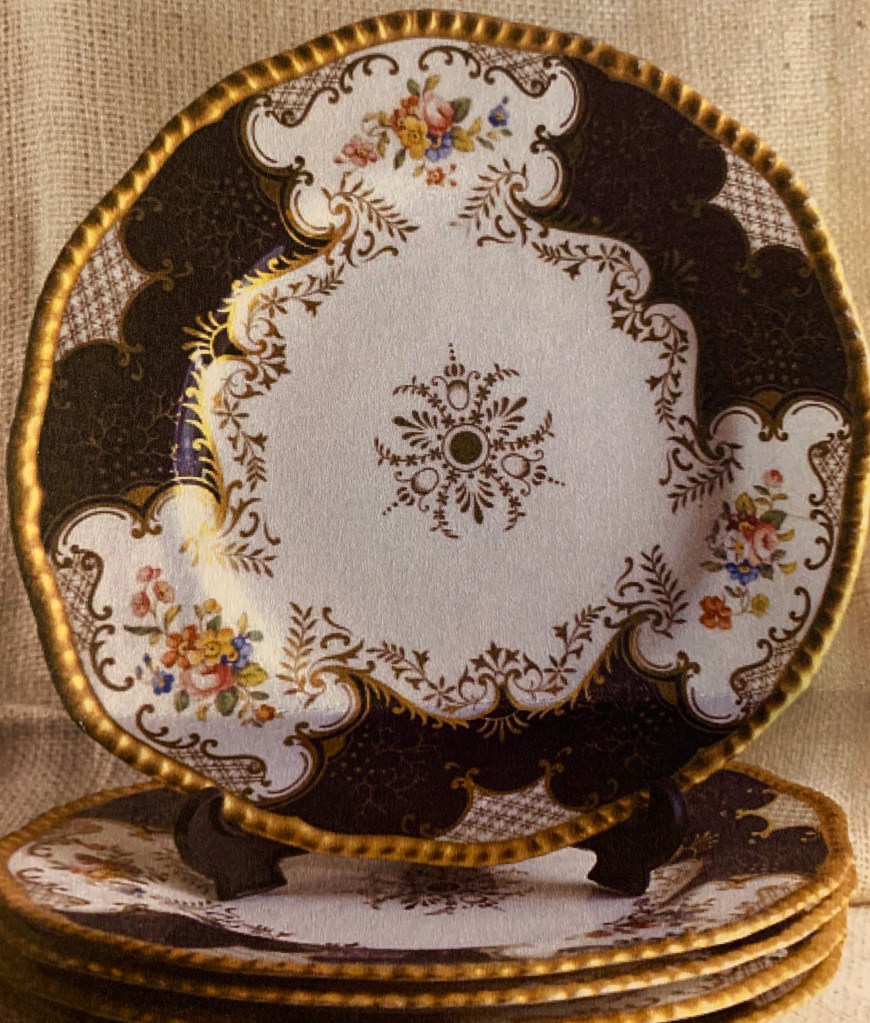
The Huntington’s Butler’s Pantry was a large room, located just north of the Huntington’s Dining-Room. It held all of Mrs. Huntington’s necessary porcelain & fine bone china plates that were used in the Dining Room. The Huntingtons had 40 cabinets of plates, bowls, & tea cups, with most sets having 50-60 plates sets. For special occasions, Mrs. Huntington used her “Best” was a ornate gold & white plate made by Old Copeland & Garrett.
A popular thing to do for hostesses was to have the family crest or family initial “H” painted gold on fine china plates. Bullocks, a local fine department store in Pasadena, (which is now Macys on Lake Ave.), use to have this service. The font for the family initial(s) was usually Old English or Gothic type in gold & very elegant. When Mrs. Huntington died in 1924, Archer Huntington would have inherited her “bric-a brac”. When Mr. Huntington died in 1927, his 3 daughters would have inherited all his treasures except for the all his treasured books and document collections, master paintings & the tables under the paintings. His son, Howard Huntington died in 1922.
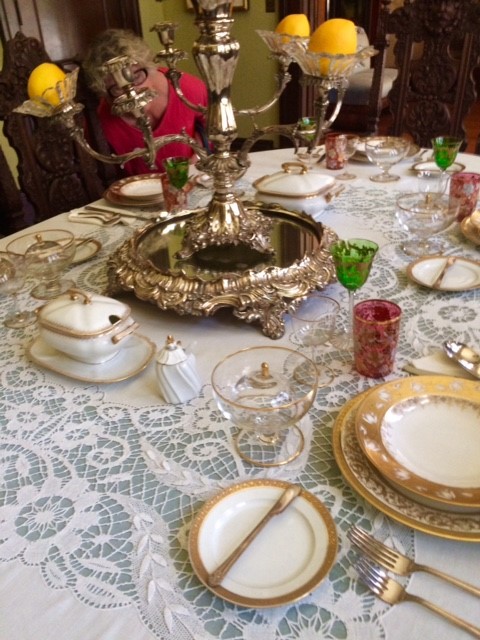
At a Gilded Age formal dinner each “cover” (table setting) would have included a mass amount of elegant plates & bowls : a charger, oyster plates, bouillon or soup bowls, bread plates, finger bowls, entrée & game plates, salad plates, cheese & fruit plates, dessert plates, ice cream bowls, tea or coffee or demitasse cups & saucers.
The Huntington’s sterling silver was Gorham (the sterling silver at the US White House in Washington DC). Included all the serving spoons & forks & serving trays for the footmen. Mrs. Huntington had 2 large boxes of Gorham silver flatware for a dinner parties would include oyster fork, fish or fruit fork, soup spoon, chicken fork, entrée & game fork, salad fork, cheese spoon, cake fork, ice cream spoon. The Huntington’s had Tiffany gold crystal glasses had water tumbler glass, champagne & white wine glass & red wine, Claret & Hock glasses, lemonade & ginger ale glasses. Many crystal ware used for cordial & liqueurs (Crème de menthe or Curacao) used in the Drawing Room they had Salvanti Venetian glasses, Tiffany gold, & etched crystal ware. Many of the Huntington pieces had “H” engraved or HEH engraved on them. Mrs. Huntington also own Sheffield silver too.

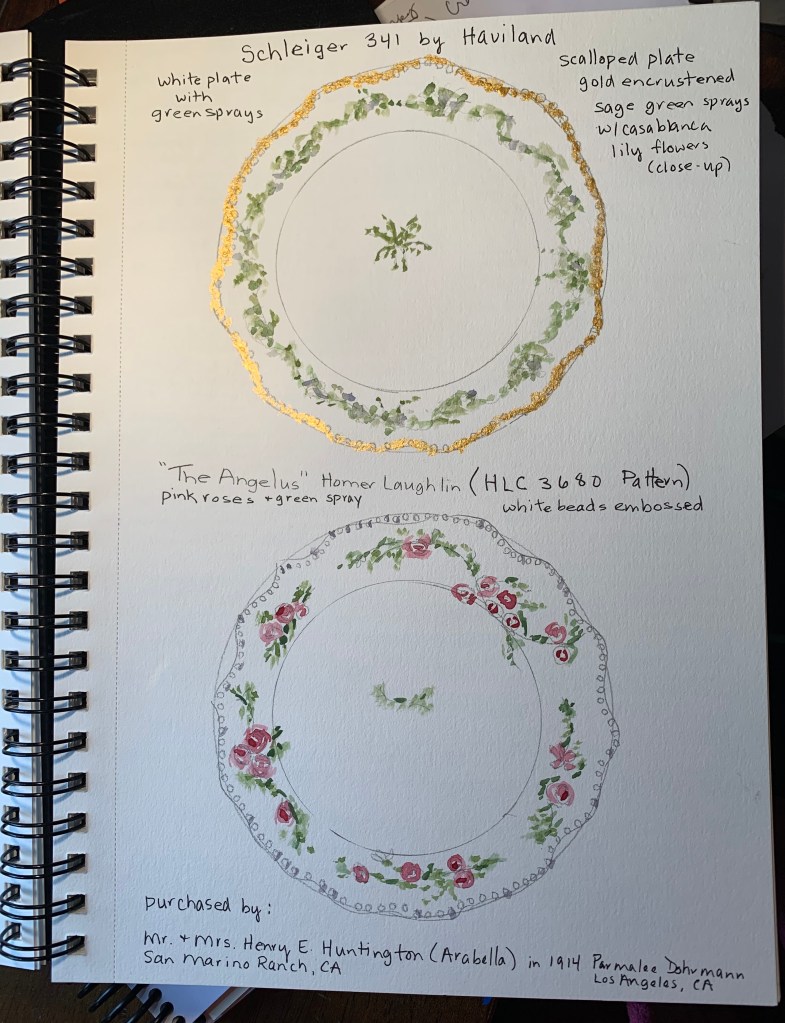
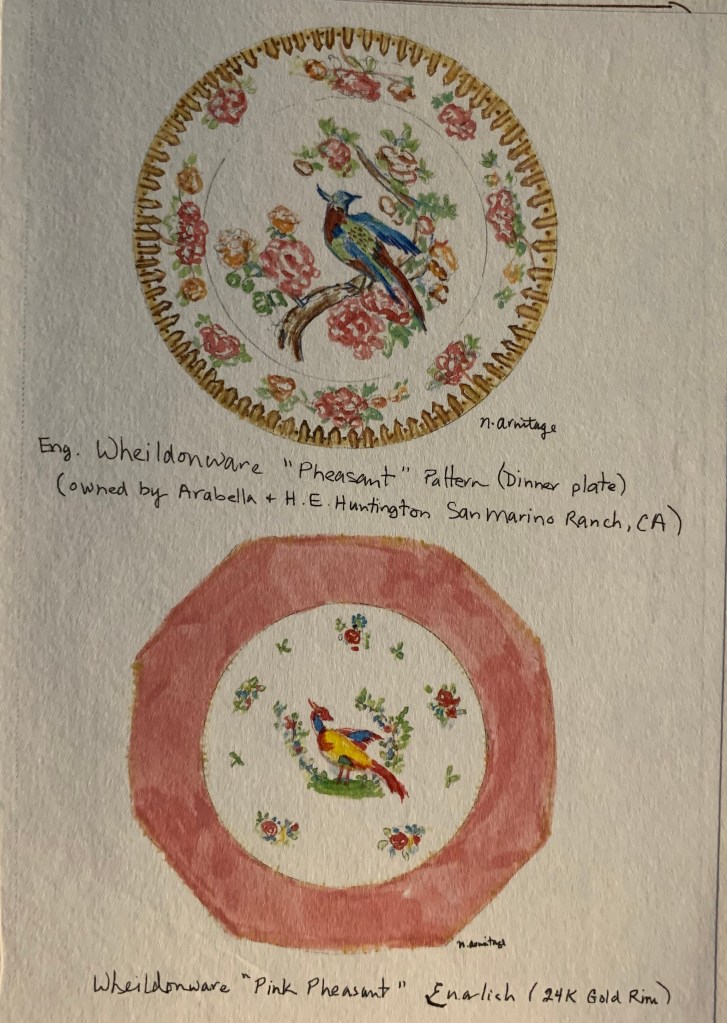
Mrs. Arabella Huntington had a enormous amount of fine bone china & porcelain plates, bowls & coffee & teacups. She loved French porcelains: Sevres (tea & dessert set in pink, gold, & white), Limoges, numerous sets of Havilland, & Old Paris chocolate pots. She had English fine bone china like Royal Crown Derby, English Whieldon “Pheasant”, Copeland & Garrett, Blue Delt, Worchester, Coalport (gold, white & blue), Dresden & so many more. The Huntingtons had a huge collection of American made Homer Laughlin called “Angelus” pattern, with white & gold with little pink roses on it.
 Inside the Huntington's Story