
by Nancy Armitage
The Victorian or Edwardian “Drawing-Room” of a large manor, mansion or estate should be decorated with the finest things that the owner has. This philosophy was written by Edith Wharton in her book, The Decoration of Houses. In the Mr. & Mrs. Henry E. Huntington’s (Arabella) collections, everything they owned was of the finest quality & beauty.
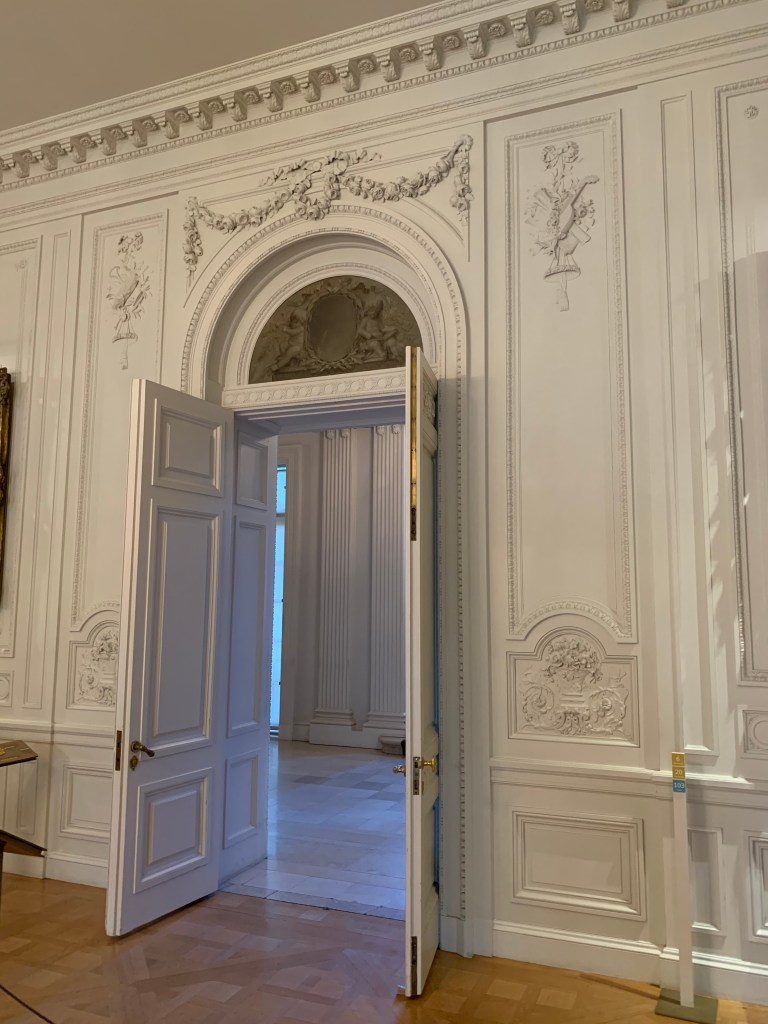
At that time period, in the Gilded Age, wealthy Americans emulated royalty & especially Queen Maria Antoinette of France. This was was illustrated by a architectural drawing of the Large Drawing-Room of the Huntington Residence. The paneling & the fireplace & symbols were emulated from Marie Antoinette’s Petit Trianon at Versailles in Paris. Information: Art of Wealth by Bennett
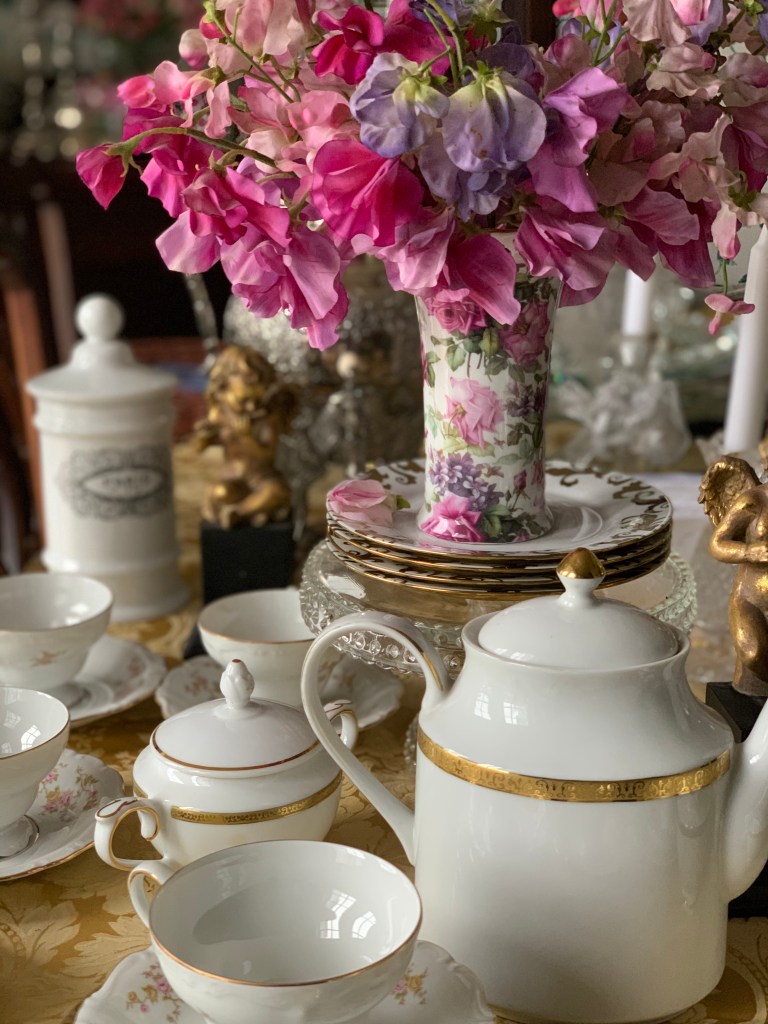
The H. E. Huntington’s Large Drawing-Room was used for several different purposes. They used it sometimes to receive guests but usually that was done in the Large Library. They enjoyed Afternoon Tea or what they called “5 o’clock Tea” was served by the Huntington’s butler; also after-dinner tea & entertainment was often located in the Large Drawing-Room in the Huntington Mansion on the San Marino Ranch, CA.
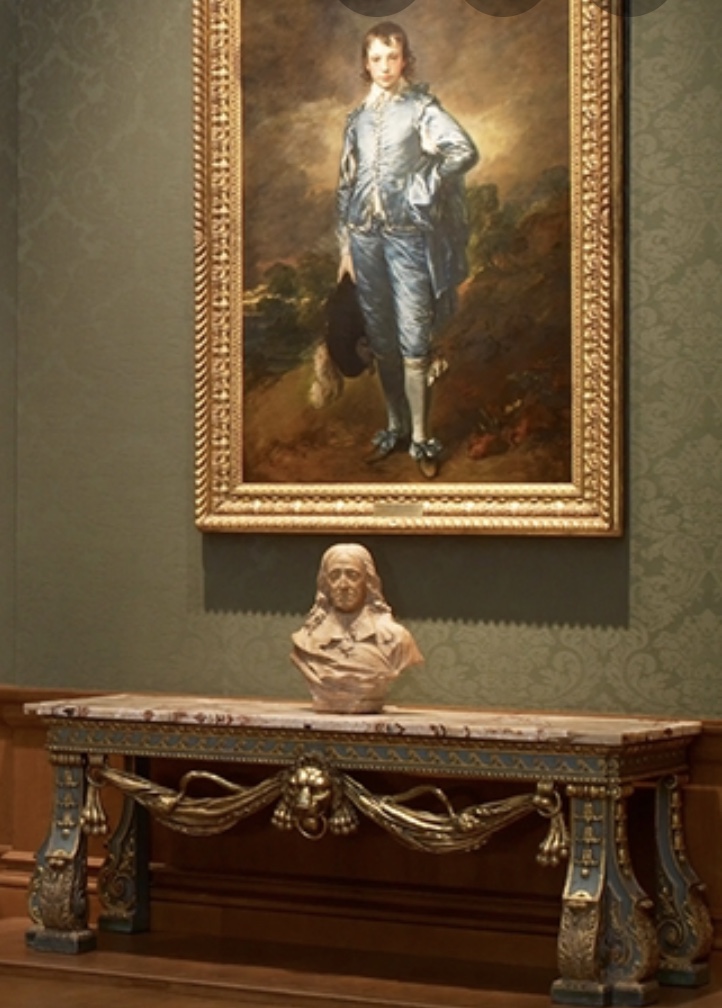
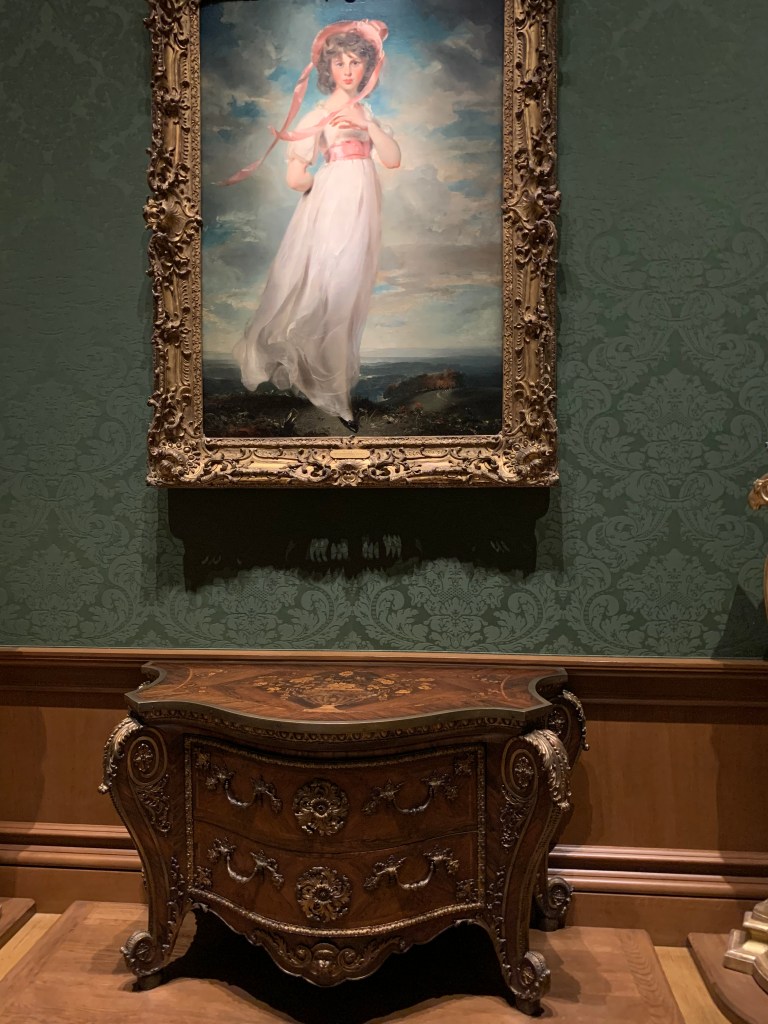
While the Huntingtons lived at the Huntington Mansion: The Large Drawing-Room paid tribute to 5 of Gainsborough’s paintings: “Blue Boy”, The Cottage Door”, “Duchess of Cumberland”, “Hon. & Mrs. Henry Fane”, & “Hon. Lavinia Brigham”. Mr. Huntington was particularly proud of “Blue Boy” who arrived at the San Marino Ranch in March 21, 1922. “The Blue Boy” was hung in the Large Drawing Room by March 22, 1922. Other master oil paintings located in the Large Drawing-Room were “The Fortune Teller” by Reynolds, & “Marriage of the Adriatic” by Turner. The famous “Pinkie” painting by Reynolds was also located in this room; but Mr. Huntington did not buy “Pinkie” until 1927. Mrs. Huntington did not get to enjoy “Pinkie” at the San Marino Ranch mansion, because she had died in 1924.
The cool color palette the Huntington’s choose for the Large Drawing-Room were blue, grey, white, & gold (gilt). A large Louis XIV figured rug (Savonnerie) decorated the floor, the 3 windows were covered with heavy grey, satin brocade curtains. That was very clever of the decorators, (Joseph Duveen & Mrs. Arabella Huntington) to have subdued curtains & white walls, the white paint was called “the Kings White” to show up the paintings.
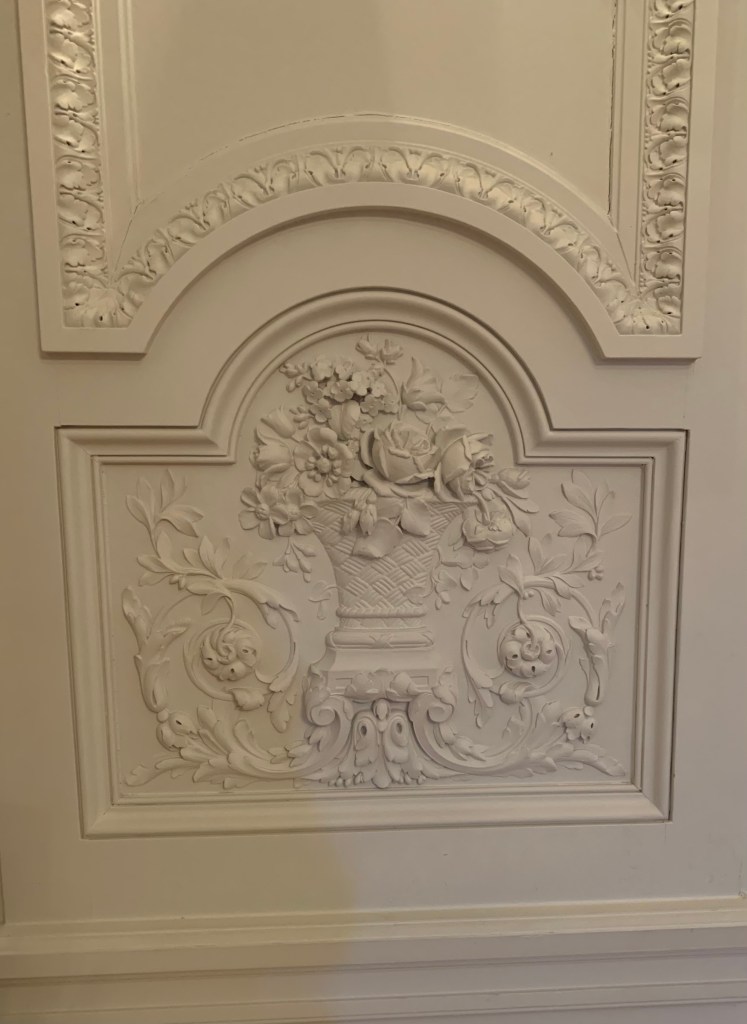
The Huntington’s Large Drawing-Room was most likely their Music Drawing-Room or “Entertainment Room”. On the walls they have embossed motif reliefs depicting entertainment: Irish harp, a guitar, an artist’s palette, etc. These creative French style motif reliefs hint that is was a Music Room. Also, one of the Louis XV marquetry tables hints that it was a Music Room with it “Musical Trophies & Flowers” engravings.
Mr.H. E. “Edwards” Huntington like to smoked cigars. In the Edwardian years, after formal dinners men would retire to a Smoking Drawing-Room to enjoy cigars with cognac or brandy. Mrs. Arabella Huntington did not like cigar smoke in the house, so Mr. Huntington & his men friends probably went out on the front terrace, or more likely to the Billiards House/ Bowling Alley. The Billiards House & Bowling Alley was a narrow building running north & south, located just north of the rose garden & west of the Huntington Mansion (Huntington Library now). The Billiards/Bowling Alley was decorated like a Gentlemen’s Hunting Lodge. The women most likely retired to the Small Drawing-Room to have after-dinner cordials, like Crème de Menthe (mint-flavored) or Curacao (orange-flavored) liqueurs. A short while later, the men & women joined each other again for some kind of musical entertainment or cards in the Large Drawing-Room.
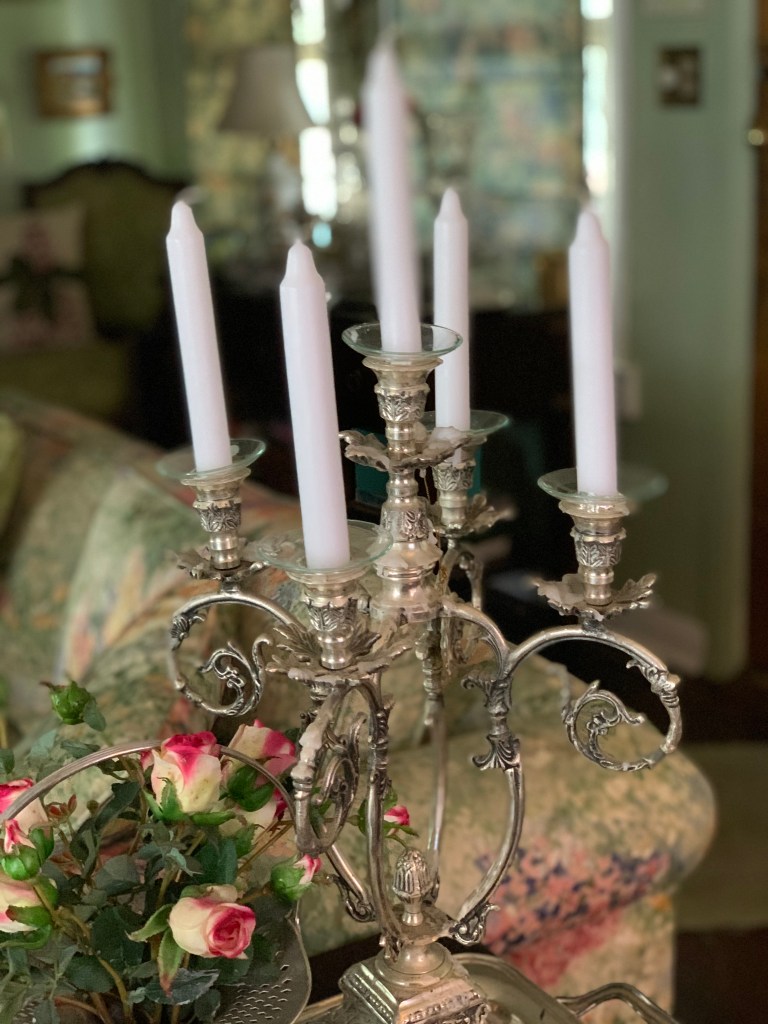
In 1920’s etiquette books, described candlelight at afternoon tea in the Drawing-Room. They suggest that the hostess close up her curtains for more subdued lighting & have lovely classical music playing. Many used candlelight, as in “tea lights” (little votive candles) to light up the Drawing- Room for a calm mood & lovely ambiance. These afternoon teas or “At-Homes”, or “5 o’clock teas” were usually given between 4-6 pm o’clock or 5-7 pm o’clock. Men were also invited to these tea receptions. Sometimes, entertainment was provided like a harp or violinists & refreshments were served.
“Do come in for a cup of tea” Emily Post in her 1922 Etiquette Book writes: ‘This is Best Society’s favorite form of invitation. It is used on nearly every occasion whether there is to be music or a distinguished visitor, or whether a hostess has merely an inclination to see her friends. She writes on her personal visiting card: ‘Do come in on Friday for a cup of tea & hear Ellwin play or Farrish sing, or to meet Senator West or Lady X….But if the tea is of any size, from 20 upwards, the [tea] table is set in the Dining-Room.’
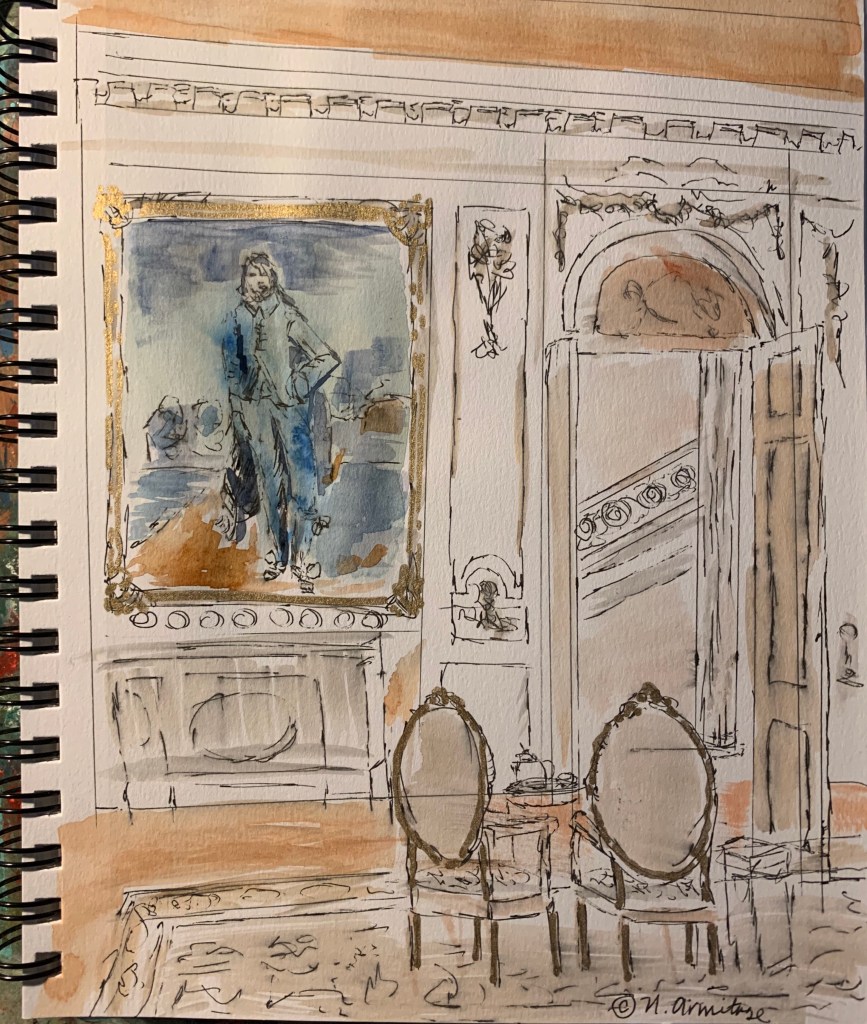
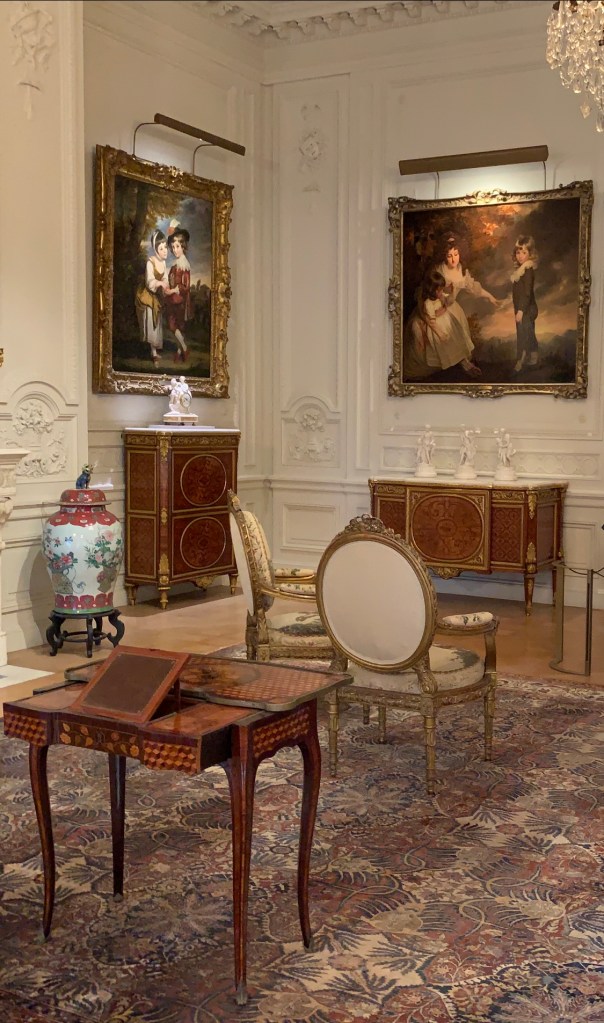
In the large Drawing-Room, Mrs. Huntington had seating for 19 guests for tea & conversation. A room that had comfort & luxury, the Drawing-Room contained: 2 gilded French sofas, 12 Drawing- Room Louis XIV chairs, 6 large & 6 small Boucher chairs tapestry backs & Ouvry seats. Also, there were 2 carved gilded side chairs (Louis XV) & “The Bishops Table” (Louis XV) with a leather top & bronze mounts by Caffieri. Information from Mr. Huntington ‘s Mansion inventory book.
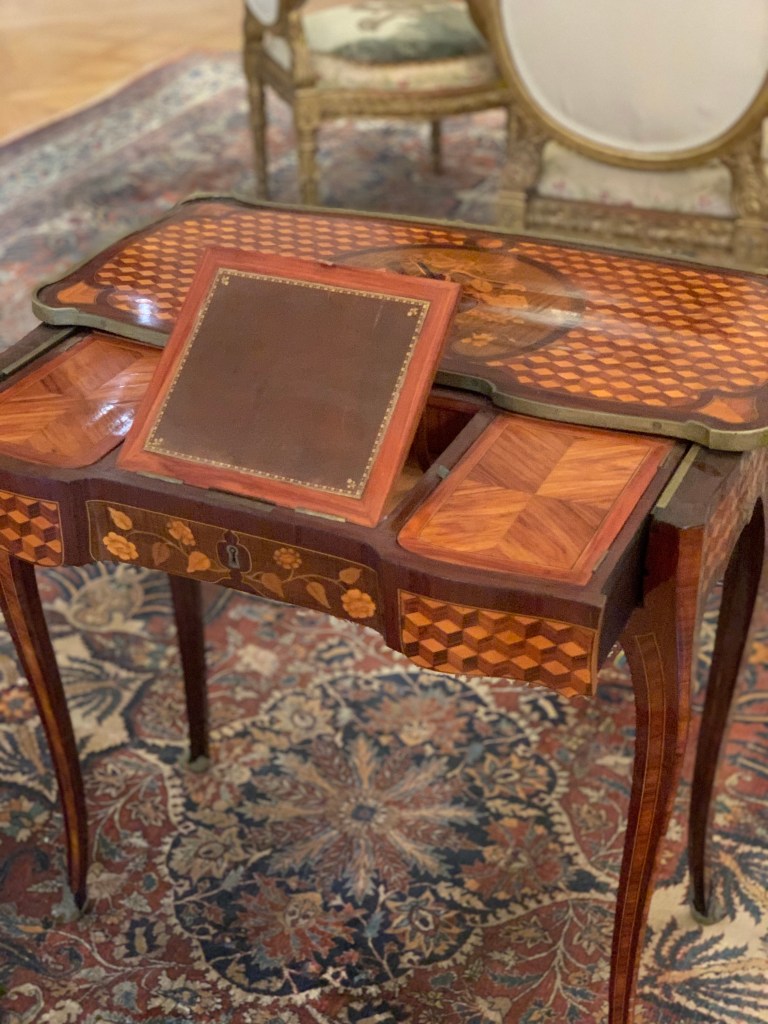
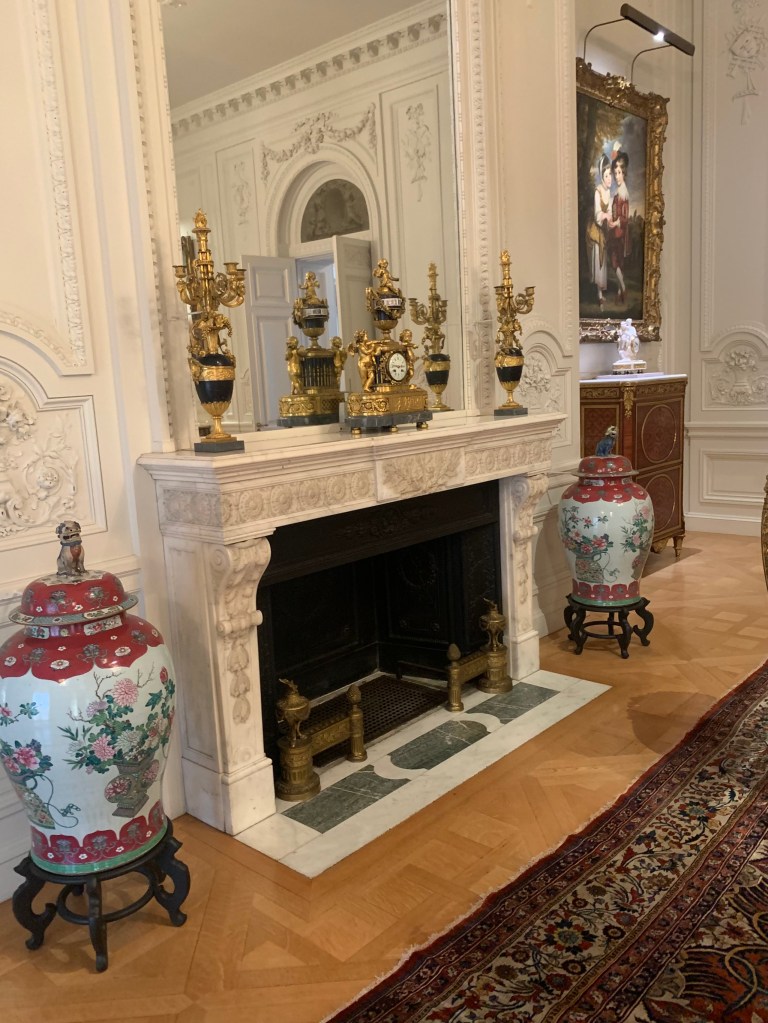
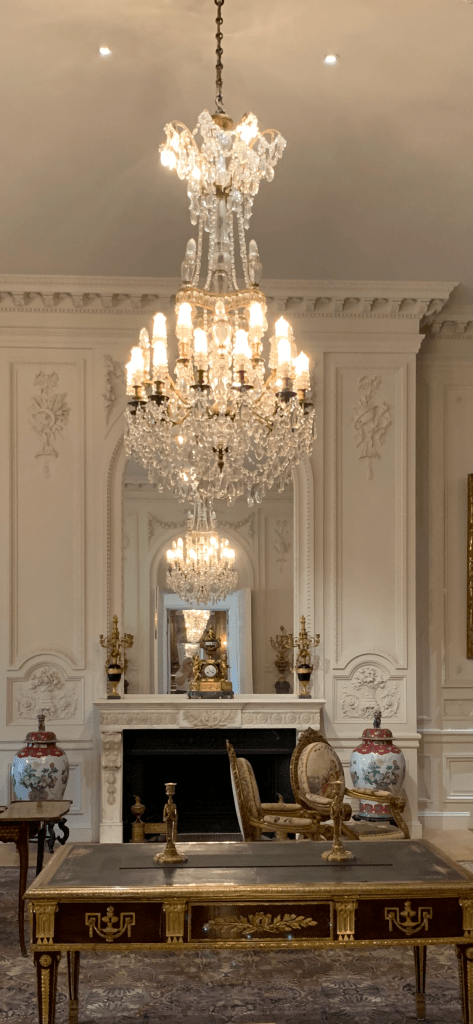
A lovely romantic atmosphere in the room was created by candlelight & nude figurines. The fireplace was on the west side of the room with a blue & ormolu mounted mantle clock with miniatures (Louis XV) & 2 3-light candelabra, of blue & gold Bronze (on mantle). At the base of the fireplace was a pair of gold bronze Louis XVI ormolu mounted andirons-female figures & cupids.
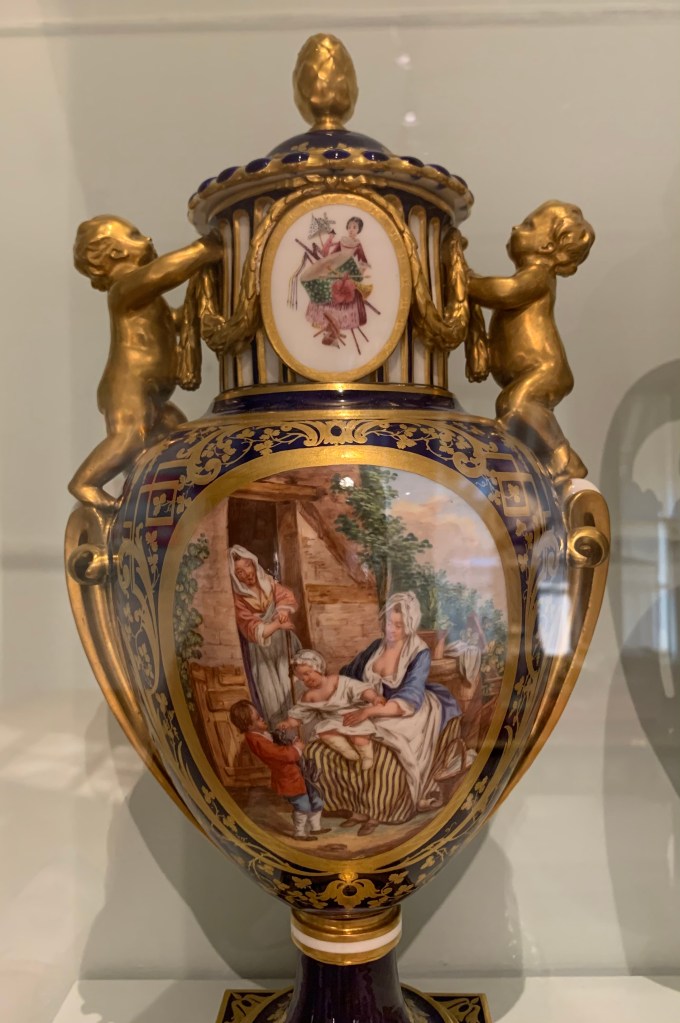
Mr. & Mrs. H.E. Huntington had live-in secretaries; they worked on “entertainments” for the Huntingtons. Each week and month, making party invitations, and designing luncheon & dinner menus, & the Huntington’s letter writing correspondence, also. By 1918, Mr. Huntington’s private secretary was George Hapgood, nicknamed “Happy” (per Head butler, Alfonso Gomez). Mrs. Arabella Huntington’s private secretary was Miss Caroline “Carrie” M. Campbell. The lovely French Louis VI write table with elaborate inlaid top (picture and described below), might have been used by Mrs. Huntington or her social secretary, Miss Campbell.
In the Large Drawing-Room, there were many writing tables & marble topped furniture pieces of Louis XVI, which they may have used such as: Louis XVI secretaire by Carlin 52 1/2″ high, white marble top 15″ x 35″; Louis XVI Commode by Carlin 39″ high with white marble top 56″x 24″; Louis XVI commode by Riesender mottled marble-top 55″ x 23″ x 34″ high; Louis VI writing table with gold bronze mounted elaborate inlaid top 16″x 31″ x28″ high. The Huntingtons and house guests other activities beside letter writing were playing cards, dominos, reading, & after-dinner music.
Mrs. Arabella Huntington Large Spring Luncheon Tea (May 1920)
Mr. H. E. Huntington brother-in-law (E. “Burke” Holladay) kept somewhat detailed journals about the whereabouts of the Huntingtons. Carrie Huntington Holladay was HEH’s sister and Burke’s wife.
On Thursday, May 6, 1920 – Mrs. Arabella D. Huntington “Belle” was her nickname hosted a Large Ladies Luncheon at the Huntington Mansion at the San Marino Ranch. Burke writes in his journal, “Carrie went over to Belle’s & attended a luncheon given there. Edwards [HEH] & Mary Lewis [HEH’s cousin] went with me to San Gabriel & saw the Mission Play [at the San Gabriel Playhouse]. Fred k’ Warde part of Junipero Serra”. Document: HEH Collection HEH MS 10968 (Burke Holladay Journals). The number of guests attending Mrs. Arabella Huntington’s Spring Luncheon could have been 30-200 guests, I have no idea. She had numerous fine china plate sets with 60 plates in each set. . She had so many choices for plateware: French Haviland & Sevres England’s , Coalport, and Copeland and Garrett/Spode ( her fanciest and very ornate – gold & white with lots of hand painted filigee and lattice work). Mrs. Huntington had so many sets of fine bone china plates a&porcelain plates. If the number of people was over 60, Mrs. Huntington had many plates with gold, pink & white roses, using several different fine china sets. She also could have had the Ladies Luncheon catered by the Hotel Huntington in Pasadena.
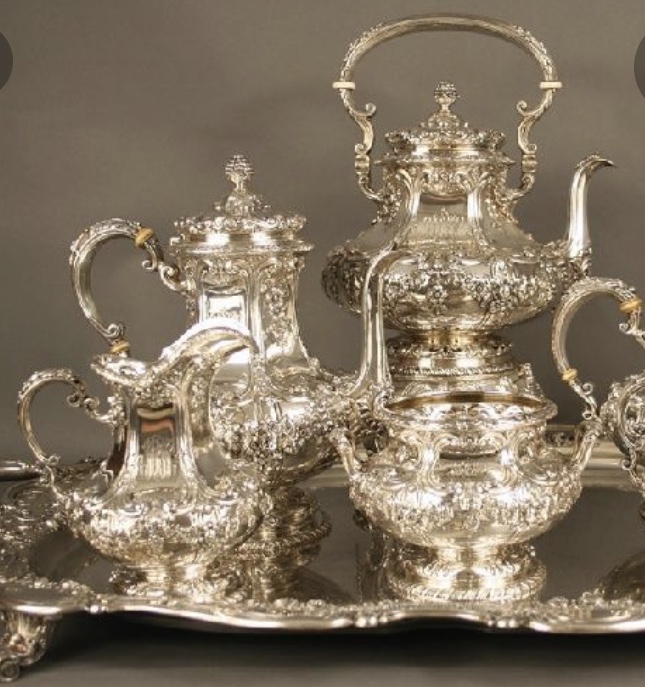
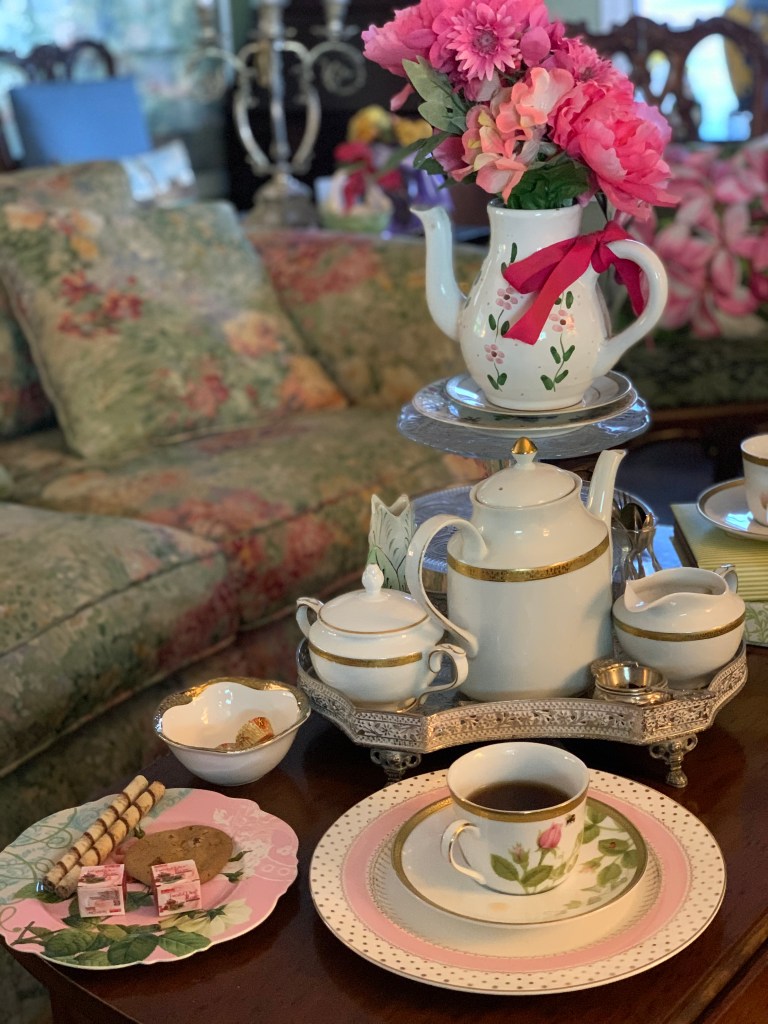
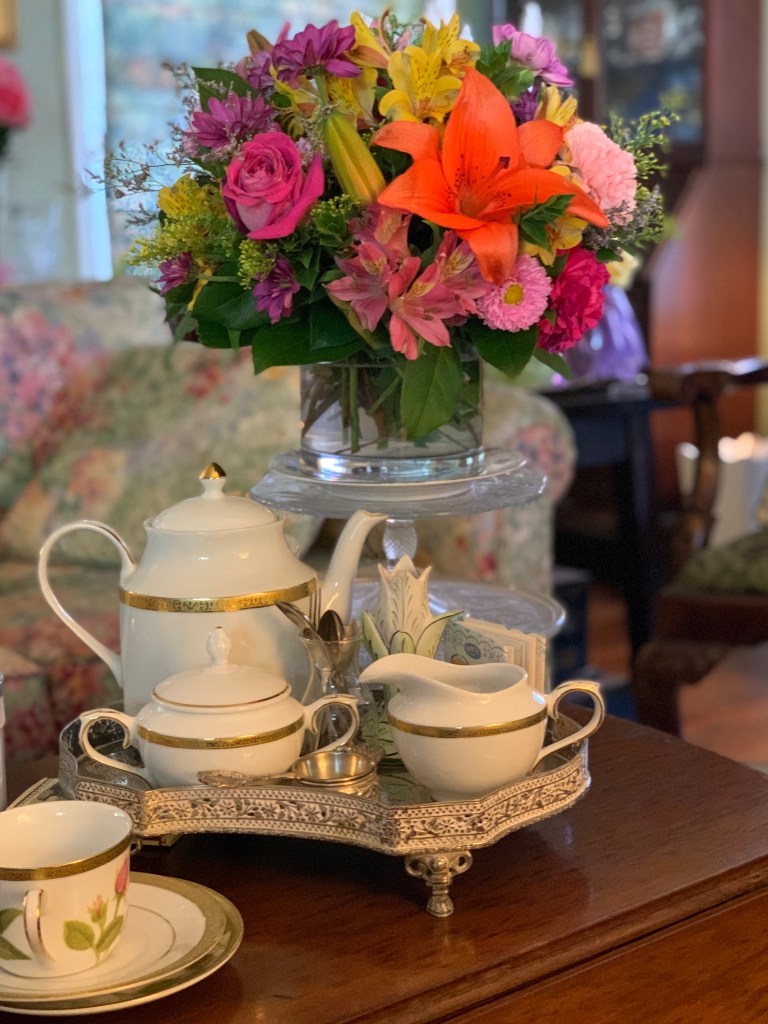
A prized piece & probably often used was a large silver French tea set valued at $1,250.00 in 1927. This silver tea set with on a large tray with handles, a kettle & a stand, the teapot, a coffee pot, sugar bowl & cover, cream pitcher, milk pitcher, slop bowl, & tea caddy with silver lid (holds the loose tea).
The tea “curate” is a 3-tiered tea stand, sometimes top plate covered with a silver dome. Emily Post’s Etiquette in Society – Book of 1922 informs us: “Things people eat at tea” (1922)
“The top dish on the ‘curate’ should be a covered one, & holds hot bread of some sort; the 2 lower dishes may be covered or not, according to whether the additional food is hot or cold; the 2nd dish usually holds [tea] sandwiches, & the 3th cake. Or, perhaps all the dishes hold cake; little fancy cakes for instance, & pastries, & slices of layer cakes. Many prefer a simpler diet & have bread & butter, or toasted crackers, supplemented by plain cookies. Others pile the ‘curate’ until it literally staggers, under pastries, cream cakes, [tea] sandwiches, or Pate de foie gras or mayonnaise. Other, again, like [orange]marmalade, [raspberry] jam, or honey on bread & butter or on buttered toast or muffins. This necessitates little butter knives & a dish of jam added to the already overloaded tea tray.”
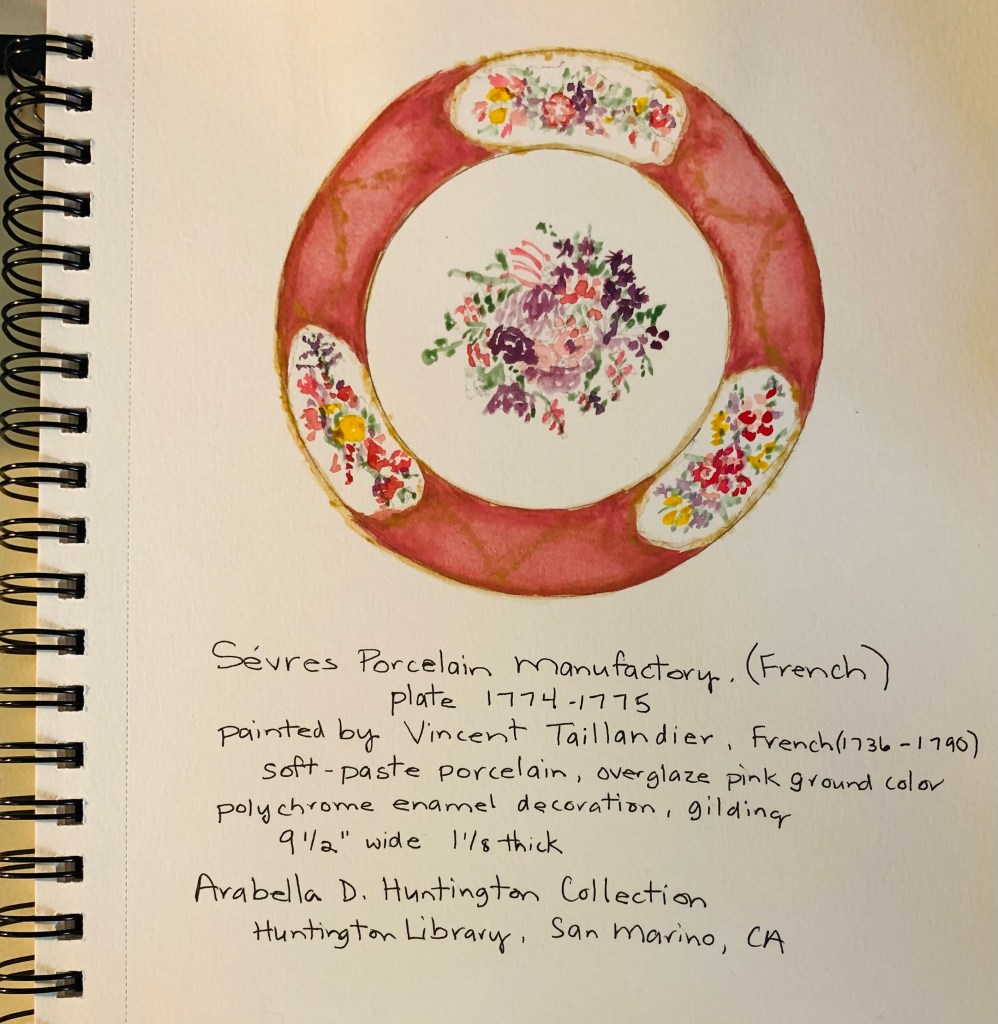
The Huntingtons had a large number of porcelain fine bone china “Breakfast sets” (for tea & coffee). These were for the house guest, to have coffee or tea in their rooms early in the morning for “tea or coffee & toast”. They were used in numerous rooms in the Huntington Mansion. A large number of these tea or coffee sets were used by Huntington’s house guests. In the morning, Mr. Huntington & Mr. Hapgood (his social secretary) might be doing some business in his “office” (Small Library), asking for a cup of coffee or tea. Mrs. Arabella Huntington could have been upstairs in her boudoir, drinking coffee & looking over daily luncheon or dinner menus while getting dressed for the day. Miss Caroline Campbell (Mrs. Huntington social secretary & friend) could have been sipping on coffee while preparing to make a Automobile Picnic.
The Huntingtons & their houseguests often went for automobile rides. They would ride around their San Marino ranch property & around Long Beach, Los Angeles, Santa Monica & Malibu. Joseph Duveen was a houseguest & Huntington’s house decorator with Mrs. Huntington could have been in the Large Drawing-Room with French fabrics, objects d’art, & color swatches for furniture, drinking English tea. Carrie & Burke Holladay (HEH’s sister) before 1916 were house quests at the Huntington Mansion, for a month at a time. They could have been upstairs in the Guest Sitting Room enjoying a cup of coffee, while looking out the window at Santa Catalina Island in the a distance. Maybe Princess Clara Hatzfeldt & entourage housed in the Huntington Guest Cottage having a cup of tea in the Large Hall.
Before June 23, 1925, Mr. H.E. Huntington received a letter from a librarian, she didn’t have a proper “Letter of Introduction”. But she inquired to met with him & visit the “Blue Boy”, which was located at the time in the Large Drawing-Room. Mr. Hapgood (HEH’s social secy.) wrote her back. His letter is as followed “June 23, 1925 Mrs. Cora Case Porter Manhattan Place Los Angeles. “….he [Mr. Huntington] will be glad to have you see them if you can come Friday afternoon, the 26th at 2:30 in the afternoon. He will be glad to have your friend accompany you. Yours truly, _____Sec. “Document: HEH Coll. MS Box 176 Correspondence The San Marino Ranch/ Huntington Library is especially beautiful in the afternoons in any season.
Mr. Henry E. Huntington’s rare book called “Practical Cooking & Dinner Giving” by Mary Henderson (1877), helps us to understand the purposes of a Drawing-Room. She gives an example for having a dinner party, & tells how the hostess & guests mingle & introductions are made in the Drawing-Room. Then after the dinner is over, the men & women drink tea in the Drawing-Room:
In The Drawing-Room before Dinner is served: (1877)
“When the guests are assembled in the Drawing-Room, if the company be large, the host or hostess can quietly intimate to the gentlemen what ladies they will respectively accompany to the Dining Room [arm & arm]. After a few moments of conversation & introductions, the dinner is to be announced [by the Butler], when the host should offer his arm to the lady Guest of Honor, the hostess taking the arm of the gentlemen Guest of Honor, & now the host leading the way, all should follow, the hostess, with her escort, being the last to leave the Drawing-Room. They should find their places at table with as little confusion as possible, not sitting down until the hostess is seated.
After-Dinner Tea in the Drawing Room (1877)
Instructions also in Henderson book called Practical Cooking & Dinner Giving (1877)
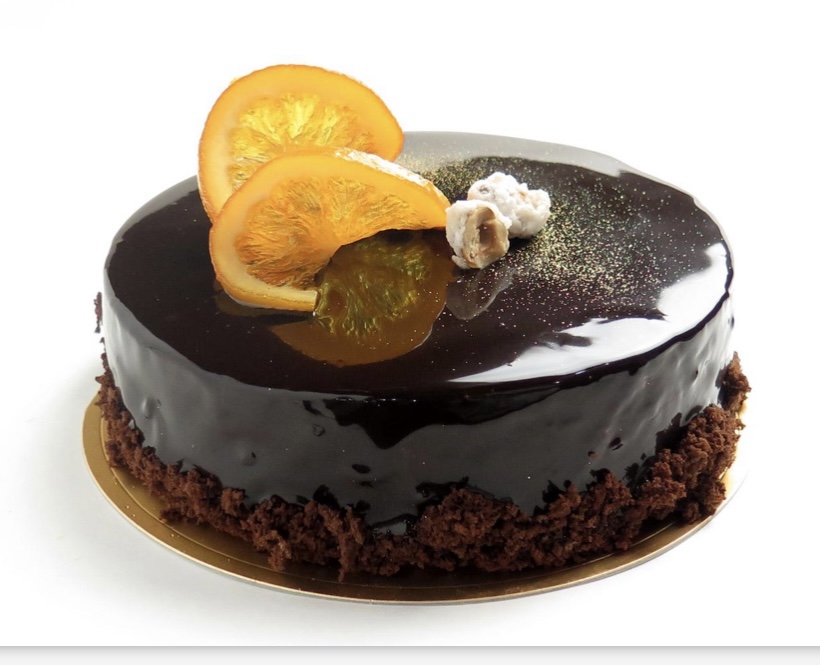
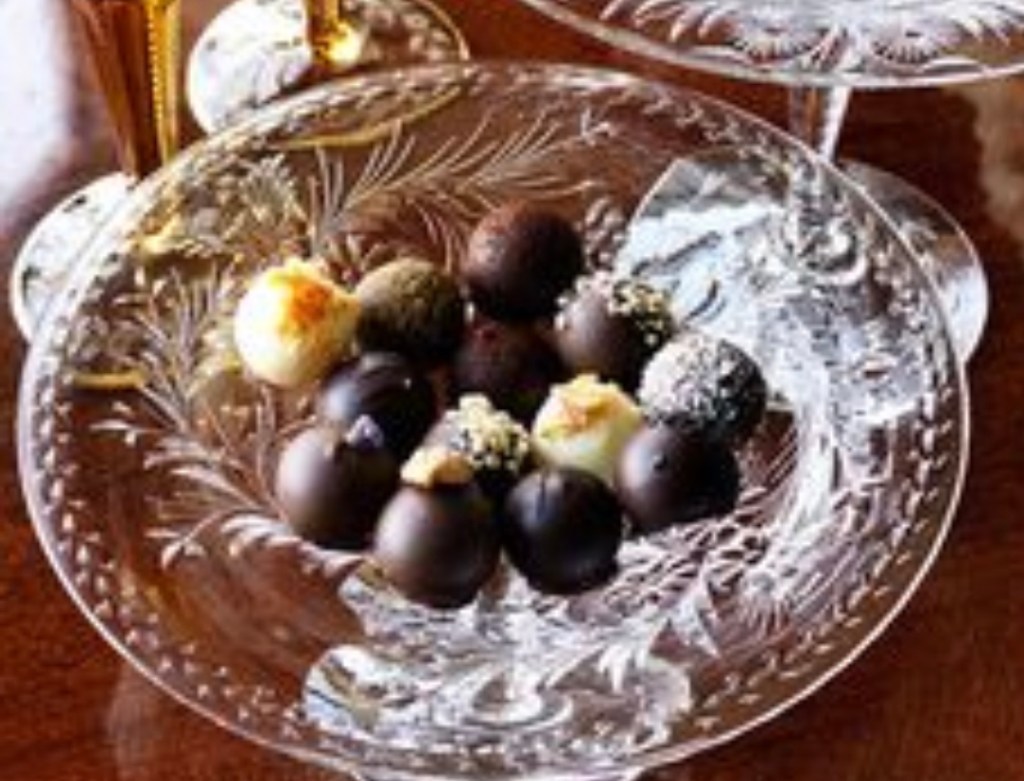
“After dinner is over, the hostess giving the signal by moving back her chair, all should leave the Dining-Room. The host may then invited the gentlemen to the smoking-room or Library. The ladies should repair to the Drawing-Room. A short time there after [perhaps half an hour], the butler should bring to the Drawing Room the tea-service on a salver, with a cake-basket filled with fancy biscuits, or rather crackers [with cheeses] or little cakes [petit fours cakes with Royal icing] [& French chocolate bonbons]. Placing them on the table, he may then announce to the host that tea is served. The gentlemen join the ladies & after a chat of a few minutes over the tea, all the guests may take their departure. If the attendant is a waiting-maid, & the tea-service rather heavy, she might bring two or three cups filled with tea, & a small sugar-bowl & cream-pitcher, also the cake-basket, on a small salver, & when the cups are passed, return for more.”
Document:
HEH Coll. MS38/6 uncat (Mr. H.E. Huntington’s mansion inventory brown book)
HEH Collection HEH MS 10968 (Burke Holladay Journal)
Document: HEH Coll. MS Box 176 Correspondence [Letter written for HEH by Mr. Hapgood to Mrs. Cora Case Porter (1925)
Book: The Decoration of Houses by Edith Wharton (1922)
Book: Etiquette of Society, Business, in Politics, & at home by Emily Post (Mrs. Price Post), a matters & social rules book, Funk & Wagnalls Com, NY & London (1922)
Book: Henderson book called Practical Cooking & Dinner Giving (1877)
 Inside the Huntington's Story