
by Nancy Armitage

in San Francisco, CA.
I’ve have been researching tea parties for a couple decades & I had never heard the phrase: “At- Homes”. I didn’t know what it meant, but I found out. In the Victorian & Edwardian times, “At-Homes” were social tea gatherings or tea receptions; gentlemen were also invited to these get-togethers. In the American big cities, like San Francisco & New York City, each neighborhood had a special “At-Home” Day. At the Collis & Arabella “Belle” Huntington’s Mansion on California Street in San Francisco, their At-Home day was Tuesdays. In the Collis & Arabella Mansion in New York City their at-home day was also Tuesday, I found out.
A family’s “At-Home” day was even printed in the social directories of the large American cities. On Victorian “Calling Cards”, they printed their name & the day of the week for their “At-Home” gathering, stating the time like “4-6 pm on 1st Tuesday”. Sometimes, the host choose 5-7 pm as the time. So the first Tuesday of each month, if a person was the lucky recipient of the host’s calling card: they were invited to a elegant “At-home” tea party.
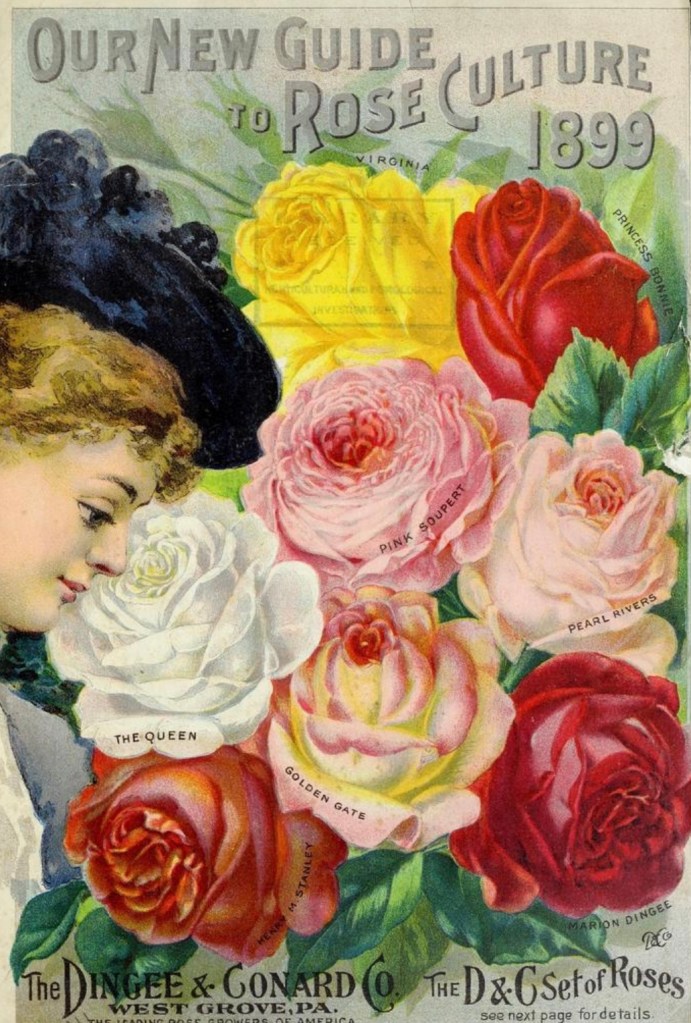
The “At-Home” tea menu is described in a book called Consolidated Library of Modern Cooking (1905) ” The menu may include… Tea & Coffee or Tea & Chocolate…2 kinds of Dainty Sandwiches, baskets or plates of Fancy Cakes…a dish of fine Bonbons…& that Bouillon, Oysters, Salads, Ices, Fruit, etc. are not expected”.
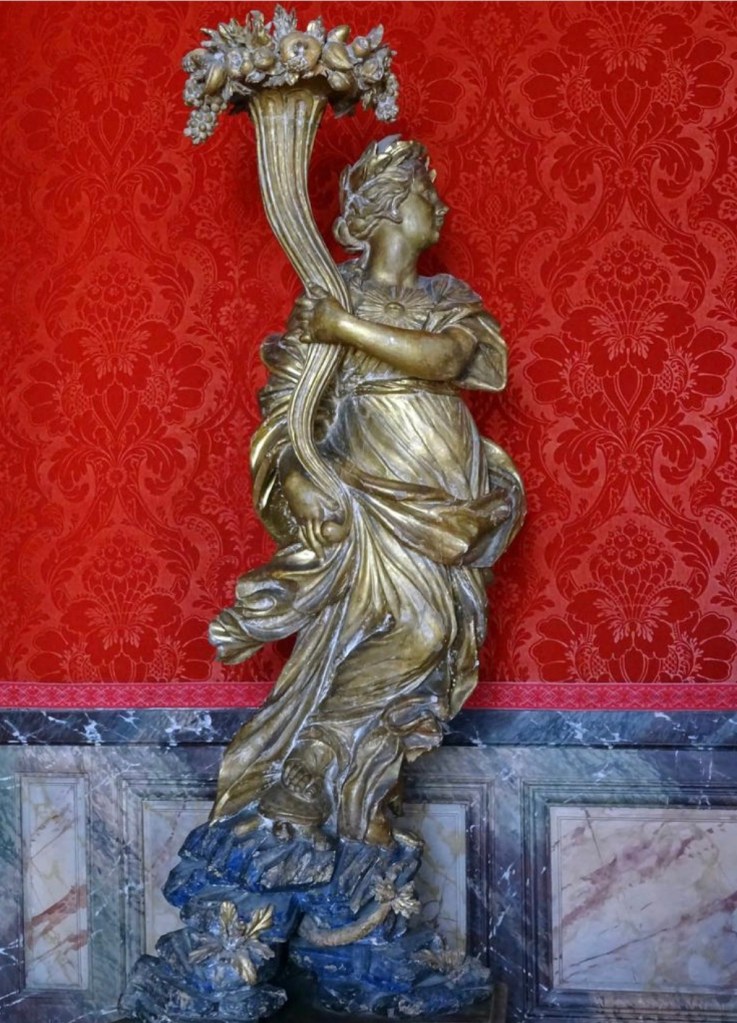
Victorian Calling Cards (Invitation to a “At-Home tea)
High Society ladies had “At-Home” cards or “Calling Cards” printed up on fine stationary stores. These “At-Home” cards were the invitation to the “At-home” tea event. They would have their name printed in script or cursive writing in the middle of the card. Usually these cards were printed by a professional printer; but sometimes I have seen hand-written calling cards on a thick card stock with a embossed border (like a table name card) .
These very small little “calling cards” were about 2 1/2″ x 3 1/2 ” in size. The left bottom side of the card – was the day of the week (“At-home” day); with their host’s address on the right side of the card. “Mrs. Astor’s At-Home” card had a blank line underneath her name – to write in the date of the “At-Home” & the time “at ten o’clock with RSVP & her address “842 Fifth Ave. NYC on the bottom of the card. Sometimes, the calling card would say “1st Tuesdays 5-7 pm”, meaning every 1st Tuesday of every month, that person would host an “At-Home” tea at their home. Look at my blog, titled Calling Cards, to see some of the Huntington Family calling cards & more details.
The hostess would usually host a “At-Home” tea between 4-6 pm or 5-7pm; tea & cakes were served. It is my guess that Mrs. Arabella Huntington served a lot more then “tea & cakes”. She was kind of the Martha Stewart of her day. At her fancy tea parties & at-homes, most-likely they were often over the top, especially in the New York Huntington mansion. Mrs. Huntington served lots of variety: 5 kinds of tea sandwiches & 5 kinds of cookies and biscuits, etc. Sometimes, Mrs. Collis P. Huntington’s (Arabella) her “entertainments” were catered (probably the Palace Hotel) & some were not. Any Huntington Mansion on Nob Hill San Francisco ephemera has been destroyed by the San Francisco EQ-Fire n 1906.
We do know how Mrs. Arabella Huntington did entertained in New York City mansion: No 2. E 57th street New York City- Huntington mansion:
On Sept. of 1919, Mrs. Henry E. Huntington (Arabella) hosted a “At-Home” on Tuesdays, probably once a month (maybe once a week) tea party. The kitchen staff & Head Housekeeper ordered these items from her local gourmet market: Tilford & Park in NYC :
Mrs. Arabella Huntington would have 5 kinds of Tea Sandwiches: (Chicken salad, Egg salad, Cucumber& Dill, Roast beef, also Bread & Butter Sandwiches)
Cream Scones or Buttermilk Biscuits with Raspberry Jam or Lemon Curd or San Marino Ranch Orange Marmalade,
Crackers & Cheese: Saltines & water crackers, American sharp NYC cheddar cheese, McClarens (Canadian whipped French Roquefort cheese or sharp cheddar cheese,)
Desserts & Sweets: petit raspberry tarts, lemon curd tarts, Petit pecan tarts or tassies,
Tea Cakes: sweet cakes & pound cakes (apple cake, lemon cake with lemon frosting, Cinnamon Spice cake, Almond cake, rum cakes, Vanilla cake & chocolate frosting,
Small plum puddings with hard sauce, Orange & lemon puddings made with Bromangelow, Small mincemeat pies.
Cookies or Biscuits 5 different kinds of tea cookies: (French H &P Petit Buerre, 2 pkg. 5 o’clock tea biscuits, 2 pkgs, Butter thins, 1 pkg. “Social tea” cookies, 2 pkg. American vanilla wafers (invented in NYC in 1898), 1 box Osborne biscuits, 1 box Wheatena biscuits, American Lorne Doone square shortbread cookies (invented in 1912) , or English biscuits (cookies), Orange & lemon puddings made with Bromangelow. Document : HEH Collection MS 38/11 (HEH Household bill NYC) at San Marino, CA
Mrs. Arabella Huntington had some very successful “At Home” receptions in her Huntington Mansion on California Street on Nob Hill in San Francisco, CA. Sometimes, she had 50 or more people to her “at-homes” with very interesting people invited.

An “At-Home” reception might have been a small or large gathering of friends or acquaintances. The “At-Home” tea gathering could be located in the Drawing-Room, Parlor, the Salon, or Reception Room and/or the Dining-Room to serve the tea. The Collis Huntingtons had a marvelous “Reception Room” in their Nob Hill mansion with “pocket doors” in the middle. The get-together could start small in a more intimate room (smaller Drawing-Room) & when more people arrived they would open the pocket doors to display another large room so more people would fit comfortably – a brilliant entertaining technique.

While I was researching the Huntington family’s history, I was reading Caroline Huntington’s [Holladay] diaries at the Huntington Library in San Marino, CA. She was Collis & Arabella Huntington’s niece & Henry E. Huntington’s favorite sister. She mentions “Belle’s At-Homes” several times in her diaries. As a young girl, Carrie Huntington, would write in her journals depicting the lives of all the Huntingtons in San Francisco, CA. In the 1890’s, the whole Huntington clan lived in San Francisco. Collis married to Arabella Huntington, Henry E. Huntington & his 1st wife Mary Huntington, Archer Huntington sometimes in SF, CA ( because he was in college at this time period).
Carrie also talked in her journals about great travel adventures the Huntingtons had; while taking train trips together across the United States of America. They left New York City in the Spring, they visited exciting southern cities like New Orleans and Savannah. Also traveling west on the private train car: Atlanta, Texas, Phoenix Arizona, Los Angeles & San Francisco CA . Uncle Collis & his clan also sailed the whole family to their “Grand Tour” in Europe on Cunard ships. They visited Paris, London, Italy & Spain.
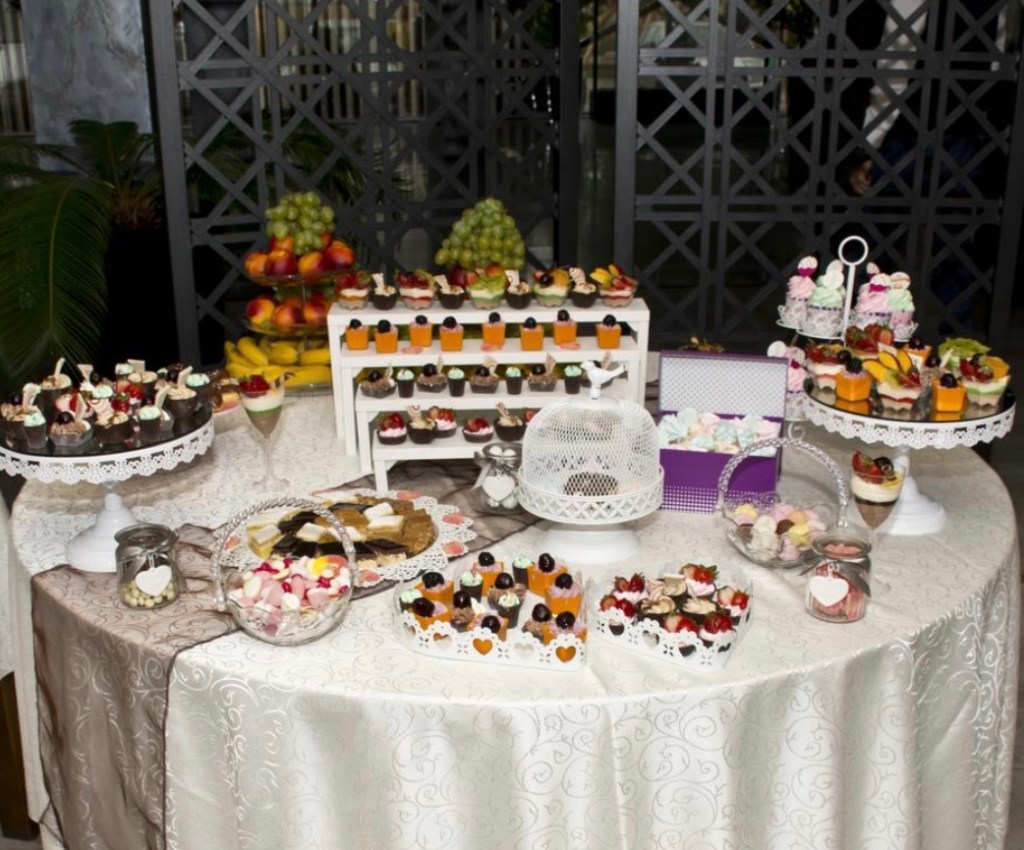
Carrie Huntington also wrote about “Belle’s At-Homes” in San Francisco, CA in her journals & diaries. So Mrs. C. P. Huntington “Arabella” or (nicknamed “Belle”) hosted many “At-homes” receptions at her various Huntington mansions.
In 1879, San Francisco Social Directory, it states that Nob Hill’s “At-Home day” were Tuesdays & Carrie’s journal entry’s are also on Tuesdays. It would have been fun for Belle to entertain in her newly renovated mansion at 1020 California Street on Nob Hill in San Francisco, California. When Collis & Belle Huntington lived “In-Residence” at the Palace Hotel, their “At-Home” day was Mondays. Like all the other hotels, that was the day one visited friends staying at a hotel.

Carrie Huntington wrote in her diary: On Tuesday, Feb. 28, 1894, it was Arabella “Belle” Huntington 1st at-home; meaning the Huntington arrived in residence in February. I’m guessing, 1st at home of the season for Belle, I’m not sure. Carrie writes, “A lot of people called. In the evening, Edward [HEH’s] had a birthday [party] which I attended [HEH & Mary Huntington’s Jackson Street, San Francisco, CA] & won the incher [Game] prize. Mr. Ellicott & take [took] me up there. I spent the night as it was late when the party was over.”

Arabella Huntington’s niece, Caroline “Carrie” Huntington wrote the next month at the same Nob Hill location: “Tuesday, March 7, 1894 San Francisco, CA “Belle’s Day At -Home, about 50 people called among others were Miss Bourke [Miss Maude Burke, niece of Horace Carpentier & his $20,000,000] , Prince Poinotonski, [Chas. Casimir Poniatowski] & Haralamant [in charge of the World’s Fair Expo 1894 in San Francisco & located at the DeYoung Golden Gate Park] – the Great Sensations of the Day.”
In the 1890’s, the French claim to have started this clever tea tradition of “Chez Soi” (At-Homes). This being a French word, meaning a cup of tea & conversation on a certain day of the week. Parisian women would pick a day of the week to meet in their “Salon” (Drawing-Room), or at a teahouse or fancy hotel like the Paris Ritz.
Wealthy Americans traveling abroad in Europe brought this tradition back home to America especially spreading to New York City & San Francisco. An “At-Home day, tea gathering was usually from Monday to Friday. On their “At-home” day, the hostess was expected to be at-home to receive her guests. In the 1890’s to 1920’s, the society register(s) of America, actually listed the family’s “At-Home” day of the week, next to their name, address, summer homes, & social clubs.
The tradition of “At-Homes” teas, large & small is explained in a interesting book. It was called Manners & Rules in Good Society by a member of aristocracy written in 1923, published in London & New York. At a large “At-home” the gathering is located in a Drawing-Room or Parlor; the tea & food is served in the Dining-Room. The large “At-home” entertainment could be up 50-200 people. “At a large “at-homes” the hostess should receive her guests in the Drawing-Room door, & shake hands with each on arrival…the guests should arrive from a quarter-past four (4:15 pm) until half past five (5:00 pm) or six o’clock (6:00 pm)”.
“When tea is served in the Dining-Room, the guests are usually asked by the servant in attendance if they will have tea before ushered into the Drawing-Room.” Food consists of “tea & coffee, the latter served from large silver urns….sherry, champagne-cup, claret-cup, ices, fruit, fancy biscuits [cookies] & cakes, thin bread-&-butter [sandwiches], potted game, [tea] sandwiches, etc. Ice plates are used for ices, desserts for fruit & fruit salads.”
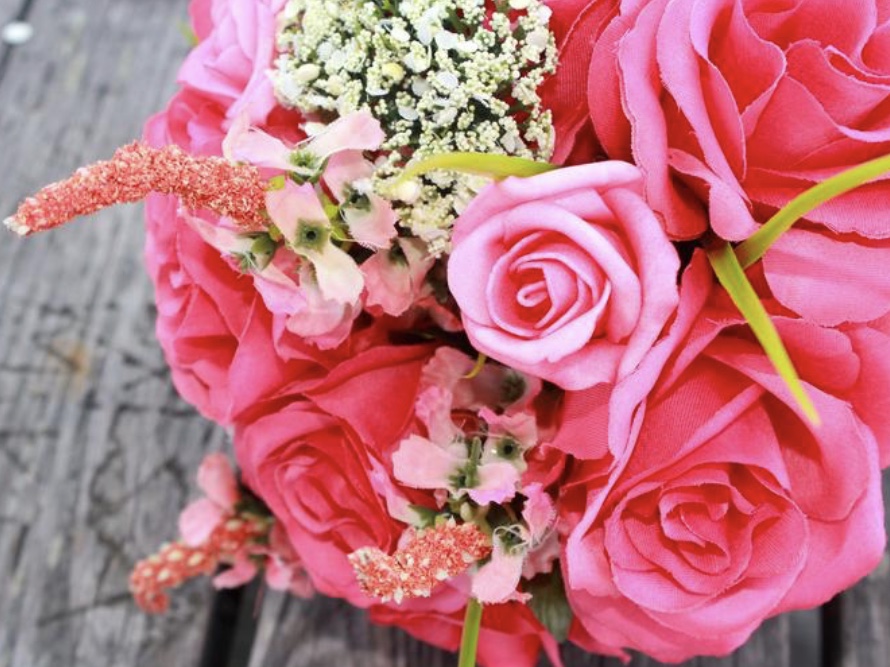
The Huntington’s Nob Hill Dining-Room could have been filled with all sorts of wonderful dainties. Some foods that Mrs. Huntignton always had a her tea parties was Jordan Almonds, Virginia Peanuts,& Chocolate French BonBon Candies served in special BonBon sterling silver bowls. Sometimes, a punch might have been served like “Punch Californian” or Huntington Roman Punch.

Punch Californian (1907)
I first saw this refreshing punch on a 1907 menu for the Merchant Club of San Francisco, which the Huntingtons were members of. The club was helping rebuilding the great city of San Francisco, California after the devastating Earthquake/Fire of 1906. This recipe is adapted from the 1907 rare book of Henry E. Huntington’s at the Huntington Library in San Marino, CA. It was called Paul Richard’s Book of Breads, Cakes, Pastries, Ices, & Sweetmeats.
3 qt. Water
2 c. Lemon Juice
2 c. Pineapple, grated
1 qt. California white wine
1 c. Orange juice
rind of 2 Oranges
1 pt. Brandy
1 qt. Orange sherbet or orange sorbet
Mix the water, wine, fruit juice & juices. Freeze in a plastic pitcher. Add to punch bowl, with minced spearmint, & brandy. Just before serving, add orange or sorbet. Make 5 1/2 qts. Recipe: Nancy Armitage

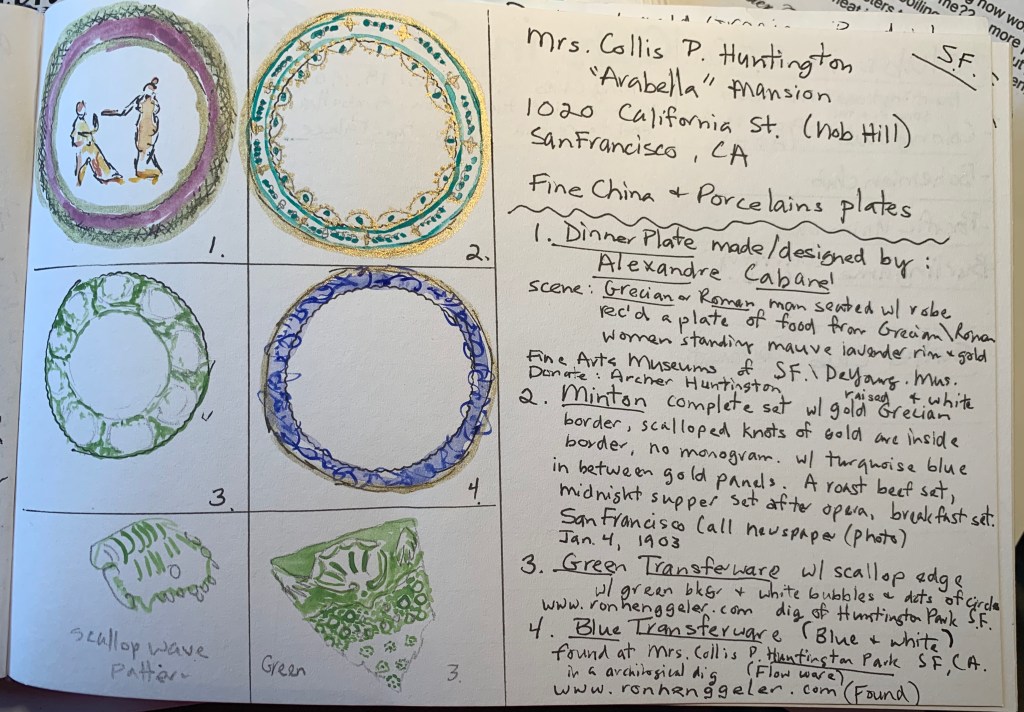
A San Francisco Call newspaper article titled: “Monogram Minton a China Craze” tells us about Mrs. Arabella Huntington’s extravagant purchase. I thought it was humorous that this information was written in the newspaper, but it was the sign of the times…. “Mrs. Will Crocker also has a complete Minton set. It has an ivory tint with a raised gold Grecian border. Scalloped knots of gold are inside the border & they break the rigid effect. She has no monogram. This set is the 2nd one ever made after this particular design, the other one being ordered by [Mrs.] Collis P. Huntington[Arabella]. Talk about one-of-a- kind purchases, actually only two set made in the world. Also, Mrs. Arabella Huntington got the full set: meaning Roast Beef Set, Breakfast Set, Midnight Supper Set (after the opera). Wow. She had sets of plate ware with 60 and more plates for larger entertainments.

We know that Mrs. Arabella Huntington owned numerous amounts of Blue Transferware & Green Transferware. I was so excited when I actually found the pattern name of this English Green Transferware! It is called Old Spode/Copeland & Garret: “Green Lily” (with the rim of scallop shells & bubbles & dotted flower motif). This pattern is dated 1830, & colors are a mixture of green: sap green is the dark & celadon green is the light & white background. It was used at Collis & Arabella Huntington’s Mansion on Nob Hill in San Francisco, CA.
We know this information because of a man named Ron Henggeler (a photographer) in San Francisco. He was in charge of a amazing archaeological dig at the former site of Arabella & Collis Huntington’s mansion on Nob Hill, San Francisco, CA. Ron & his crew dug up rocks, fine bone china plate bits, & placed them in large pickle jars. He photographed them & placed this information on his website about Collis & Arabella Huntington & their San Francisco mansion. His photographs gave me enough information to find one of Mrs. Arabella Huntington fine bone china plate patterns! I am so excited!! Below, because of Ron’s information, I found one of the Green transferware platewares– that was owned by Mrs. Arabella D. Huntington!

The Huntington’s Nob Hill Mansion land is now called “Huntington Park” in San Francisco. The property (a whole city block) was donated by Mrs. Arabella D. Huntington herself to the City of San Francisco in 1915. Sadly, after the Huntington mansion was completely leveled in the great San Francisco EQ/Fire of 1906.
Mrs. Arabella Huntington also had a great affection for French Sevres porcelain plateware. At her San Francisco mansion, she also had gold Sevres knives (blue, white, & gold) with birds & roses on them. I assume she probably had a Sevres set of plates (blue, white & gold) to match these gold knives with birds & roses. The knives were found at the Fine Arts Museum of San Francisco, donated by Archer Huntingtonin 1925 (a year after Arabella Huntington died).
I feel that the Huntington’s did their most lavish entertaining at this Huntington mansion. It was the Gilded Age at the time and San Francisco embraced Mrs. Arabella Huntington. Collis and Arabella Huntington also host their largest entertainments there at 110 guests in the Picture Gallery/Ballroom.
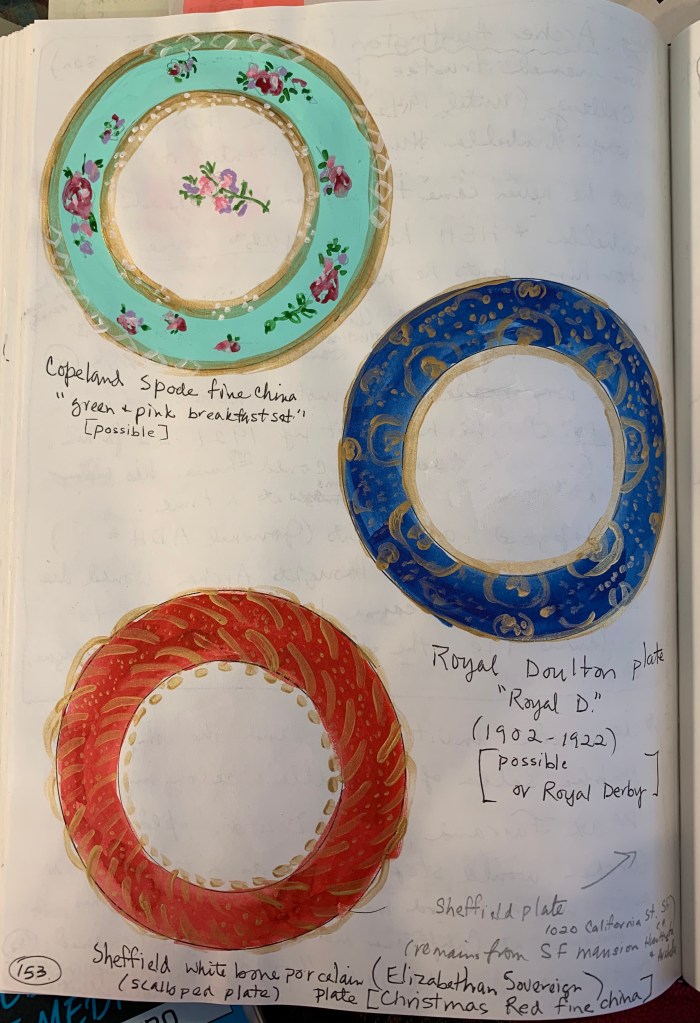
A 5th set of Sevres blue gold & white plateware seems obvious that Mrs. Arabella Huntington would have to match these beautiful Sevres gold knives (below). A 6th set of English Sheffield plates at the Huntington Nob Hill mansion could be fancy red & gold set (check illustration).

Gilded Age “At-Home” Tea Menu
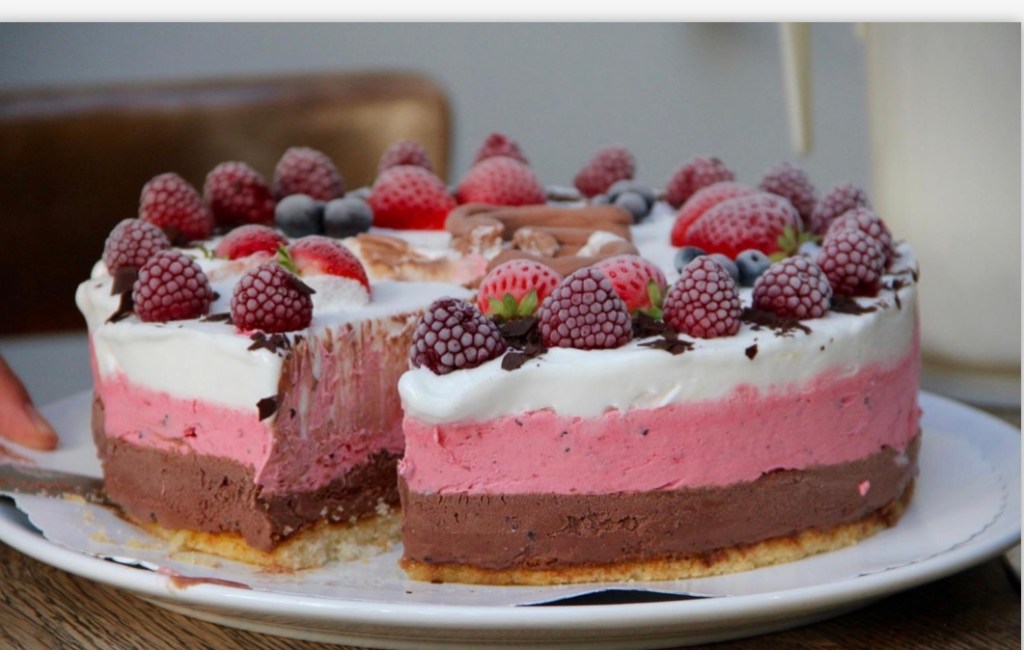
Canapes would have been served by the Huntington’s “waitresses”, (kitchen maids). Popular canapes in 1890’s were Canape Lorenzo (a spicy crabmeat bite) & Sardine Canapes. Hot Chafing dishes filled with Lobster Thermidor or Oysters au Gratin. Gorham or Sheffield silver trays filled with Tea sandwiches, made of chicken salad, egg salad, minced ham; “Bread & butter” sandwiches was popular at the time. Also, English cream scones with Chantilly cream or Southern Buttermilk beaten biscuits. Served with orange marmalade, lemon or orange curd or raspberry jam. A 1890’s dessert table could have had numerous tea cakes & treats, like “Gateaux” French cakes, Petit tarts, Rum Cake, Southern Pecan Tassies, French Petit Buerre Sable (cookies), & French Opera Cakes, & French Chocolate Bonbons (Chocolate Truffles).
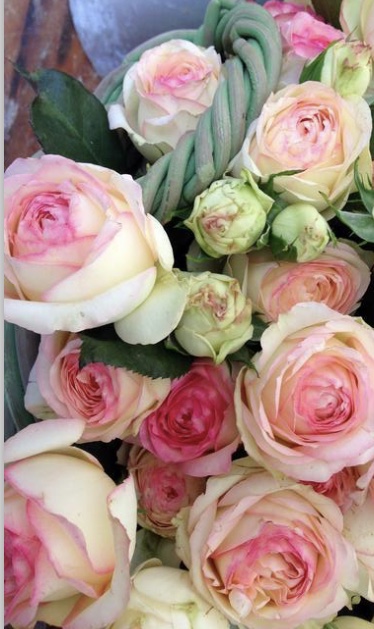
Canape Lorenzo (1890’s)
This fancy crabmeat canape was a San Francisco tradition. Often, seen on the menus of fancy hotels in San Francisco, like Hotel St. Francis & Palace Hotel. In the 1880’s and 1890’s, Collis & Arabella Huntington actually lived “In-Residence” at the Palace Hotel; when they came to San Francisco for business & renovating their Nob Hill mansion.
My mother used to make a ladies luncheon entrée that was similar to this canape. Instead of the bread, she used a English muffins. She added minced celery, onion, green pepper, & scallions to the mix. Then smear all ingredients, with mayo & crabmeat on English muffin. Dust with parmesan cheese & broil until hot & bubbly. Adapted from a recipe in one of Mr. H.E. Huntington’s rare books (Huntington Library San Marino, CA) called Hotel St. Francis Cookbook (1915), I used mayonnaise instead of the cream.
2 shallots
1 onion
3 T. flour (omit)
2 cans Crown Prince crabmeat
baby chives
3 T. butter (omit)
1 1/2 c. heavy cream or mayonnaise
Season with white pepper & cayenne pepper
top with parmesen cheese
12 white bread slices & make small rounds with cookie cutter.
Make bread rounds by pressing 1″-2″cookie cutter into white bread. In a medium bowl add crab mixture. Spread crab meat mixture with a baby spoon on bread round. Top with parmesan cheese. Place bread rounds on cookie sheet. Bake 450 for 15 minutes until the bottom of the bread is toasted in golden brown. Place hot canapes on a doily lined silver tray & pass around to guests. Remember to have cocktail napkins.
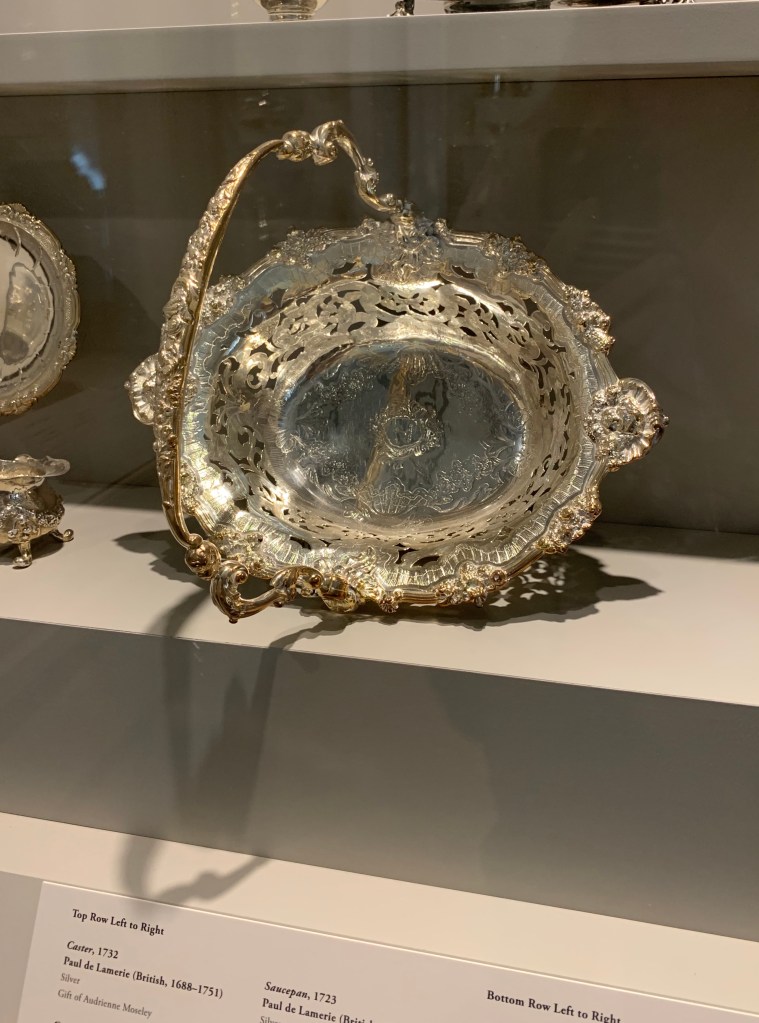
In the 1890’s, “At-home” receptions were also popular in England, France, & America. But in America, the tea menu could be quite extensive. In England, the tradition started as just “Tea & Cake”; but in America Gilded Age, these reception teas became quite elaborate. Heartier hot dishes were provided for guests (gentlemen were invited) such as Lobster Thermidor, Tuna a la King, & Shrimp or Lobster Newburg.

Lobster Thermidor
This is a adapted recipe from one of Mr. H.E. Huntington’s rare books at the Huntington Library San Marino, CA. It is called Hotel St. Francis Cookbook (1919). Chef Victor Hirtzler states “cut a live lobster in two lengthwise, sprinkle with olive oil, season with salt & pepper put in oven & bake”. This passage made me laugh, I kept thinking a lobster with 6 legs & 2 big lobster claws trying to bite & claw me. A more practical way is pop the 3 (1 1/2 lb.) live lobsters in boiling water & cook for 8-10 mins or until the shell turns bright red. Take the cooked boiled lobster out of water, let cool, & cut lobster meat into pieces.
Lobster Thermidor Sauce
4 shallots
2 t. parsley, minced
2 t. French tarragon, minced
1 t. beef stock, cube
2 t. dry Colemans mustard, dry powder
1 c. (Aunt Penney’s) white cream sauce or make a roux
1/2 c. butter
good meat gravy or sherry
paprika
grated white cheddar or parmesen cheese
In a casserole, add a little white sauce to the bottom, then place cooked lobster shells. Add cut up lobster meat to the shells. Pour the rest of the sauce on top. Sprinkle cheese on top. Broil until golden brown & bubbly. Recipe: Nancy Armitage

Document:
HEH Coll. MS 1210 (Caroline Huntington’s Journal; San Francisco Nob Hill At-Home (1894)
San Francisco Call Newspaper Volume 93, Number 35 (B/W photo of the fine bone china of Mrs. Collis Huntington’s.
Book: Hotel St. Francis Cookbook (1919) by Chef Victor Hirtzler
Book: 1879 San Francisco Elite Directory
Article: “Golden Gate bridge fast facts” by CNN Library CNN US
Book: Stephens, Autumn, The Essential Handbook of Victorian Entertaining, San Mateo, CA Bluewood Books, 2005
Book: Manners & Rules of Good Society by a member of the Aristocracy London Frederick Warne & Co.Ltd and New York 1923


The story of the Huntingtons is engaging and on many levels an important part of the fabulous gilded age in America. Abe’ doesn’t miss a beat and draws you in to incredible lives long lost.
LikeLike
Dear Someone, Thank you so much for your kind comments, I so agree. Best Nancy
LikeLike
Very interesting. Thank you for sharing
LikeLiked by 1 person
Thanks Nina, I ‘m so glad you enjoyed the story! Much appreciated Nancy
LikeLiked by 1 person
Nanc, Thank you so much for such an in depth look into our local history. So nice to escape into another universe!
LikeLiked by 1 person