

By Nancy Armitage
At the Collis & Arabella Huntington’s Mansion in New York City, they had many “Entertainments”. It even stated it in Architectural Record 1903 Magazine that the Huntingtons had a “State Dining-Room” (a room used to entertain presidents). Collis P. Huntington hosted many Gilded Age multi-course fancy dinner banquets. Their Huntington’s mansion address was No. 2 East 57th St. New York City, NY (& 5th Ave.) affectionately called “No. 2”. Some elegant dinners the Huntington’s hosted for the top executives of his numerous train & ship companies; one particular business dinner for Southern Pacific Co. menu is preserved at the Huntington Library in San Marino, CA. These unique intimate dinners were Collis’ way of having his executives & wives gather & break bread. Mr. Collis P. Huntington, or “C. P. ” they called him. It could be said of him that these dinners were his way of mixing business with pleasure.

Mr. Collis P. Huntington, was the President of the Southern Pacific Co. He was one of the railroad “Big Four”, (Huntington, Hopkins, Stanford and Crocker) who helped build the Transcontinental Railroad. Collis was a driven businessman & railroad man. Helping the economy of the US; in 1869, meeting two railroads together: the Union Pacific RR & the Central Pacific RR in Utah. Creating the ability for America to be linked from coast to coast. He was the founder of Central Pacific Railroad Co. running from New York City to Utah. CPRR became the Southern Pacific Co., based in New York City and San Francisco, CA.
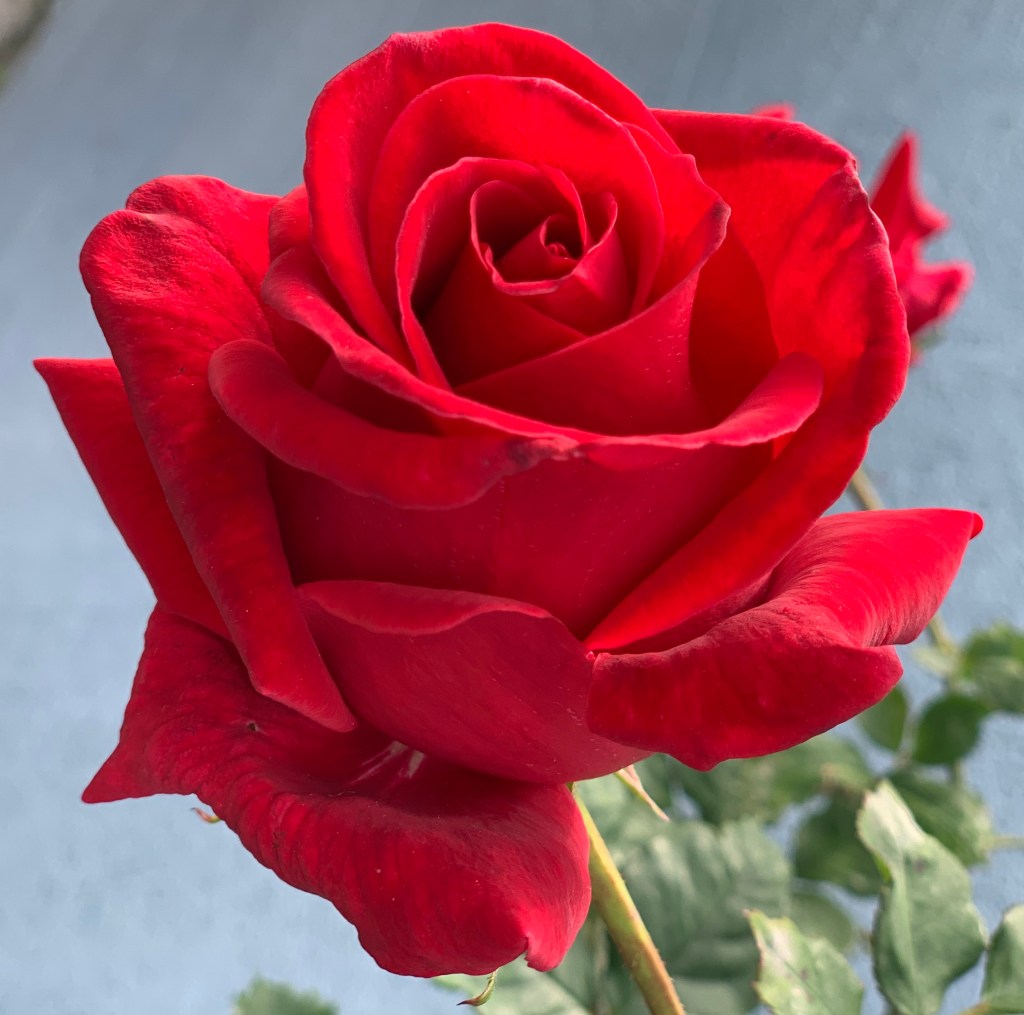
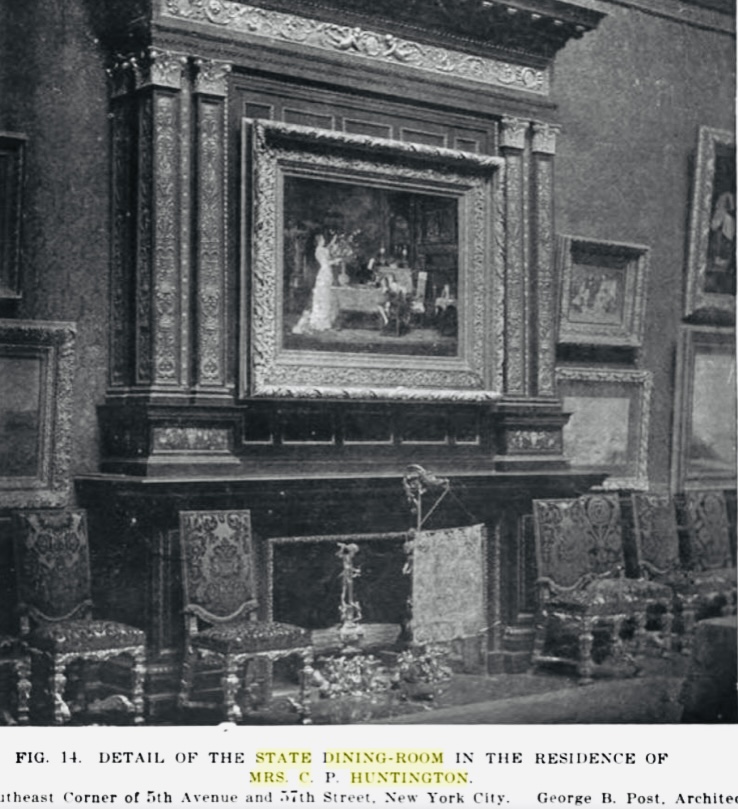
In the Huntington’s New York City mansion, they had 2 formal Dining-Rooms: one was for fancy banquet dining for larger amounts of people & the smaller one was a family dining-room. The fancy State Dining-Room (pictured below) was also called the “East Salon”. This was documented in the Architectural Record Magazine in 1903. It described & photographed of Mrs. Collis P. Huntington’s labeled it “State Dining Room”. It should be noted that in 1900, the only other mansion in the United States of America that had a “State Dining Room” was the White House. Where the President of the United States lived in Washington, DC. The Huntington’s “State Dining-Room” was a formal dining-room with a salon-style art gallery filled with master oil paintings. The dining table could fit up to 24 dinner guests. Red Roses would have been appropriate flowers for the special dinner party. The Huntington’s favored “American Beauty” red roses in very large arrangements with 100-300 of roses. Full fragrant flower arrangements, like the foyer of fancy hotels.
The “State Dining-Room” intrigued me to investigate more. What made it a State Dining-Room? Who did the Huntington’s entertain there. There were 3 U.S. presidents who would have dined with the Huntington’s. There was President Ulysses Grant (Grant was in office when the Transcontinental Railroad went thru in May 1869); it changed the course of American history linking the US from coast to coast; Collis Huntington & Grant had many letters of correspondence between them. President Taft (C. P. Huntington helped start to build the Panama Canal; Taft & many others were trying to get the Panama Canal finished. Finally in 1915 the Panama Canal was finished with the help of so many people; another great thing for the commerce of USA; very important to Collis Huntington & his Mexican Railroad. We know that the Huntington family dined with the President of Mexico, President Diaz in 1890’s. We know President Theodore Roosevelt knew Collis Huntington, a fellow New Yorker. There is a photo with C. P. Huntington & Roosevelt what looks like Huntington’s Camp Pine Knot in Adirondack Mts. in the Roosevelt archives. We know that Roosevelt helped Huntington get the Racquette Lake Railroad built in the Adirondack Mountains. In 1903, the White House was being renovated, where did they have formal state affairs at that time?

Collis Huntington relied heavily on his wife, Arabella, her tastes & style of entertaining. Mrs. Arabella Huntington took care of everything: handwritten invitations, gourmet food, handwritten menu by Tiffany & Co., elegant table linens, & fancy dinnerware & flatware, the guests’ every need. She was a Southern Belle, after all & tablescapes at her dining-room table were important.
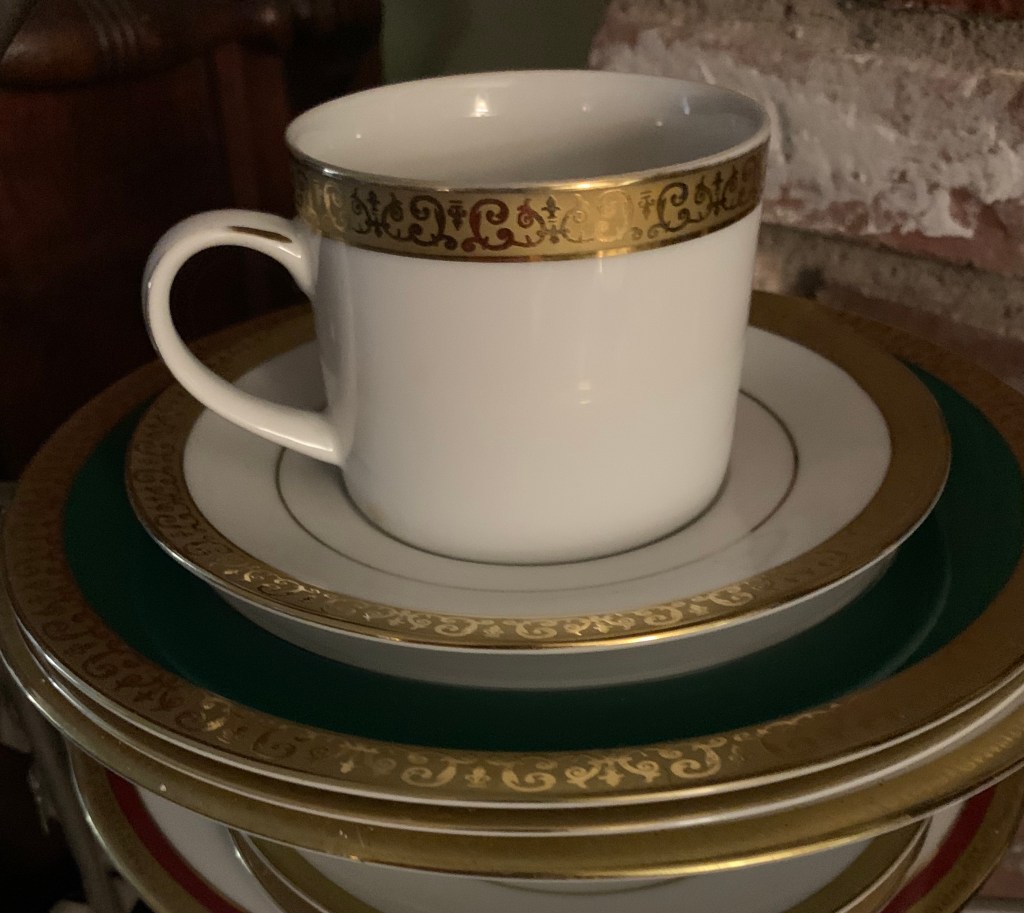
Arabella loved to decorate in the French style of Louis XV & Louis XVI with fancy brocade (green damask or brocade) fabric. Mrs. Huntington adored Queen Marie Antoinette & royal. She loved everything French; one of her favorite places was France. She & Collis sailed to Europe annually & traveled to Paris. Her first transatlantic trip was in the 1870’s. They shopped for French furniture, French antiques, French paintings by Boucher & Fragonard, & enjoyed French food. During these trips, Arabella absorbed & brought her ideas back to America; French influences that later showed up at the Huntington’s dining table & her elegant dinner menus. It was easy for her to have her menus translated from English in French (which was in vogue at the time), she spoke fluent French. She purchased many French fine porcelain dinner plates sets; she especially loved elegant Sevres, Haviland, Old Paris, & Limoges porcelain plates.
At the time (1900), it must be noted that the formal luncheon & formal dinner menus were all written in French. This was the tradition of the time period. These Huntington menus themselves were works of art. Each menu & name cards were individually hand printed/painted in fancy calligraphy & sometimes illustrated by Tiffany & Co., NYC. Written in 1900, this menu I found with beautiful calligraphy, most likely by Mrs. Huntington’s social secretary & friend, Miss Carrie M. Campbell. That was part of her job for Mrs. Arabella Huntington.
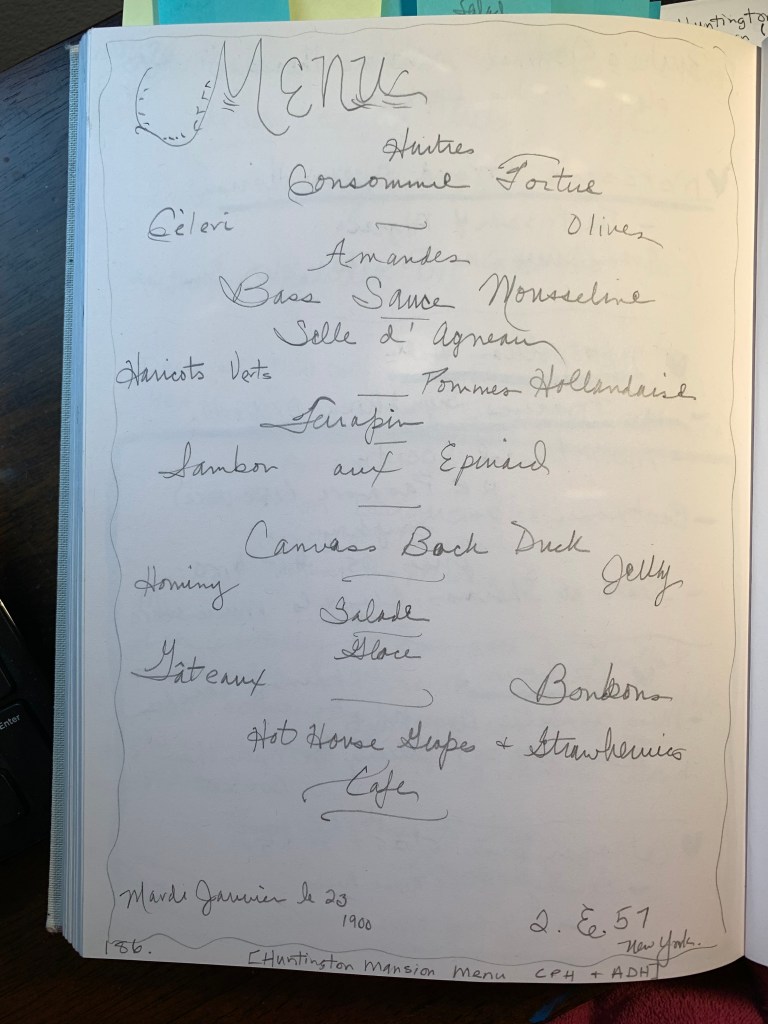
The “East Salon” was the Huntington State Dining-Room & Art Gallery that also housed some of C. P. Huntington’s favorite paintings; Collis called his paintings “pictures”. Per the seating chart for this elegant dinner, the banquet table was set up in a long rectangular shape. According to the seating chart: the 20 guests were seated along both sides of the long table with two place settings at each end. Mr. Collis P. Huntington, the host, sat directly in the middle, across the table from his stepson, Archer Huntington. H. E. Huntington, Collis’ nephew, (who worked at the Southern Pacific Co. & was “Secy. to the President”, Collis Huntington) who sat at one of the ends of the table.

Who was invited to this elegant entertainment of the Huntingtons? On the back of the fancy menu card was the seating chart for this gentlemen-only affair. The list of 22 men invited to this intimate dinner on January 23, 1900: W. West Durant, T. H. Hubbard, Levi P. Morton or Merton, A.M. Huntington (Archer), Mr. Huntington (CPH), D. O. Mills, H. E. Huntington (HEH), Lynde Harrison, J. E. Gates, A. B. Hammond, Geo. H. Sargent, Chas. H. Tweed, Wm. E. Dodge, General Ian Thomas, Jno [John] G. McCollough, Edward King, John MacKay, Whiteton Reiel, Edmund Giles, R. T. Wilson, Geo. Baker, & Jas. Speyer.

In the The Huntingtons “State Dining-Room” in NYC, the colors were green & gold. Which was a brilliant idea of Mrs. Arabella Huntington. Green (Sage, Forest, or Celery greens) match every season of the year: Winter, Spring, Summer, & Autumn. These things are important to a hostess trying to make her tablescape beautiful. So her green velvet chairs & green drapes would mingle great with the gold crystal glasses & lovely porcelain French plates & seasonal decorations.

Both Arabella’s southern & French influences were apparent in the formal dinner menu (in French) for the banquet on Tuesday, January 23, 1900. It appears from the menu, that a 10 multi-course dinner was served “Service a la Russe” (course by course). The first course, as always started with “Huitres” (Oysters on the Half Shell, probably with a mignonette sauce.) The second course, a soup course, was a Consommé Tortue (a clear turtle soup – recipe below). This oyster course would probably have been served on fine gold & white Limoges Oyster plates. Often, with the soup course, a relish course was served on the fancy table made up of “Celeri” (Celery Sticks maybe with McCaren’s Roquefort spread), Olives would be Queen Olives, & “Amandes” were Roasted salted Almonds.
The third course, usually a fish course was Bass, Sauce Mousseline usually accompanied with a Sauterne White Wine. This was a fish dish in a fancy molded creamed mousse. The fourth or entrée course was Selle de Agneau, a roasted & salted Leg of Lamb with Haricots Verts (French Green Beans). Usually, the main or entrée was served with French Champagne. The Roasted Lamb was also served with Pommes Hollandaise. I have researched the unusual “Pommes Hollandaise” using Hollandaise sauce & cream (recipe below). It is similar to French Gratin Dauphinois with garlic or American Potato au Gratin dish (using Hollandaise sauce instead of heavy cream).
The fifth course, Terrapin (a turtle or chicken stew), a food choice veered toward Arabella’s southern sensibilities. It may have been cooked like the popular Terrapin a la Maryland, with rich flavorful white wine cream sauce with mirepoix of vegetables. The next or sixth course, Jambon & Epinard, (an Arabella Southern-influenced dish that was diced ham with spinach) was the vegetable course.
The game or 7th course was a Canvas Back Duck served with Hominy & Jelly. One speculates the hominy (a southern dish), probably had Orange Jelly (made with sherry or champagne) accompanied it. I found a recipe for “Hominy casserole” dish consisting of hominy/corn, sour cream, diced green chiles, Monterey Jack cheese, & topped with parmesan & parsley or baby chives. The entrees were usually served with a Victorian Claret red wine in fine claret crystal glasses. Arabella collected numerous kinds of crystal glasses (etched glasses from Tiffany & Co., Venetian gold glasses, & English crystal, too.)
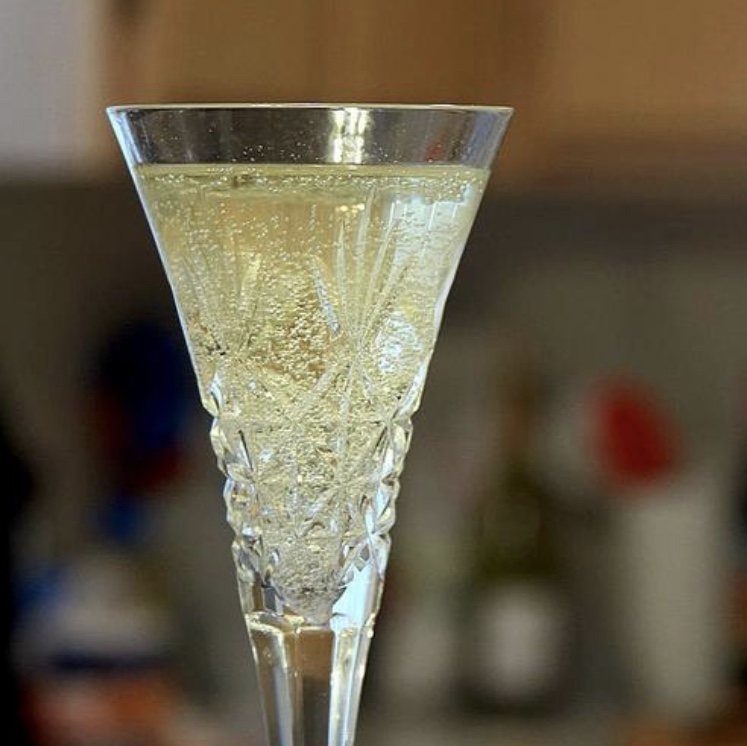
In the French style, the Salade, the 8th course was served after the entrees. The menu does not state what kind of salad but the Huntingtons often served: Waldorf Salad or Chiffonade Salad, (a French chopped vegetable, lettuce, & French herb – arugula salad with French artichokes & hearts of palm) maybe with Roquefort cheese & crunchy French garlic croutons). Served with a lovely French Vinaigrette Dressing of oil, champagne vinegar, Dijon mustard, garlic, salt & pepper. Sometimes with French herbs added like French tarragon, thyme or baby chives.
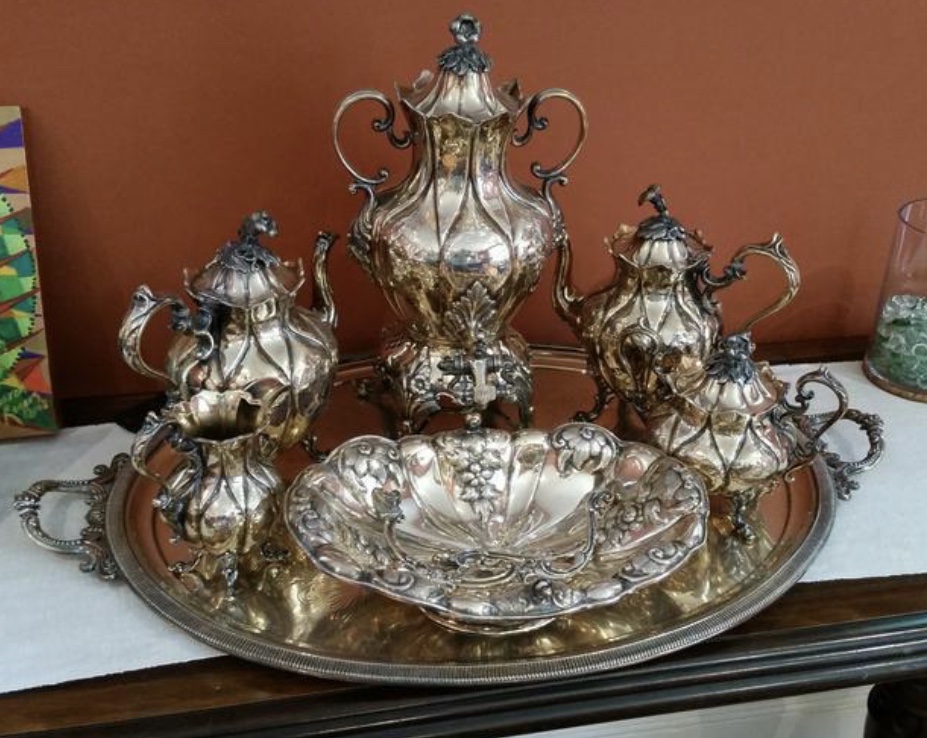
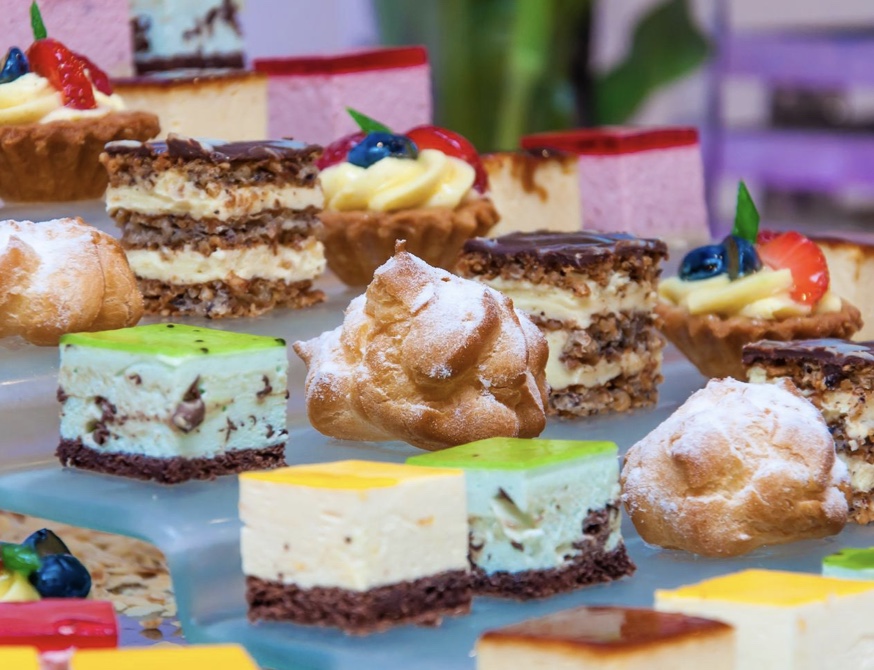
An array of tantalizing desserts was the 9th course, which was splendidly served using the Huntingtons collection of Gorham silver, and Sheffield and George III silver pieces. She had many choices of fine porcelain French plate ware like Sevres, Haviland and Limoges. The numerous desserts tempted the Huntington’s guests by the abundance of sweets. The Huntingtons often served “Gateaux” in French means French cake. French tea cakes are sometimes called “petit fours”, little squares of cake with royal icing or chocolate ganache, tarts, Glace (fancy shaped ice creams), & Bonbons. Bonbons are fancy French chocolate truffles or peppermint truffles (many were purchased for the Huntingtons No. 2 57th St. NYC address from confectionery receipts from Huylers candy shop). Hot Coffee was served with Hothouse Grapes & Strawberries that ended this multi-course dinner. A glass of cognac or after-dinner liqueurs could have been an accompaniment, most-likely served in the Louis XV Drawing Room (Angels) or the larger “Reception Room” while listening to music, or poetry.
Once the culinary part of the Huntington banquet was completed, the evening took on an artistic direction. First, there would be business speeches, after a leisurely tour of the Huntington’s 5th Avenue Mansion & C. P. Huntington Library. Mr. Huntington would offer his guests a tour of his impressive library of books (technically next door at 4 West 57th Street but attached to the Huntington Mansion). The Huntington’s had a prominent collection of paintings, they called the “Picture Gallery” he owned Rembrandt, Hal, Peale, & many other famous master painters. Brandy & Cigars would conclude the gentlemen’s delicious & productive evening.
Potage a la Tortue (Green Turtle Soup) Recipe
These recipe ingredients are from the notebooks of Aldolphe Duglere, the famous chef:
1 qt. green turtle meat, canned or cooked chicken
1 qt. chicken stock
4 carrots, cubed
1 turnip, cubed
1 qt. veal consomme or beef
2 c. Madeira wine
1 small cabbage
salt and pepper
2 t. Amontillado sherry
1 bouquet garni of herbs (basil, rosemary, savory, thyme, parsley & marjoram)
1 bouquet garni (peppercorns, coriander seeds, & garlic
To a stockpot, add all ingredients except sherry. Heat until turtle meat is cooked, about an hour. Serve in pretty fine china bones with two handles. Serve hot & sherry just before serving & sprinkle croutons on top. Historical Note: Green turtle soup was on numerous Huntington family menus. You can buy turtle meat at gourmet stores. Recipe: Nancy Armitage
Mrs. Huntington’s Pommes Hollandaise Recipe
8 russet potatoes, sliced thin
2 c. Hollandaise sauce (or Aunt Penney’s Hollandaise Sauce)
1 onion, thinly sliced
2-4 t. heavy cream or ½ & ½
salt & white pepper
Slice the potatoes thinly. Layer potatoes & onion with sauce in a buttered casserole dish. Mix the cream with Hollandaise sauce & spoon in each layer, salt & pepper. Bake 350 for 60 mins, cook until golden brown. Cut into squares & serve on pretty French plates. Garnish with baby chives & parsley. Recipe: Nancy Armitage
Orange Wine Jelly (1919) Recipe
This recipe was adapted from Hotel St. Francis Cookbook 1919.
4 oz. French gelatin
1 lb. sugar
juice of 3 oranges
6 cloves
2 qt. water
rind and juice of 6 lemons
piece of cinnamon stick
whites of 6 eggs
1 wine glassful of Sherry or {French] Champagne
In a medium saucepan add all ingredients, stir & rise to a boil. Stir well and put on fire to boil. Then stir quickly into the jelly the whites of the 6 eggs, boil again. Then take off the fire & strain through a flannel jelly bag & add the flavoring (Sherry, Rhine wine, or Champagne) desired. Pour into jelly moulds & put on ice until firm. To remove the jelly, dip the moulds into hot water to loosen; turn out on a cold dish. Make 2 qt. Recipe: Nancy Armitage
In a pinch “Orange Champagne Jelly” Recipe
1 jar orange marmalade
¼ c. Champagne
dash of cinnamon
dash of cloves
Mix together & put in a pretty crystal bowl with silver spoon. Serve with entrée or game course.
Historical Note:
In an abstract by David Deacon, he gives a description of the Collis P. Huntington’s green & gold Dining-Room. Which could possibly be describing the Huntington’s State Dining-Room. Mr. Deacon states, it “was furnished simply with one eighteen foot ( 18 ft.) oblong table in oak, carved to match the woodwork, a twelve-foot side table of marble & gilded bronze, a serving table, two armchairs, & ten chairs, all in oak with upholstery of green & gold silk velour. With curtains to match the upholstery…”
Nancy’s Note: In viewing the photograph of the C. P. Huntington’s New York Mansion’s described as the “State Dining-Room”, there is nothing simple about this room. Mr. Deacon describes it the Huntington State Dining-Room in the Architectural Record Magazine 1903, much of the mystery of the Huntington’s New York mansion is revealed.
There are these 3 black & white photographs in existence that captured the magnificence of the Huntingtons’ 5th Avenue residence; one photo of “State Dining-Room”, one photo of the private or family dining-room, & one photo of elegant furnished Mrs. Huntington’s Louis XV Drawing-Room (Angels).
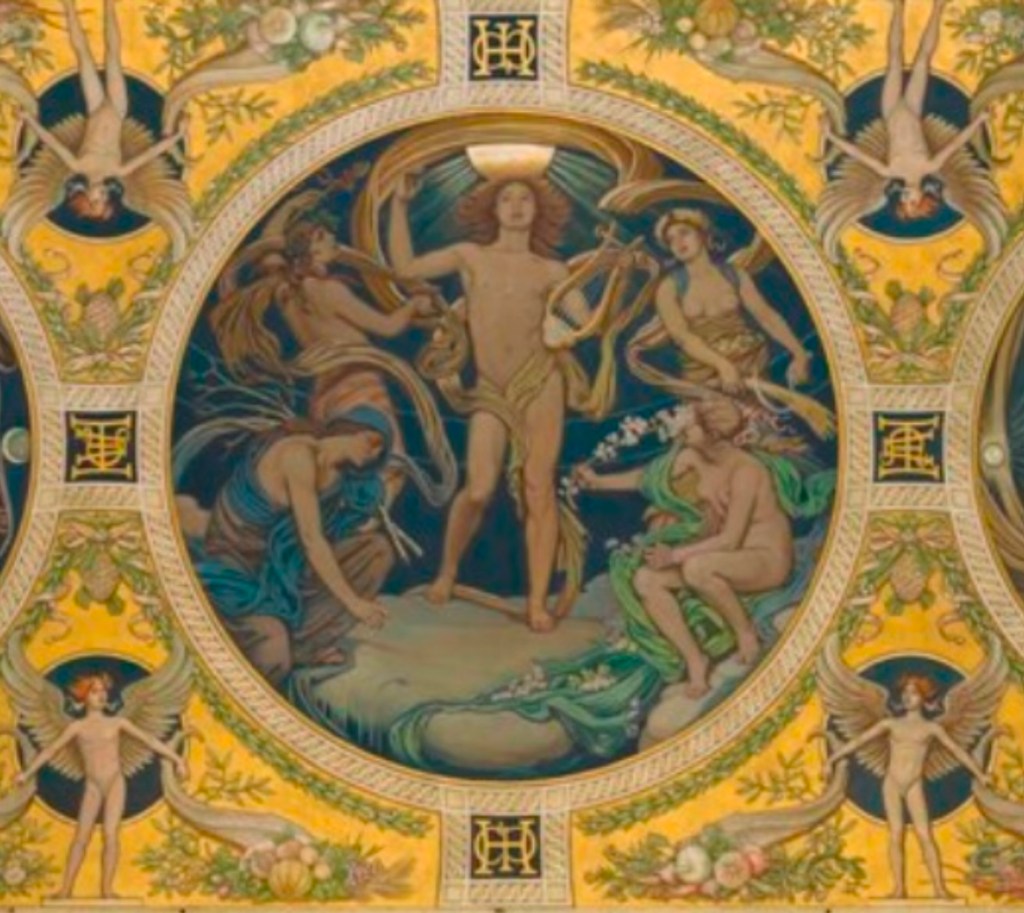
There were two Dining-rooms in the Huntington Mansion located at No. 2 57th St. & 5th Ave. NYC. There was nothing simple about either one of these European castle-like rooms. The “State Dining-Room”, looks like a room in a castle, rising up 3-stories high with stunning Italian-hand-carved wood paneling, curved round ceilings with beautiful gilt accents. We know there was a magnificent mural painted on the ceiling.
There were elegant French Louis XIV dining chairs in a Versailles design, elegant French velvet back [green], & velvet seats, & gilt gold carved legs. In this State dining-room, also called the “East Salon” was a large room with a massive fireplace in the center of the long room. A gilded framed painting hung over the fireplace. The artist of this painting is unknown; the painting was of an elegant women arranging a large floral arrangement with a child looking on, sitting in a chair. All the landscape & interior paintings in the Huntington State Dining-room surrounding the gilt fireplace. These paintings were hung salon-style along the rectangular room. A gigantic wide dining room table fit about 18-24 people.
Bibliography:
HEH Coll. MS Boxes 198-199 (Mr. H. E. Huntington personal papers & menus; Menu of C. P. Huntington No. 2. 57 Street St. New York City residence, dated Jan. 1900 Dinner Banquet menu & seating chart) located at the Huntington Library, San Marino, CA
Book: Mrs. Beeton Household Management 1860 (defining food)
Architectural Record, May 1903, published by the American Institute of Architects, (3 black and white photos of Mrs. C. P. Huntington’s Mansion, 57th St. & 5th Ave. with “State Dining-Room”, family or private Dining Room, & French Louis XV Drawing Room- Angels)
Abstract, “The Huntingtons of HooDoo Corner: the Construction of the C.P. Huntington House” (1889-1896) by David W. Deacon, Department of History, Syracuse University.
“State-Dining Room” was recorded in Architectural Record 1903, meaning that important political figures like the President of the United States dined with the Huntingtons. There is correspondence with Huntingtons & several presidents. We know that CPH knew President U.S. Grant, President Taft (Pan-Pacific project) & Presdient Theodore Roosevelt.
Letterhead of “Huntington Library No. 4 57th Street NYC” [2nd floor & attached to the Huntington Mansion at No. 2 57th St. NYC Huntington Library. San Marino, CA
Collis Huntington’s Formal Dinner Banquet (10-12 courses) 1900:
Location: Huntington State Dining Room, Huntington Mansion
No. 2 East 57th Street (5th Ave.) New York City, NY
Date: Tuesday, January 23, 1900
Guests: 12 gentlemen guests (seating chart)
Huntington Dinner Menu (Fancy)
Date: January 23, 1900
1. Huitres (Oysters on the Half Shell) [usually served with Spanish Amontillado sherry]
2. Consommé Tortue (Clear turtle soup)
with Relish dishes: Celery sticks, Queen Olives, & Roasted Almonds
3. Fish course: Bass, Sauce mousseline served with Sauterne White wine
4. Entrée course: Selle de Agneau, roasted & salted leg of Lamb served with Haricots Verts (French Green Beans) and Pommes Hollandaise (Potato au gratin with Hollandaise Sauce & heavy cream) [served with red French Bordeaux wine or French Champagne]
5. Terrapin (turtle stew) a southern specialty like “Terrapin a la Maryland” which is a white wine cream sauce with mirepoix of vegetables
6. Vegetable Course: Jambon & Epinard (a souther dish of Ham, diced with Garden Spinach)
7. Canvas Back Duck (served with Hominy & Jelly, probably Orange Jelly served with Victorian Claret red wine)
8. Salade Course (French style after the entree) probably Waldorf salad or Chiffonade Salad (French style chopped vegetables, lettuce, French arugula & herb salad with a French Vinaigrette maybe served with Roquefort cheese, a favorite of the Huntingtons
9. Dessert course, Gateaux (French fancy cakes, petit fours, & tarts) & Glaces (Fancy shaped ice creams, shaped in train car)
10. Bonbons (Chocolate-covered French truffles & Creams or Ice Cream in the shape of a train)
11. Coffee, with Fruit: Hothouse Grapes & Strawberries (perhaps chocolate-covered)
12. Brandy & Cigars in the Huntington Drawing Room or “Reception Room”
 Inside the Huntington's Story