

By Nancy Armitage
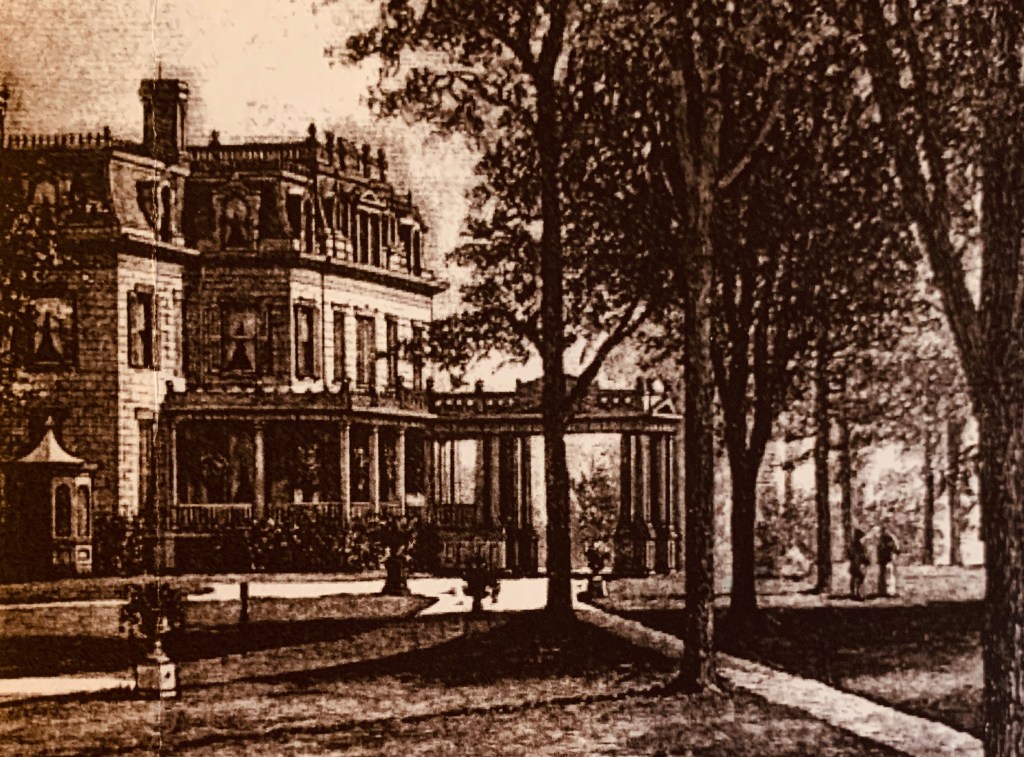
The Collis & Arabella Huntington’s “Homestead” expansive estate had a Victorian Gothic Mansion situated on an amazing 400 acres – later 800+ acres. I was so excited to find this image of the Huntington “Homestead” mansion in the Book: The History of Westchester by John Thomas Scharf. This Huntington mansion is now located on Schurz Ave in Throgg’s Neck, Bronx, NY 10465. Their property would have been considered their country estate, used on the weekends & especially in the summertime.
The palatial haven of flowers, filled with several enormous lawns, amazing canopy of shade trees, & spectacular gardens, even a Victorian conservatory & Versailles-like flower gardens. The property that bordered the Eastchester Bay, & Long Island Sound around to the East River, known as the Bronx, New York. Originally, the lush estate was in smaller land holdings, the Huntington’s were able to acquire land (1884) from the Havermeyer Estate called “Beau Rivage”, the Ashe property, & the Mitchell acres thus increasing their acreage.
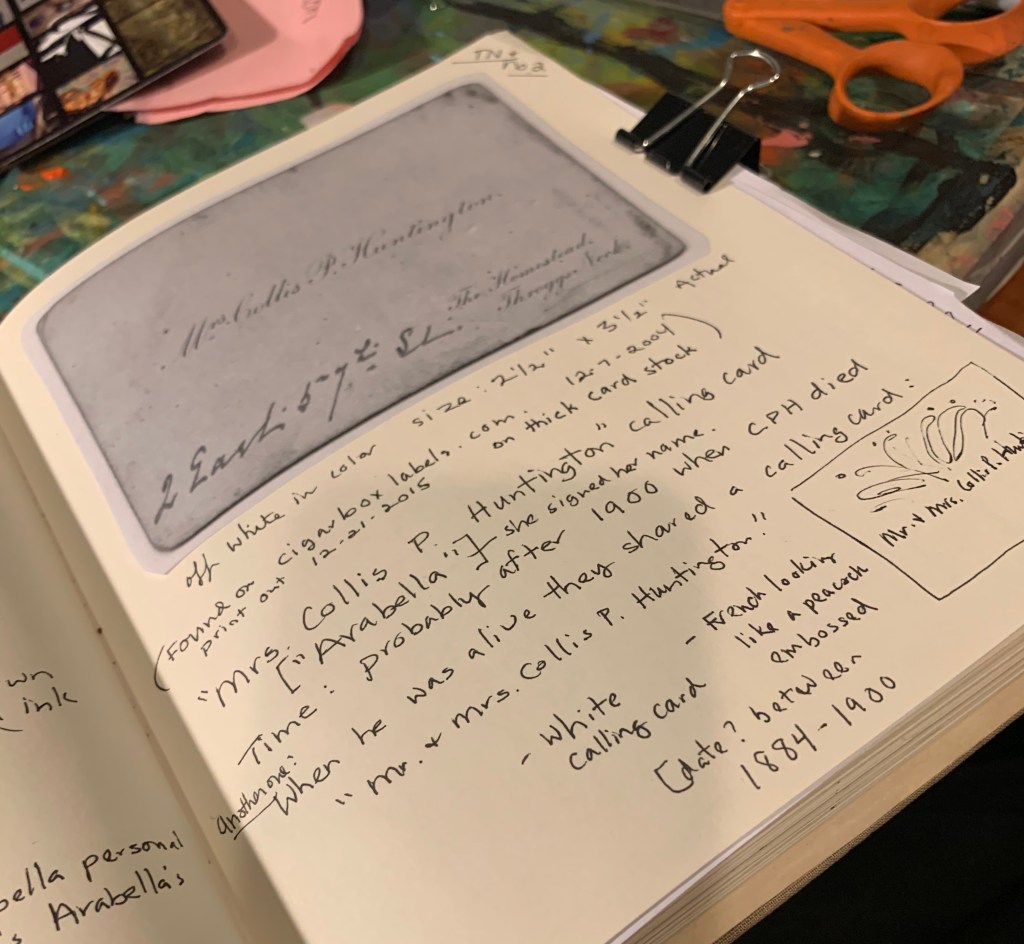
The couple (Collis & Arabella Huntington) were married in July of 1884 at Mrs. Arabella “Belle” Worsham’s 5-story mansion at – No. 4 54th Street in New York City. After they got married, Arabella & Collis honeymooned at their newly acquired Huntington “Homestead” Estate, Throggs Neck in Westchester Co., New York. They spent a blissful summer away from the hustle & bustle of downtown New York City.
It was recorded in the New York Social Register (1902) that the Huntington’s Throgg’s Neck estate was the couple’s summer residence & weekend estate; their Long Island Sound estate was also referred to as the Mitchell, Ashe, & Havermeyer properties, too. The beauty of the location was it’s oceanfront views & closeness to midtown New York. Also, the location of “Murray Hill”, (where the main Collis Huntington Mansion was located at No. 2 on Fifty-Seventh Street & 5th Ave. in New York City. The Huntington’s could go into town & partake in all of the cultural conveniences of the city (the theatre, shopping, the opera, their social clubs, & restaurants) but then return at night to their relaxing “The Homestead” Estate at the shore. The best of both worlds, the city & the country & the ocean , too.
Arabella’s son, Archer Milton Huntington was a member of the New York Yacht Club, in the late 1890’s. The New York Yacht club locations were in New York City & Newport, Rhode Island. The New York Yacht Club also hosted the grand “America’s Cup” sailing races. Quite an exciting event, indeed. Archer Huntington owned a yacht named “N. V. ROCINANTE”, (150 ft. yacht)/ He probably parked his yacht at either of the Huntington docks: at his Pelham Bay – Baychester estates or his mother & father’s Throggs Neck “Homestead” estate or at New York Yacht Club harbor or Newport, Rhode Island. In Archer’s younger years, he had schooner called “Elfin”. Also, included on the Throgg’s Neck estate was a groundskeeper’s home & a large boathouse – “a gentlemen’s retreat” with billiards table to smoke cigars, located near the large Huntington wharf.
There were several docks on the Huntington’s “Homestead” estate too, the large one was deep water or “Old Ferry Dock” (which now connects with Whitestone Bridge). It was large enough for the local steamers/ferry boats to dock & pick up Mr. Collis P. Huntington to go to his office at Southern Pacific Co. on Broad Street in NYC. He was the President of Southern Pacific Co. with 50,000 employees ( in 1900). Southern Pacific Co. ran multiple train companies, ship companies and ferry boat companies, across America. The ferry boat ride was a easy way for Mr. “C.P.” Huntington to go to work in the city. Or go to the family reunions at “Colliscraft” (named after Collis where they would have Huntington family reunions across the river). They would also use the Southern Pacific Co. ferry boats to start their long journeys north to their “Great Huntington Camp. Their Huntington Camp was called Camp Pine Knot on Raquette Lake in the Adirondack Mountains in upper state New York.
Behind the 4 stately Huntington gates on the estate, the grand Huntington Mansion was considered a model residence. For a seaside, “country residence”, it had many of the most modern conveniences of the day, per the blueprint of the land. The mansion had its own advanced system of water & gas works, unusual in the 1880’s. On the large property, there were numerous horse stables & barns, chicken coops, garden conservatories & hot houses, farm buildings, rose houses, & garages. Also, buildings & cottages for employees to live. There were 100’s acres of rolling pastures, included on the grounds leading down to the shores of the Eastchester Bay north of Long Island Sound & Weir Creek to the east & the East River to the South (where the Mansion was).
After Mrs. Arabella “Belle” Huntington died (1924), her estates listed her owning 100’s of parcels of land on many different streets in Throggs Neck, City Island, & Westchester Co. Many streets were named after the Huntington Family & friends, after Archer Huntington donated the land: Collis Ave., Huntington Ave. & Prentiss Ave. (Clara Prentiss Huntington – C. P. Huntington’s adopted daughter who became Princess Clara von Hatzfeldt) & Miles Ave. (C. P. Huntington’s loyal personal & social secretary & friend.)
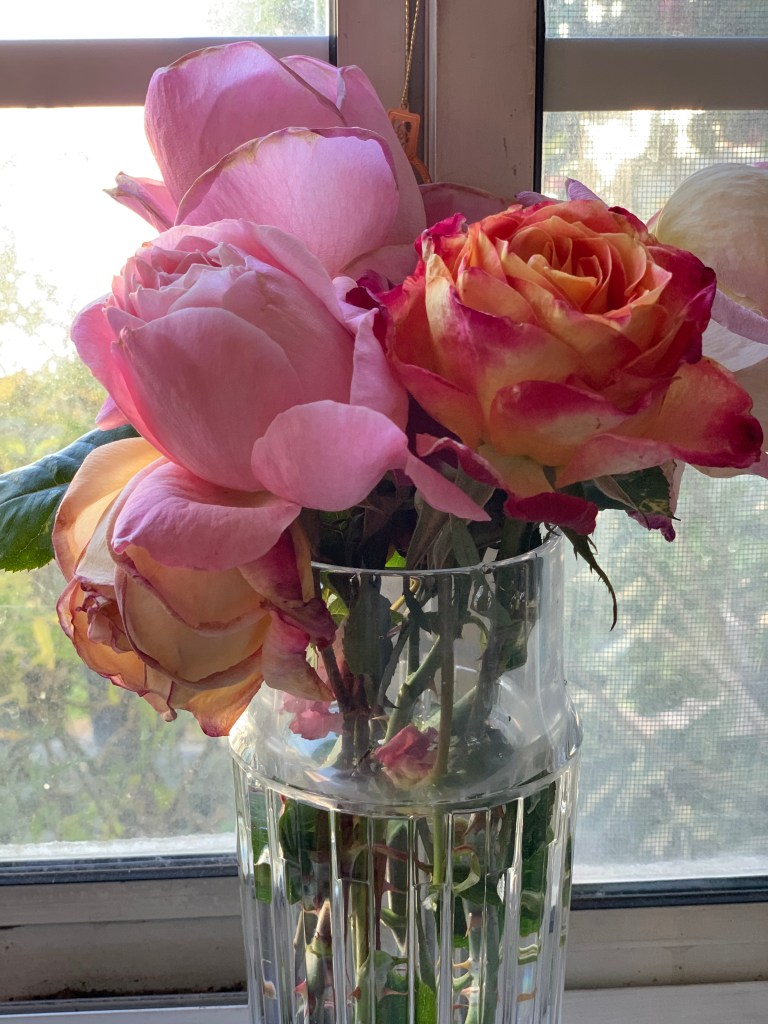
At the Huntington’s “The Homestead” retreat, there were lovely garden shady walks & garden paths leading to the elaborate Victorian conservatory. The conservatory houses with tropical palms & exotic flowers, & orchids were a favorite of Mrs. Arabella Huntington. In the salt air, it created an atmosphere of privacy & relaxation for the Huntington’s & their numerous houseguests, family, & friends. Mrs. Arabella Huntington loved her flowers: especially fragrant Victorian & French roses (pink, white & red), exotic orchids, lily of the valley, & sweet violets.
In the book, The History of Westchester County, it documents three etchings of the Huntington’s “Homestead” property in Throgg’s Neck, NY. Two etchings are of the Huntington’s Victorian Gothic mansion & one of the large Huntington Wharf. On a clear day, or a pleasant evening, Mr. Collis Huntington was described as walking the land, a “gentlemen of commanding stature dressed in black & wearing a black skull cap may often be seen strolling up & down in conversation with friends, or watching the steam boats or sailing-vessels as they pass, in a genial humor, & always ready with his jovial story or generous laugh…”
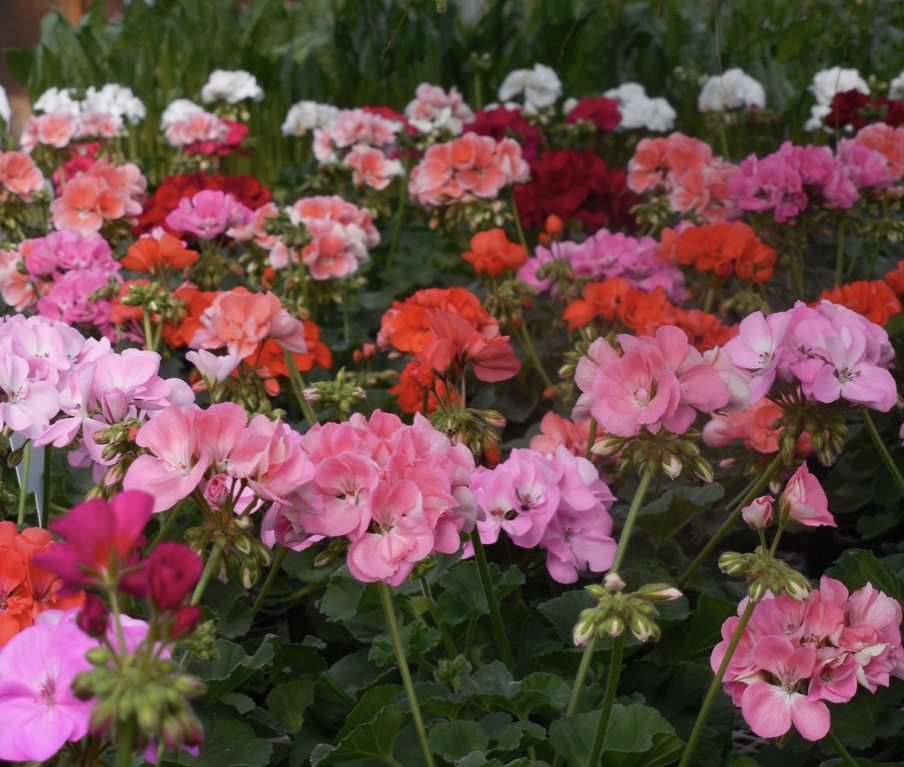
The large 49-room Huntington Mansion was a four-story Victorian Gothic with two wings. It had (2) 4-story towers at the end of each of the wing. The seaside mansion was complete with a Victorian widow’s walk on the top of the roof. They had a double-wide Victorian veranda in the front with an extended colonnaded portico. The mansion’s etching show hanging baskets of prolific flowers (maybe bright pink geraniums), between each of the decorative columns on the porches. It was known that white & pink flowers (especially roses) were favorites of Mrs. Arabella Huntington. The veranda had bay windows extending out from the mansion. Which would have been a great entertainment spot for tea in the spring & the summer.
The portico was built to accommodate the horse-drawn carriages of the Huntington’s guests; it was situated on the driveway side of the mansion. The white brick covered with stucco were the outside walls of the home & four chimneys protruded from the roof.
In Bennett’s book, The Art of Wealth, informs us that the young Mrs. Arabella Huntington was quite passionate about her gardens at Huntington’s “Homestead” – on the Throgg’s Neck property. She had a ornate Victorian conservatory they called the “Palm House”. With numerous hot houses: a fern house, a rosary (rose house), a violet house, with a large kitchen garden (vegetables & herbs), a orchard of fruits, & nut trees, too. Most – likely southern vegetables like Okra, Sweet Potatoes, Kale, Green tomatoes, & Collard greens.
Arabella joked with her son Archer, that she could start a violet farm, with all her English violets, Russian violets, & Parma violets, too. Arabella had a large botanical book library to educate herself about her garden flowers.
Mr. Collis Huntington had a gentlemen’s “playhouse” by the shore with a great view of the water & Long Island; it had a Bowling Alley & Billard’s room for the Huntingtons to enjoy, maybe to enjoy a cigar or two.
There were bronze urns on pedestals filled with fragrant flowers lined the walkways & driveway to the grand Huntington residence. Arabella had these urns planted with either fragrant lilies of the valley, ferns, or roses. On Huntington family ledgers, each month there were hundreds of Lilies of the Valley bulbs (a favorite of the Huntingtons) purchased for the Huntingtons’ Throgg’s Neck seaside property.
It seems that Mrs. Collis P. Huntington (Arabella) had a nautical theme in her seaside Dining-Room at Throgg’s Neck. We know she was partial to gold & white fine bone china or porcelain plates. She owned Wedgewood, French Haviland, French Serves, English Copeland & Garrett (Old Spode) & Dresden & many more. In catalogs of Arabella Huntington’s estates after she died (1924) were 100’s of pieces of Blue Transferware, Chelsea, Delftware & so much more plateware. At this Huntington property location, she owned Coalport fine bone china plates (blue, gold & white) which could have been used at Throgg’s Neck.
The Huntington’s dined in elegance with the finest of her crystal, & (Gorham) sterling silver. In those days, Gorham silver was used on the grand Dining-Room table of the US president at the White House in Washington DC. Arabella Huntington emulated this grand American tradition on her Dining-Room table, too.
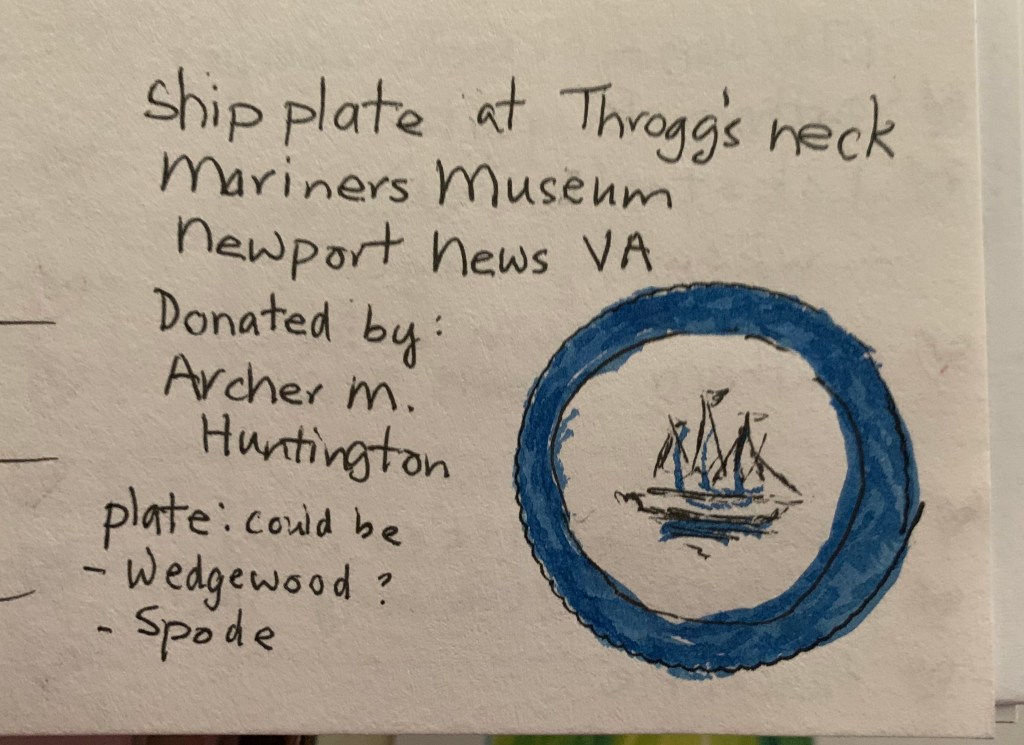
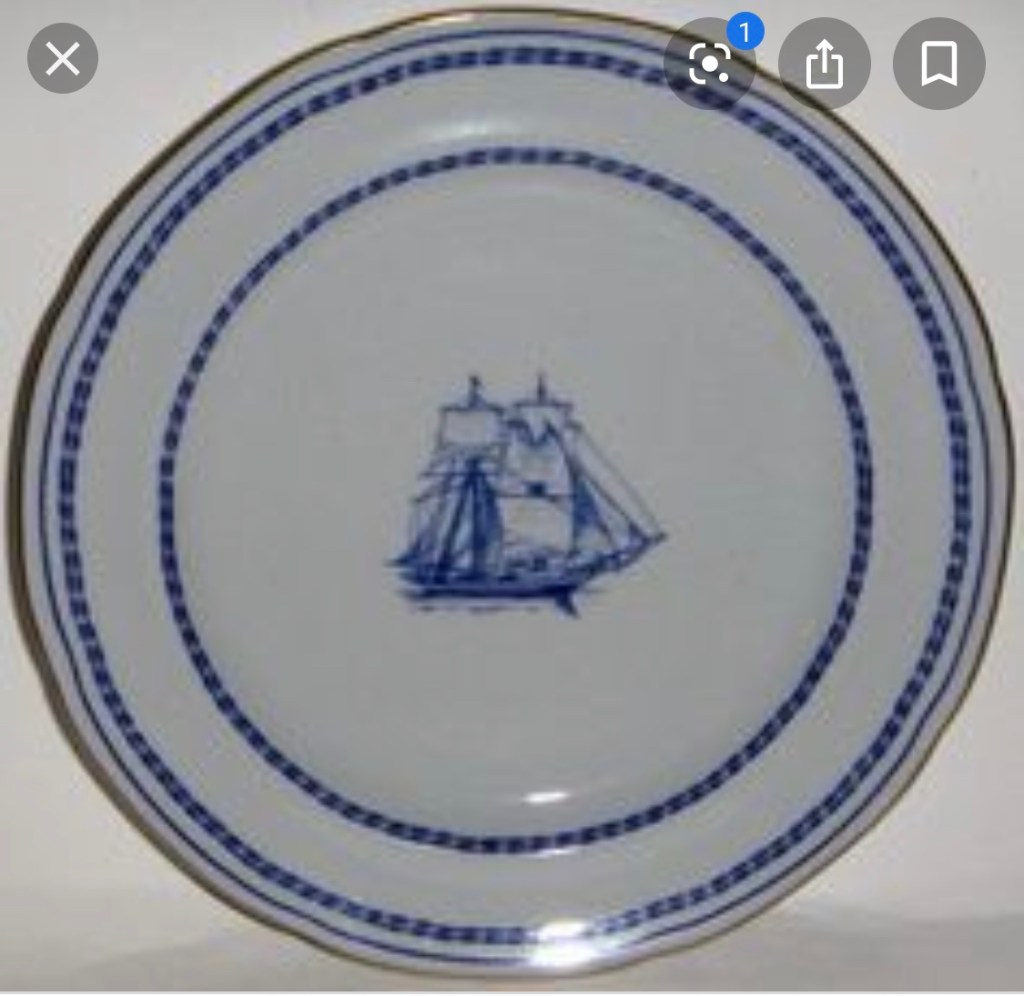
At the Mariner’s Museum in Newport News, VA, which was founded by Archer Huntington (with 1000’s of nautical items of the Huntington Family and their shipping lines). I found a fine bone china pattern that could have been used at the Huntington’s Throggs Neck estate. It was a nautical Clipper ship dinner plates ( blue & white), donated by Archer Huntington after Arabella Huntington death in 1924.
These plates were Wedgewood & Spode fine china (American clipper ship) plates, Arabella Huntington collected hundreds of pieces of Blue Transferware in Sheffield, Wedgewood, & Spode. We know Arabella Huntington collected Old Wedgewood fine china & had a huge “service” set of 100 pieces in 1884. It makes sense that a nautical or patriotic theme could have been used at Arabella’s “entertainments” at this grand Huntington seaside estate. Nautical themed-plate ware would be great for her American summertime holidays: Memorial Day, patriotic American 4th of July, Lobster Feasts & Clam bakes, & Labor Day all would warrant a Red, White & Blue American-Nautical Theme.
Even though this mansion was a seaside house, dining was still a formal affair for the Huntington Family. They dressed in elegant clothes every night for dinner, white tie for the men, & long dresses for the women.
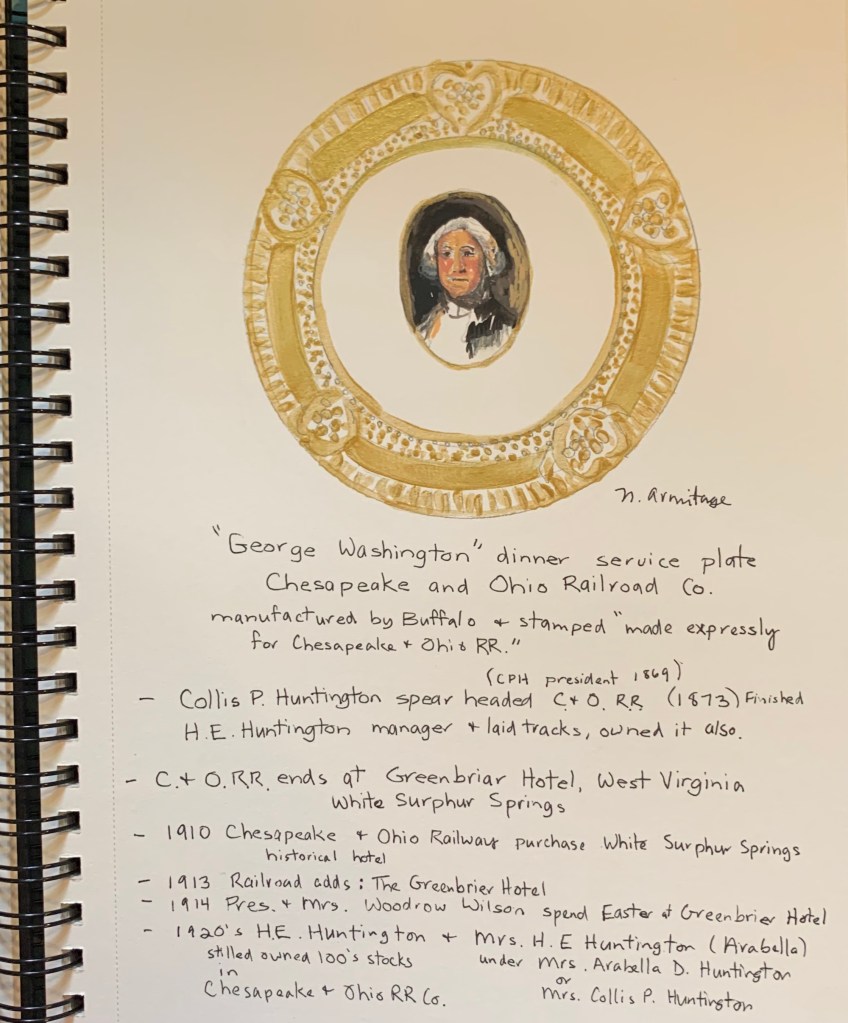
Also, I found in the Chesapeake & Ohio Railway Co. archives a stunning “George Washington” gold plate. This is no ordinary plate, it is a large ornate dinner plate/charger plate with a thick gold (probably 24K) rim; in the middle of the plate, a fine portrait of George Washington. On the back of the plate in the middle, states “C&O RR Co. Railroad”. These patriotic plates were used on the C & O Railroad which the Huntington Family actually built that railroad, too. Collis & H. E. “Edwards” built that railway together, hosting presidents, royalty, & often traveling from NYC to Washington DC. Could Mrs. Collis Huntington (Arabella) have ordered some these handsome plates for her own “State Dining-Room” in her mansion in the city of New York City or Throgg’s Neck mansions??
February was a month that was specifically for Americans to honor 2 of our US presidents: George Washington (February 22) & Abraham Lincoln (February 12). I found many Huntington luncheons menus celebrating the Birthday of our 1st President – George Washington. I found one menu from New York Chamber of Commerce & other NYC club,s that the Huntingtons were members of (Huntington Library archives) & also President Lincoln menus too. Henry E. Huntington has an amazing collection of Washingtoniana & Lincolniana menu ephemera & collections (at the Huntington Library in San Marino, CA)
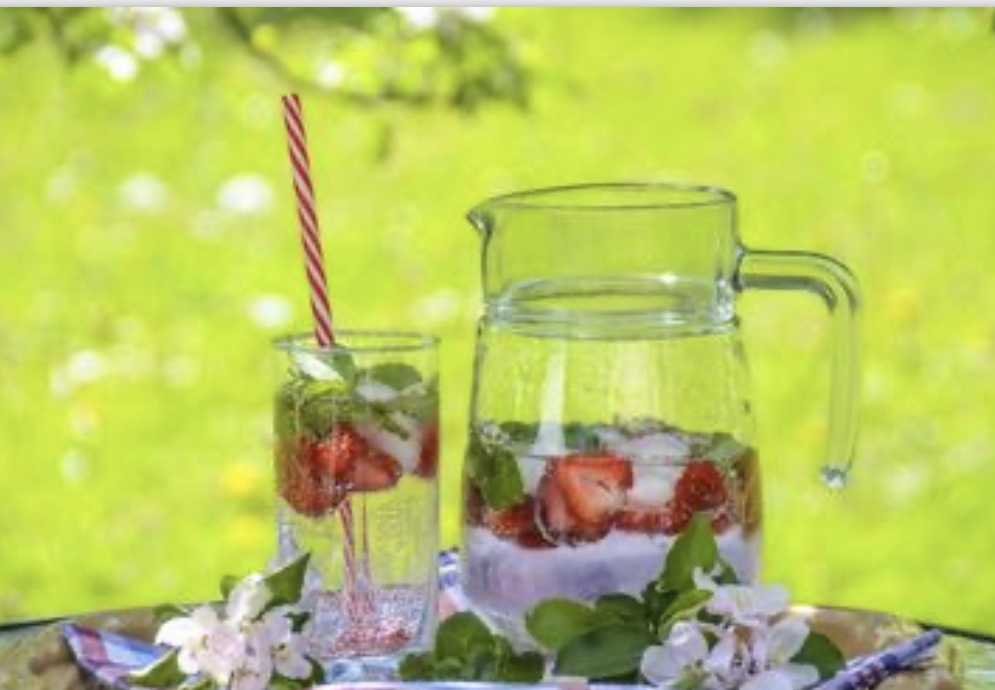
A patriotic American party for 4th of July would have been a festive affair. Often, on the Huntington menus was a beverage called “Roman Punch”. Maybe, they also used the 1887 White House Cookbook for the recipe for “Roman Punch No. 2”. It is a combination of lemonade, extract of lemon, brandy, & rum. This cookbook was also located at the Huntington Library rare book collection.
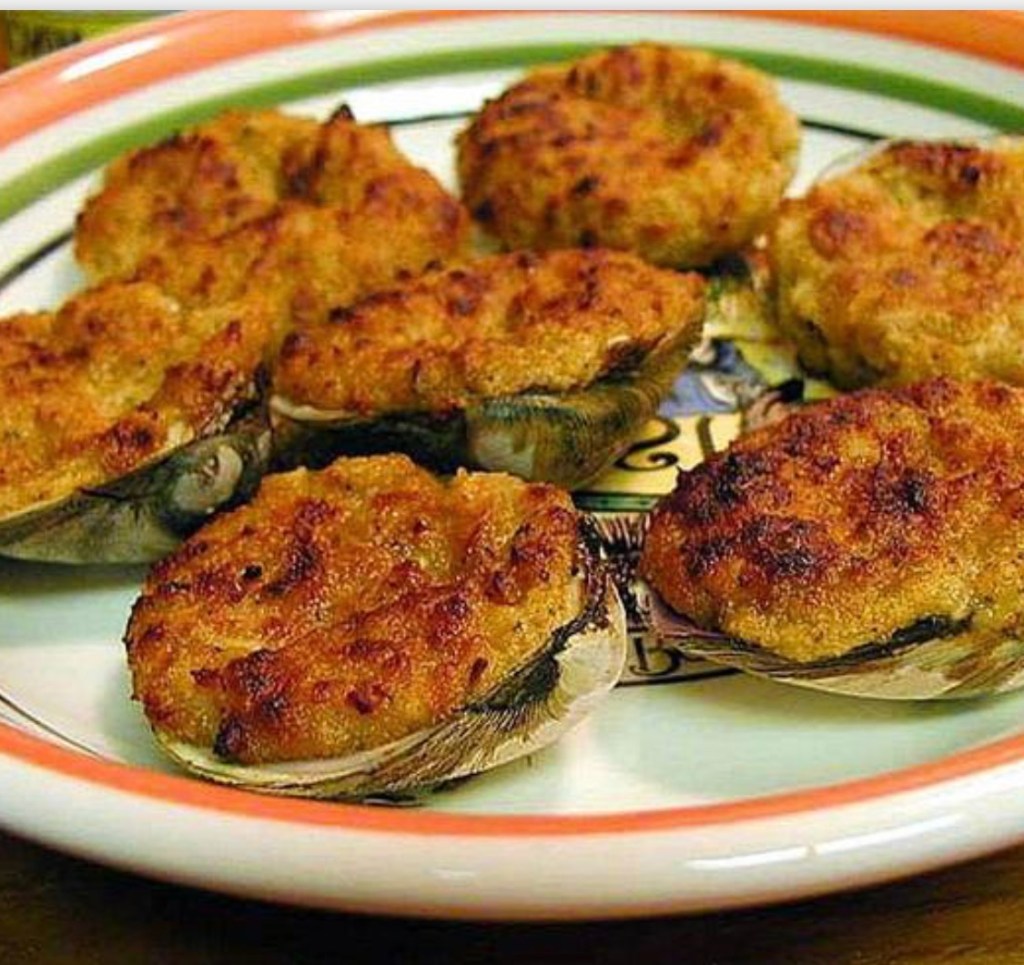
The Huntington’s had fun family reunions like weekend get-togethers, especially Sundays, & the 4th of July. From the Huntington’s “Homestead” estate, I found numerous fish monger invoices. The Huntingtons would have served up a grand Seafood feast and/or seaside Clambake, indeed.
Remember that Mrs. Collis P. Huntington “Belle” or “Arabella” was a Southern Belle. Her “Entertainments” always included delicious Southern food, also. Drinks like Southern Iced Tea, Foods like Seafood Gumbo, New Orleans Beignets (a fried sweet puff and dusted with powdered sugar), Bread Pudding, & Bananas Foster from New Orleans. Arabella’s head butler, Alfonso Gomez informs us in his interviews, that Arabella & her friend/ social secretary went to school together. Miss Caroline Campbell & “Belle ” Yarrington (in about the 1860’s once went to school in New Orleans, LA, maybe a convent or finishing school.
The Huntington could have served their guests: Oyster on the half shell to start at Oyster Suppers & Seafood clambakes on the beach or Oyster Rockefeller. At a clambake, they would have Clams &/or Mussels with Sausage & Corn on the Cob. At large Lobster feasts1-3 lbs Lobsters served with little ramekins of melted sweet butter. Probably served with Cole Slaw or Potato salad or maybe New York’s famous Waldorf Salad on the Long Island Sound. While watching the Annual Summer Regattas & even the America’s Cup yachts race by. All while drinking Southern Sweet Iced Tea, Lemonade, or a lovely cold Southern Seaside Punch or Champagne Punch.
Mrs. Arabella D. Huntington did much to please Archer Huntington her son. Maybe, a Spanish theme to his liking, maybe they served a Summertime Spanish Paella with a medley of Seafood. Like Lobster, Shrimp, Mussels, Clams, Chicken & Pork Sausage, all cooked in a Seafood Broth & served with Spanish Yellow Rice (turmeric spice). Often, the Huntington family made southern food like Seafood Gumbo, famous in New Orleans. This would have pleased Archer Huntington who loved all things Spanish. In 1904, Archer opened up his “Spanish Museum” called The Hispanic Society of America at Audubon Terrace in New York City, NY.
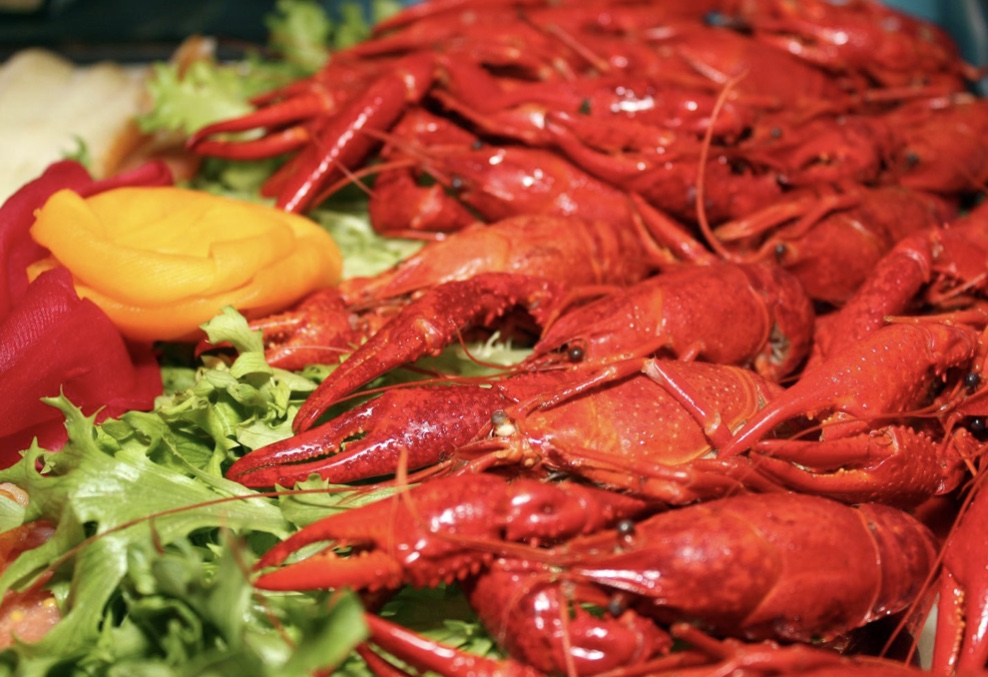
A typical seafood dinner (Luncheon or Supper) on the Long Island Sound was a lobster feast, or a clambake. The feast would always start with raw oysters on the half shell: Blue Points Oysters are the best. The soup course might be a Throgg’s Neck Red Clam Chowder or New England White Clam Chowder; or a Southern influence by Arabella: Oyster Stew or Southern Seafood Gumbo – New Orleans style. The tradition of Bronx– Throggs Neck Red Clam Chowder is a delicious spicy red chowder: a mixture of clams, clam broth, potatoes, tomatoes, vegetables, & herbs (like oregano & basil).
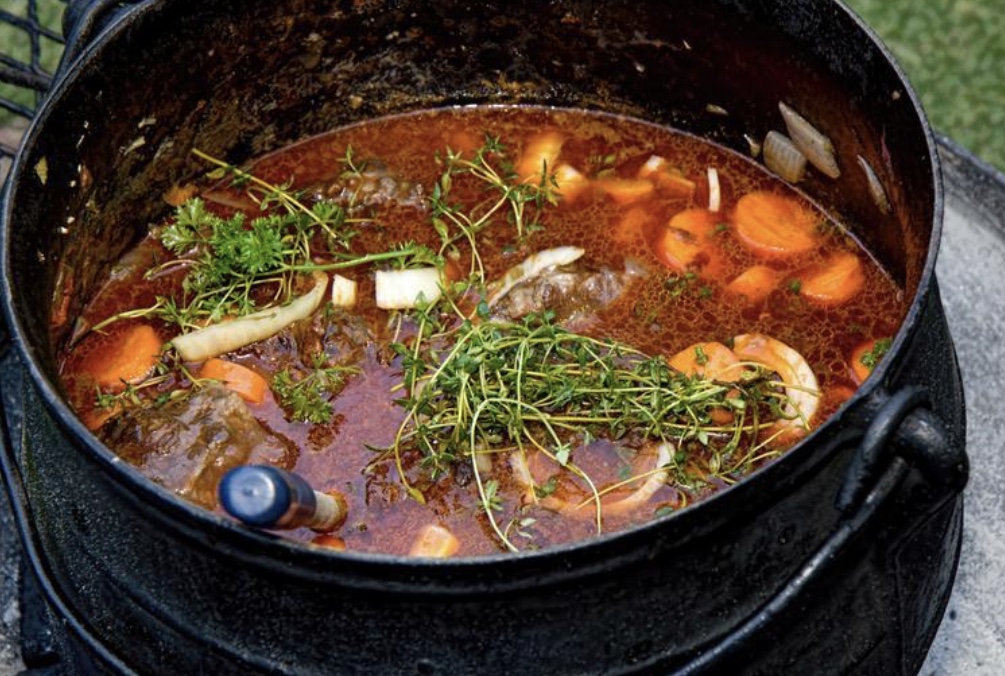
Throggs Neck Red Clam Chowder Recipe
4 lb. quahog clams
1 t. olive oil
2 celery stacks, chopped
4 garlic cloves, chopped fine
4 irish russet potatoes, chop
1 c. clam broth
2 t. thyme, minced
mixed peppercorns
1 t. butter
1 onion, minced
2 carrots, chopped
1 large can whole tomatoes (28 oz.)
2 t. tomato paste
2 t. Greek oregano, minced
salt and finely ground black pepper
dash of Tabasco or cayenne pepper
To reduce sand & grit, in bottom of pan, soak the clams in water 4 times in sink about 15 mins. each. Fully drain water & rinse after each soak. In a large stock pot, add 2 qt. water & all the clams. Put on high heat & bring to boil, reduce heat & wait for the clams to open. Take clams from their shells & set aside; discard the shells. If any clams did not open, throw them away. In the same stock, add butter & vegetables & sauté. Add herbs & tomatoes. Add clam broth & bring to boil. Reduce to simmer & cook 30-40 minutes until the veggies are cooked. Add the clams back into the chowder & season to taste. Recipe: Nancy Armitage & Kathi Davis
On the Huntington grocery invoices, hundreds of pounds of fish & shellfish were ordered for their entertainments. Seafood for the Huntington estate at “Throggs Neck” & at the Huntington Mansion in NYC: “No. 2” on 57th Street in the New York City. Seafood galore was shipped to the Huntington’s residence(s): lobster, clams, mussels & other types of fresh fish (like: Kingfish, Salmon, & Seabass ) were abundant. Oysters for raw oysters or Oyster chowder, Shrimp or Crab Cocktail, Crab Cakes with Dill Tartar Sauce, Clams & Mussels, Clam Balls (Rhode Island tradition), French-style Mussels (mushrooms, onions & cream), Scallops, & the grand finale being the whole Lobsters with Sweet Butter.
Maybe, they could have served Canapes on doily-lined silver trays like: Roquefort Puffs or Canapes Washington. Seaside Salads could have been Cole Slaw, Potato Salad with French Tarragon or Seafood Salad, or Waldorf Salad (made of apples, celery, walnuts & mayonnaise). Arabella was a Southern Belle, she always had a little bit of “the South” in her menus. Sides could be Southern Cheese Grits or Hominy, Corn on the Cob, Sauteed Salsify or “Oyster Plant”(tastes like artichoke or hearts of palm), or Southern Baked Beans or Southern Red Beans & Rice.
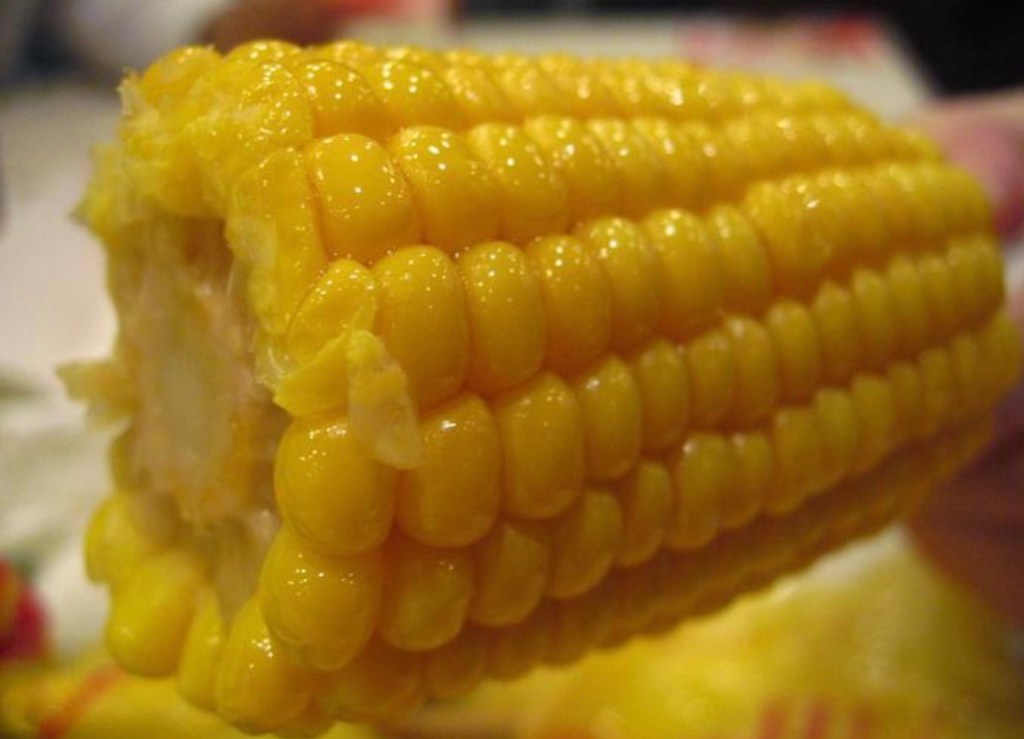
Southern Cheese Grits Recipe
6 c. chicken stock
2 c. grits or hominy
2 C. New York sharp cheddar cheese
3 garlic cloves
5 eggs
Salt and white pepper
½ stick butter
½ half and half
dash tabasco or worcestershire sauce
dash paprika or cayenne pepper
In a medium saucepan, add chicken stock, garlic, grits, salt & pepper, Using a whisk, stir the ingredients for about 8 minutes. In a bowl, add the rest of the ingredients. Pour into a casserole dish. top with some cheddar cheese. Bake 350@ for 35-40 mins. Recipe by Nancy Armitage
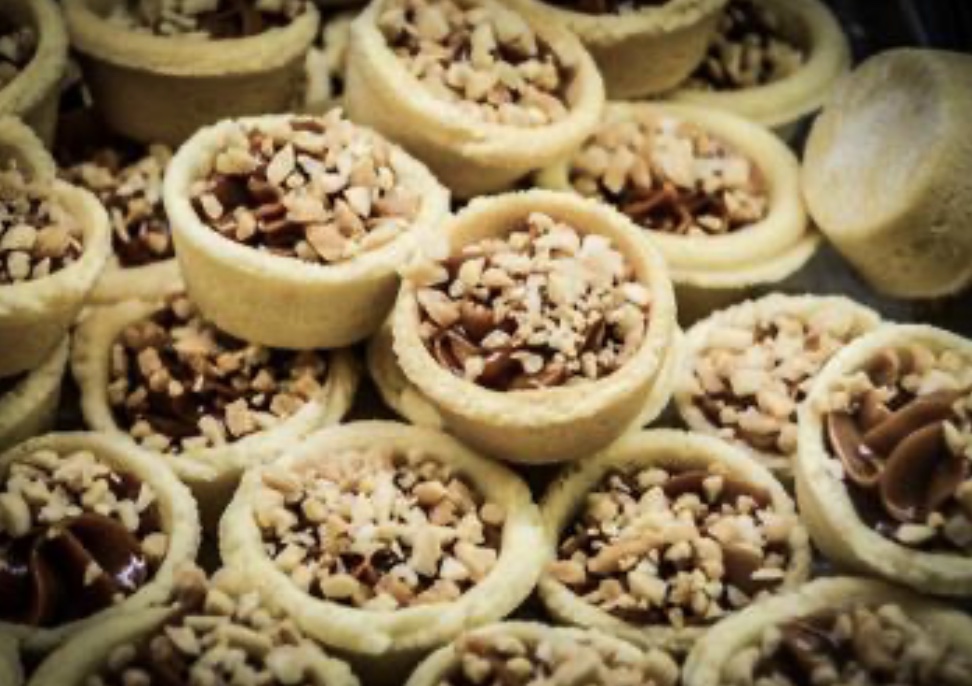
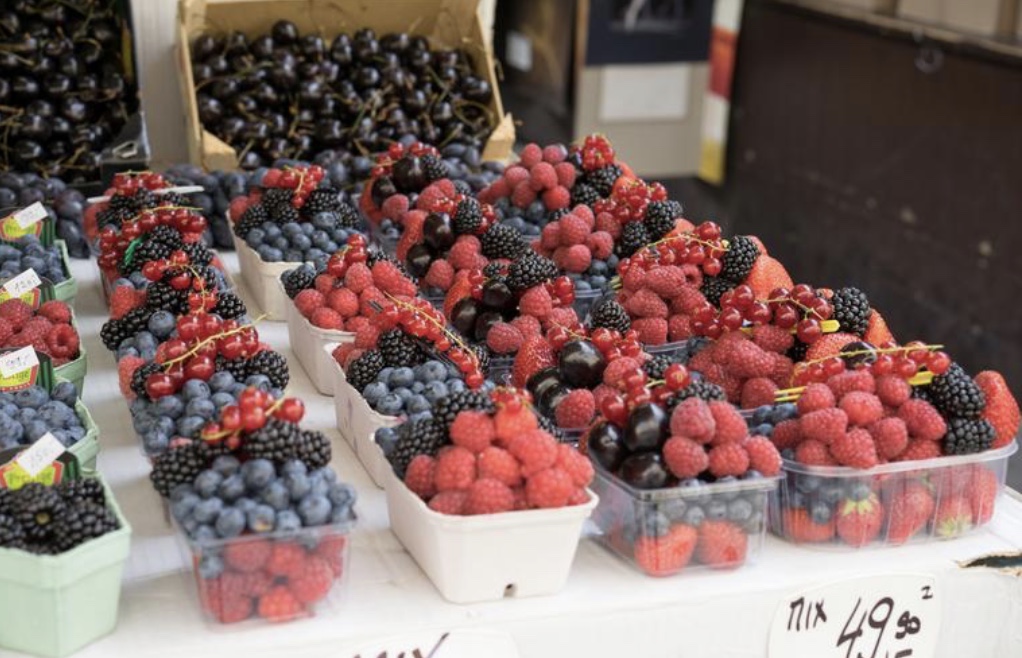
The ending to this Seaside Seafood feast would be summertime desserts like pies, or hand held pies (half moon) for a picnic, & elegant petit tea pecan tarts, or chocolate mint brownies. The Huntingtons ate New York Cheesecake, Cape Cod Berry Pie, Washington Pie, Cranberry Tarts, or Southern Pecan Tassie (some bite-size tart). Some of the best pies (like Myrtle berry pie) are a mixture of berries: with raspberries, blackberries & blueberries with cinnamon & sugar. Apples, a New York tradition could have come in a pie, small individual tarts, or Apple Russe Pudding but served with Homemade Ice Cream, a Huntington family favorite with lots of Berries & fresh Summer Fruit, like Nectarines or Peaches or Strawberries.
Also, Mrs. Arabella “Belle” Huntington often served Petit Fours at her teatime “entertainments”. Petit fours are a lovely petit square tea cakes iced with Royal Icing or Chocolate Ganache, maybe topped with a candied violet.
The Huntingtons preferred a special blended tea which was made by mixing India tea mixed with Ceylon tea making an delicious Orange Pekoe Tea. Mrs. Arabella Huntington could have added roses petals or orange peel and/or cinnamon spice to enhance her tea. We know that the Huntingtons also drank Lipton’s tea & Englands’ Ridgeway Tea which is also Orange Pekoe tea. Orange Pekoe, is a refreshing tea served hot or cold in the summertime.
This popular tradition of “Iced Tea” came to America, on one very hot summer day at the World’s Fair in 1904 in St. Louis, Missouri. In a tall iced tea glass add lots of ice. Add cold iced tea. Add a long ice tea spoon & a straw. Add a slice lemon or orange (California style) to the rim & a sprig of Spearmint. If its Southern Sweet tea, they add alot of sugar.
Collis Huntington loved to be surrounded by family & friends in New York especially for the American’s Fourth – 4th of July holiday. Many get-togethers are recorded by E. Burke Holladay in his journals. Throgg’s Neck was so close to the Long Island Sound, the estate was perfectly situated for viewing the magnificent fireworks in the East River. Or they could have sailed on Archer’s yacht or the ferry boat on to the New York Harbor, to get closer to the fireworks. The Huntington’s were a very patriotic family & very proud to be Americans. The Fourth of July was a special occasion for the Huntington. They would have enjoyed the holiday not only for the delicious food but also for what the American Day represented to them.
Arabella’s husband, Collis P. Huntington sadly died in August of 1900 at their Huntington Camp Pine Knot in the Adirondack Mountains in upper state New York. American newspapers reported that the economy of the United States of America would have been affected by his death, he was that wealthy!! Arabella was well taken care off when he died. She received 1/2 his estate the other half went to H.E. Huntington – Collis Huntington favorite nephew. It was stated in the New York Times, that she was the wealthiest woman in the United States after Collis passed away. Arabella Huntington used the Throgg’s Neck estate often with her family & friends on weekends & holidays. After Collis Huntington died, it was hard for Arabella her to go back to Camp Pine Knot after Collis died. It was recorded that Archer Huntington went to the Adirondack Mountains every so often. Arabella Huntington went on long extended trips to Europe & especially her favorite city, Paris.
She also spent a great deal of time in Paris, France; 1901, 1902, 1904, 1907, 1910, were years Arabella, Archer, & his 1st wife, Helen Huntington spent many months there. Mrs. Arabella Huntington would stayed at the Hotel Paris Ritz & Hotel Bristol, or Hotel Continental in Paris, France. She had many friends that also had residences in Paris, live Mrs. Harriet (Crocker) Alexander.
In 1907, she bought her 1st mansion in Paris on 2 & 4 rue de Gabriel (rebuilt by Baron Hirsch & once occupied by Empress Eugenie of France). She purchased a 2nd Paris mansion in 1910 at 20 Rue de Lubeck, Paris. For details of Arabella Huntington 1st Paris mansion look at my blog:
In 1913, when Arabella Huntington (Mrs. Collis P. Huntington) married H. E. “Edwards” Huntington they enjoyed many more peaceful Huntington family vacations there at the Huntington Estate at Throgg’s Neck, also.
Historical Note: The layout of the Collis and Arabella Huntington “Homestead” property was outlined on several large blueprints (Syracuse University). These blueprints were created in 1922 by Earl B. Lovell, an engineer & city surveyor. They really helped us to understand what the property looked like when the Huntingtons lived there. The Throgg’s Neck – C. P. Huntington property had been previously owned by Frederick C. Havermeyer from June 1874-1884.
On the Huntington property blueprints: these streets surrounded the property were Morris Lane, East Tremont Ave., 177th Street, & an old road from Fort Schuyler to dock to village of Westchester in New York. The entire Huntington “Homestead” property was surrounded by a tall granite walls & granite posts & several tall (4) elaborate gates on all sides.
The Huntington “Homestead” at Throggs Neck property had large brick buildings, one of them a brick tower for the Huntington’s guards at the corner of Morris Lane. The blueprint describes the Huntington Mansion on the estate as a 2-story Victorian Gothic Mansard Stucco flanked by two four-story stucco wings with a huge triple porch or veranda with steps on each side of the mansion. The property had numerous framed buildings, some 1-story high & some 2- story high, probably housing for gardeners, guards, chauffeurs, etc. The property had 3 large hot houses, 2 boathouses, 3 docks (large dock big enough to dock a steamship ferry to pick up the Huntingtons & entourage), old long dock on Mitchell property, & the old dock built by Whitestone Ferry Co.- Sept.1913). The property had several large horse stables; “Mrs. Huntington’s horses”; a employee, a man named Sullivan took good care of Mrs. Arabella Huntington’s horses. Mrs. Arabella D. Huntington also raced her horses, (I found evidence in H. E. Huntington Journal Ledgers), also 1 large brick horse stable, & several other framed stables – one on the old public Road Whitestone ferry. There is also an interesting description to some of the property as the “Virgil de Escoriaza”.
Bibliography:
Book: Scharf, John Thomas, History of Westchester County, 1886
New York Times Newspaper article, “C. P. Huntington’s Purchase” November 23, 1898 (Mr. Collis Huntington purchases another 100 acres adjoining the 300 acres which he already owned in Bronx borough, waterfront owned by John Mitchell)
New York Times Article, “C. P. Huntington acquires Havermeyer estate”, 1890’s [which was 300 acres]
New York Times article: Sept. 4, 1902 “Waitress shot by one of Mrs. Huntington’s Men” (numerous gates on Huntington estate)
New York Social Register (Social Directory) 1904, 1921
Syracuse University, Mrs. Arabella Huntington estate papers- Throgg’s Neck Blueprint of Huntington Mansion & property in Westchester Co. NY
Book: H. E. Huntington a Biography by Thorpe
Documents at the Huntington Library, San Marino, CA: HEH Coll. HEH MS 38/11 uncat (New York House); Household receipts at the No. 2 57th St. NYC & Throgg Neck “TN” Fishmonger bill, for Mr. & Mrs. H. E. Huntington bills 1919 (Huntington Library, San Marino, CA);HEH Coll. HEH MS 53/2 (1-2) (E. Burke Hollidays Journals; HEH’s brother in law) HEH Coll. MS 19/5 MS uncat (HEH bio file) & H. E. Huntington checkbook ledgers, (100’s of Lilies of the Valley bulbs purchases for TN-Throggs Neck ) Hunt. Library, SM Calif. HEH Coll 37/1-18 Arabella Huntington Surrogate Court property papers; (Arabella’s will had 100’s of parcels of Throggs Neck in her will.) Location: Huntington Library, San Marino, CA
January 23, 1900 Dinner Menu: Mr. & Mrs. Collis Huntington hosted a Huntington banquet at the No. 2 Huntington Mansion, they served “Hominy & Jelly with Canvas Back Duck”.
Book: The Art of Wealth by Bennett (talks of the Throggs Neck gardens & flowers of Arabella)
Chesapeake & Ohio Railroad archives, Gold & white ornate “George Washington” service plates
New York Yacht Club in the city in on 44th St NYC & New York Yacht club (on the water) located in Newport, Rhode Island, hosted America’s cup events & annual regattas. Archer Huntington was a member of the New York Yacht Club.
 Inside the Huntington's Story
I grew up in and around Throggs Neck and thought the location mentioned of 177th Street & East Tremont Ave didn’t seem right. That area is not near the water nor is it Throggs Neck. The Homestead would have been and is located 2780 Schurz Ave in Throggs Neck, near the Throggs Neck Bridge. It is now Preston High School. The building is still standing although it’s been altered a bit. This location is on the shore with the East River & Long Island Sound in view. Also, the streets in the immediate location are named……Miles Ave, Huntington Ave and Collis Place. In the bio of Preston H.S., it is noted the building was “formerly Frederick C. Havemeyer’s “Beau Rivage” and Collis P. Huntington’s “Homestead”. And Wikipedia mentions “The original school building, also known as “The Huntington Mansion” or “the mansion” to students and faculty, was the 19th-century waterfront mansion of Collis P. Huntington, whose wife Arabella Duvall Huntington purchased the property from Frederick C. Havemeyer, Jr. in 1884.[4] Havemeyer lived there from 1863 when he purchased the property from the heirs of Dominick Lynch Lawrence.”
LikeLike
177th and East Tremont Ave. were some of the numerous properties that Mrs. Arabella Huntington purchased. Thanks for your info. Nancy
LikeLike
Dear Someone, The street locations i mentioned were the surrounding streets of the Collis Huntington property on the blueprints I found at Syracuse University archives. Thanks for your info. Nancy
LikeLike
What a wonderful essay on The Huntington’s! I am reading The American beauty by Shana Abé and came to “Beau Rivage” in Throggs Neck on page 284. Your essay came up when I googled the name. I used to supervise student teachers in Queens, and I am a former guide at The Preservation Society of Newport county, as well as a background extra in “The Gilded Age”. In addition I have visited the Sorolla paintings at Archer Huntington’s Hispanic Society for years! Needless to say I have a love of all things Gilded Age! It is so nice to have found your writing. All the best.
LikeLike
Hi, Gilded Age 3rd Season starts tonight!! So exciting I hope you are in it this season. Someday I will get to the Hispanic Society and see those pretty Sorolla paintings! The Newport Mansions are a marvel, that is so nice you are a guide there. Have a great summer. Best, Nancy
LikeLike
Thank you for writing such a lovely piece about the estate. Fascinating reading and well researched.
LikeLike
Fascinating! Thank you for researching and writing.
LikeLike